Ṣàngó
Ṣàngó is the Yoruba divinity of thunder, lightning, fire, justice, and royal power, whose cult formed the theological foundation of the Ọ̀yọ́ Empire.
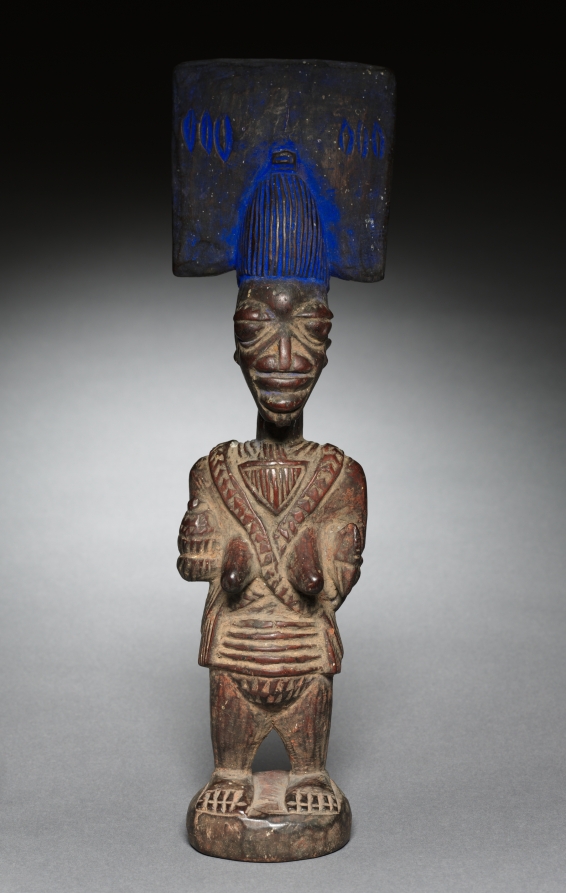
Ṣàngó is the òrìṣà of thunder, lightning, fire, cosmic justice, and royal legitimacy in Yoruba cosmology. He is revered as an uncompromising agent of divine retribution who exposes deceit, strikes down malefactors, and manifests the combustible power of the heavens on earth . In historical traditions, he is remembered as a powerful ruler of the Ọ̀yọ́ Empire whose dramatic life, abdication, and deification established the sacred authority claimed by subsequent kings of Ọ̀yọ́ .
The worship of Ṣàngó unites meteorological phenomena with imperial politics, legal arbitration, and distinct artistic forms. Through sacred material culture such as the double-headed dance wand (oṣé Ṣàngó), prehistoric stone celts (ẹdun àrá), and the complex polyrhythms of the bàtá drum, devotees access a power that embodies both fierce destruction and restorative balance .
Domain and Theological Role
Ṣàngó exercises dominion over the atmospheric energies of storm, lightning, and electrical fire . In the cosmological order, he functions as an executive power enforcing cosmic and social righteousness (ìwà).
Divine retribution and cosmic justice. Ṣàngó is not simply a deity of raw weather: he is the moral arbiter who unmasks secret corruption . Lightning strikes are understood by traditional practitioners not as random meteorological events, but as directed executions of divine judgement against thieves, poisoners, oath-breakers, and practitioners of malicious medicine. When lightning strikes a house or a person, the hereditary priests of Ṣàngó are summoned to excavate the site, appease the deity, and extract the offending charge .
Sovereignty and royal authority. Ṣàngó represents the volatile, absolute nature of royal dominion (àṣẹ ọba) . As an ancestral king of the Ọ̀yọ́ dynasty, his cult was institutionalized as the state religion of the Ọ̀yọ́ Empire, binding the legitimacy of the Aláàfin (the paramount ruler of Ọ̀yọ́) directly to the deity's destructive and protective capacities .
The dynamic of heat and cool. Theological thought positions Ṣàngó as the embodiment of divine heat (gbigbona) and volatile energy . This heat is balanced within the ritual sphere through cooling offerings, specific praise poetry, and the white elements of his sacred insignia, ensuring that his explosive potency protects rather than consumes the community .
Epithets and Praise Names
Ṣàngó is addressed through titles and praise epithets that capture his royal status, his martial fury, and his mythical ascension.
- Ọba Kò So ("The King Did Not Hang"): The central civic and theological title of the deity. It affirms his continuous life as an òrìṣà following the disputed events of his death at Kòso .
- Jàkúta ("The Stone-Thrower" or "He Who Fights with Stones"): An ancient epithet linking Ṣàngó to the primordial practice of hurling thunderbolts from the heavens .
- Kábíyèsí ("His Royal Majesty" or "The One Whose Actions No One Questions"): Derived from the contraction Ká-bí-yè-ésí ("Let no one ask him reasons"), acknowledging absolute, unchallengeable sovereign power .
- Iná Lẹnu ("He Who Spews Fire from His Mouth"): An epithet evoking his mastery over incendiary medicine, lightning, and terrifying martial speech .
Praise Poetry: Oríkì Ṣàngó
The nature of Ṣàngó is preserved in his oríkì (praise poetry), which is recited and chanted by priests, royal bards, and spirit mediums during public and private liturgies .
Layer 1: Yoruba Transcription
Iná lójú,
Iná lẹ́nu,
Iná lórí òrùlé.
Ọba a gun orí igi wọ̀lú,
Jàkúta, olóògùn àrá,
Ọba kò so, kábíyèsí o!
Layer 2: Literal Gloss
Iná (Fire) lójú (in the eyes),
Iná (Fire) lẹ́nu (in the mouth),
Iná (Fire) lórí (on the top of) òrùlé (the roof).
Ọba (King) a (who) gun (climbs) orí (the top of) igi (a tree) wọ̀lú (to enter the town),
Jàkúta (The stone-thrower), olóògùn (owner of medicine of) àrá (thunder),
Ọba (King) kò (did not) so (hang), kábíyèsí (unquestionable majesty) o (exclamation)!
Layer 3: Idiomatic English
Fire in the eyes,
Fire in the mouth,
Fire on the household roof.
The king who climbs the tree to descend into town,
Jàkúta the stone-thrower, master of thunder medicine,
The king did not hang, all homage to his majesty!
(Rendered from transcriptions in Samuel Johnson and Karin Barber )
Notes on the Translation and Poetic Function
- What it means: The poem asserts Ṣàngó’s complete control over fire across three realms: bodily gaze, speech, and the domestic architecture of the human settlement. It contrasts destructive conflagration with royal supremacy, insisting on the paradoxical presence of the king who bypasses normal human boundaries .
- What it is used for: These lines are recited by Ẹlẹ́gùn Ṣàngó (spirit mediums) and Mọgbà (priests) to salute the deity, summon his spiritual presence during trance induction, and ward off destructive lightning strikes from residential compounds .
- Illustrative scenario: During the annual festival in Ọ̀yọ́, as the bàtá drums accelerate their cadence, a priest recites these lines before the assembled townspeople. The chanting marks the transition where the medium embodies the deity, signaling to bystanders that ordinary human decorum must give way to reverent deference .
- Importance and value: The poem enforces royal and cosmic accountability. By reminding the community that Ṣàngó sets fire to the roofs of wrongdoers, the text functions as an active legal and moral deterrent .
- Tonality and puns: The repetition of high and mid tones in Iná lójú / Iná lẹ́nu creates a staccato rhythm matching the cadence of lightning strikes. Stripping tone marks removes the contrast between iná (fire) and other homophones, obscuring the poetic meter .
The Narratives: Ìtàn and Scholarly Debates
Scholarly literature on Ṣàngó preserves two primary narrative paradigms regarding his origins: the euhemerist historical model and the primordial cosmic model .
                ┌──────────────────────────────────────────────┐
                │             Cosmological Origin              │
                │        (Primordial Divinity / Jàkúta)        │
                └──────────────────────┬───────────────────────┘
                                       │
                               Syncretic Fusion
                                       │
                ┌──────────────────────▼───────────────────────┐
                │          Historical Ruler of Ọ̀yọ́             │
                │        (Aláàfin Ṣàngó at Kòso Shrine)         │
                └──────────────────────┬───────────────────────┘
                                       │
                    ┌──────────────────┴──────────────────┐
                    ▼                                     ▼
      ┌───────────────────────────┐         ┌───────────────────────────┐
      │     Imperial Politics     │         │     Material Culture      │
      │   (Mọgbà / Aláàfin Rites) │         │ (Oṣé / Ẹdun Àrá / Bàtá)   │
      └───────────────────────────┘         └───────────────────────────┘
The Euhemerist Monarchical Narrative
The most detailed narrative of Ṣàngó as an earthly ruler was recorded by Samuel Johnson . In this tradition:
Ṣàngó was the son of Ọ̀rànmíyàn, the founder of Ọ̀yọ́, and Torosi, a Nupe princess . He succeeded his gentle brother Àjàká to become the ruler of Ọ̀yọ́-Ilé. Renowned for his volatile temper and his deep knowledge of magical preparations, Ṣàngó acquired the ability to emit fire from his mouth and summon lightning bolts from the sky .
During his reign, two powerful military commanders, Tìmi and Gbọ̀ngkà, grew excessively insubordinate, threatening royal authority. Ṣàngó pitted the two generals against one another, dispatching Tìmi to govern the frontier outpost of Ẹdẹ in hopes that he would be defeated . When Gbọ̀ngkà defeated Tìmi in combat and openly defied the monarch in the capital, Ṣàngó’s political position collapsed. Simultaneously, while demonstrating his thunder charms on a nearby hill, lightning struck the royal palace, destroying buildings and killing many wives and children .
Overcome by grief and deserted by his subjects, Ṣàngó abdicated and departed Ọ̀yọ́-Ilé toward the territory of his maternal kin. At a location named Kòso, despairing of his exile, he hanged himself from an àyàn tree .
When his political adversaries mocked his suicide, loyalists procured incendiary medicines to draw down destructive storms upon Ọ̀yọ́-Ilé, destroying the compounds of his critics. The terrified citizens relented, declaring Ọba kò so ("The king did not hang") and deifying Ṣàngó as an òrìṣà .
The Primordial Divinity Variant
E. Bọ́lájì Ìdòwú advanced a contrasting theological interpretation, arguing that Ṣàngó was originally a primordial divinity dispatched by Olódùmarè to supervise the moral order through thunder and lightning . In this view, Ṣàngó was identical with, or absorbed the older solar and meteorological deity Jàkúta .
Akíntúndé Akínyẹmí supports this cosmic precedence by noting that oral literature within the Ifá corpus depicts Ṣàngó as an active divinity in the primordial pantheon at Ilé-Ifẹ̀, long before the historical emergence of the Ọ̀yọ́ monarchical line .
Scholarly Disagreements
Scholars debate the relationship between the historical monarch and the cosmic deity:
- State Euhemerism vs. Memory: Samuel Johnson and E. B. Ìdòwú emphasize the historical succession of Ọ̀yọ́ kings, suggesting that an extraordinary, tyrannical ruler was syncretized post-mortem with an older thunder cult to preserve dynastic prestige .
- Imperial Metaphor and State Ideology: J. Lorand Matory argues that the Ṣàngó mythos was refined by the Ọ̀yọ́ state as an ideological apparatus . By associating the Aláàfin with an unpredictable, lightning-wielding divinity, the empire legitimized central royal violence against recalcitrant provincial rulers and insubordinate lineages .
- Nature of His Death: Primary traditions directly contradict one another. Court historians at Ọ̀yọ́ preserve the suicide narrative at Kòso, whereas devotee traditions insist that the king never suffered physical death, instead descending directly into the earth via an iron chain or dissolving into atmospheric lightning .
The historical record is silent regarding verifiable calendar dates for Ṣàngó's reign. Oral tradition preserves genealogical sequences and political successions rather than calendar chronologies .
Sacred Material Culture and Iconography
The worship of Ṣàngó possesses one of the most recognizable material cultures in West African sacred art .
        Oṣé Ṣàngó                       Opón Ṣàngó with Ẹdun Àrá
      ┌───────────┐                         ┌───────────────┐
      │  ▲     ▲  │  (Twin Double-Axe)      │  ( Ẹdun Àrá ) │  (Neolithic Celt)
      │  └──┬──┘  │                         │ ┌───────────┐ │
      │     │     │                         │ │  Thunder  │ │
      │   (o o)   │  (Priest Head)          │ │   Stone   │ │
      │     │     │                         │ └───────────┘ │
      │     │     │                         └───────┬───────┘
      └─────┴─────┘                                 │
         (Staff)                             (Wooden Vessel)
Oṣé Ṣàngó (The Ritual Dance Wand)
The oṣé Ṣàngó is a carved wooden staff carried by initiates during ritual processions and possession dances .
- Iconography: The staff features a handle topped by a devotee’s head or figure, crowned by a double-bladed axe (ẹdun) protruding from the cranium .
- Symbolism: The double celt represents balanced cosmic justice, lightning bolts, and the spiritual concept of twinhood (ìbejì) . The stone emerging from the head signifies the possession of the medium's inner head (orí inú) by the divine energy of thunder .
Ẹdun Àrá (Thunderstones)
Ẹdun àrá are prehistoric stone celts discovered in the ground, understood within the tradition to be physical thunderbolts hurled down by Ṣàngó during electrical storms .
- Priests collect these stones from strike sites and install them inside carved wooden bowls (opón Ṣàngó) at the altar .
- These stones serve as the material grounding of the deity's presence. They are anointed with palm oil and offerings during liturgical appeals .
The Bàtá Drum Ensemble
The bàtá drum is the sacred musical instrument of Ṣàngó .
- Structure: It is an asymmetrical, conical wooden drum with two distinct leather membranes of unequal size, played with the bare hand and a flexible leather strap .
- Function: The sharp, complex, and explosive rhythms of the bàtá emulate the sudden cracks of thunder and flashes of lightning. The drum speaks the tonal language of Ṣàngó's oríkì, guiding the footsteps of the ẹlẹ́gùn into trance states .
Colors, Vestments, and Offerings
- Colors: Red and white beads (kèkè), worn as necklaces and bracelets . Red represents the fiery temper and martial destruction of the god; white signifies the cooling restoration of justice and spiritual balance .
- Vestments: Priests wear deep red skirts, decorative panels adorned with cowrie shells, and complex hairstyles .
- Offerings: Bitter kola (orógbó), pounded yam with bean soup (àmàlà and gbègìrì), and rams (àgbò) . The ram is sacred to Ṣàngó because of its charging power, mirroring the concussive force of lightning .
Priesthood, Mediumship, and Sacred Towns
The institutional worship of Ṣàngó is governed by specialized priestly classes and linked to foundational geographical centers .
                     ┌───────────────────────────────┐
                     │          Aláàfin Ọ̀yọ́          │
                     │    (Imperial Sovereign)       │
                     └───────────────┬───────────────┘
                                     │
                    ┌────────────────┴────────────────┐
                    ▼                                 ▼
      ┌───────────────────────────┐     ┌───────────────────────────┐
      │       Mọgbà Priesthood    │     │       Ẹlẹ́gùn Ṣàngó        │
      │   (Guardians of Kòso,     │     │  (Spirit Mediums, Trance  │
      │   Coronation Officiants)  │     │   Dancers, Oṣé Bearers)   │
      └───────────────────────────┘     └───────────────────────────┘
The Priesthood Hierarchy
- Mọgbà: The hereditary custodial priests of Ṣàngó, centered at the sacred sanctuary of Kòso . The Mọgbà guard the original ẹdun àrá relics, preserve the historical liturgies, and maintain exclusive oversight of the Aláàfin’s coronation ceremonies .
- Ẹlẹ́gùn Ṣàngó: Initiated spirit mediums who are "mounted" (gùn) by the deity during ceremonies .
- During possession, the ẹlẹ́gùn embodies Ṣàngó's royal voice, delivers prophetic judgments, and carries the oṣé wand .
- Ẹlẹ́gùn priests plait their hair in elaborate women’s styles (ṣùkù) and wear skirts, a practice that J. Lorand Matory analyzes as symbolic gender transformation, positioning the priest as a receptive bride (iyàwó) to the dominating masculine power of the deity .
Sacred Geography
- Ọ̀yọ́-Ilé (Old Ọ̀yọ́) and New Ọ̀yọ́: The political cradle of the cult, where the royal palace houses primary shrines integrating civic administration with Ṣàngó’s sacred law .
- Kòso: A sacred suburban sanctuary outside Ọ̀yọ́. It is the site where Ṣàngó’s deification occurred . Every successive Aláàfin must perform mandatory coronation rites at Kòso, receiving the ancestral crown and sword of state under the direct authority of the Mọgbà priests .
- Ẹdẹ: A historic military outpost founded by Ṣàngó’s legendary commander, Tìmi Agbàlé Ọlọ́fà Iná, maintaining deep institutional ties to Ṣàngó worship and archery traditions .
Annual Festivals: Ọdún Ṣàngó
The primary public manifestation of Ṣàngó veneration is the annual World Ṣàngó Festival (Ọdún Ṣàngó), held in Ọ̀yọ́ in August .
The festival spans several days, centering upon the palace of the Aláàfin and the shrine at Kòso . The rites involve:
- The ceremonial feeding of the sacred thunderstones (ẹdun àrá) with bitter kola (orógbó) and ram sacrifices .
- Public recitations of dynastic oríkì by royal chanters and Mọgbà priests .
- Extended performance sets by bàtá drummers, culminating in public possession trances where ẹlẹ́gùn display their mastery over fire and martial medicine .
- Civic prayers led by the Aláàfin and high priests for the protection of the community against destructive fires, disease, and political discord .
Through these corporate celebrations, the social contract binding the monarch, the lineage heads, and the cosmic order is reaffirmed under the vigilant oversight of the divinity of thunder .