Ẹyọ Lagos
A scholarly examination of the Adamu Orisha Play of Lagos, detailing its mortuary ritual programme, deity conclaves, origin traditions, and contemporary socio-spatial dynamics.
intermediatehigh·
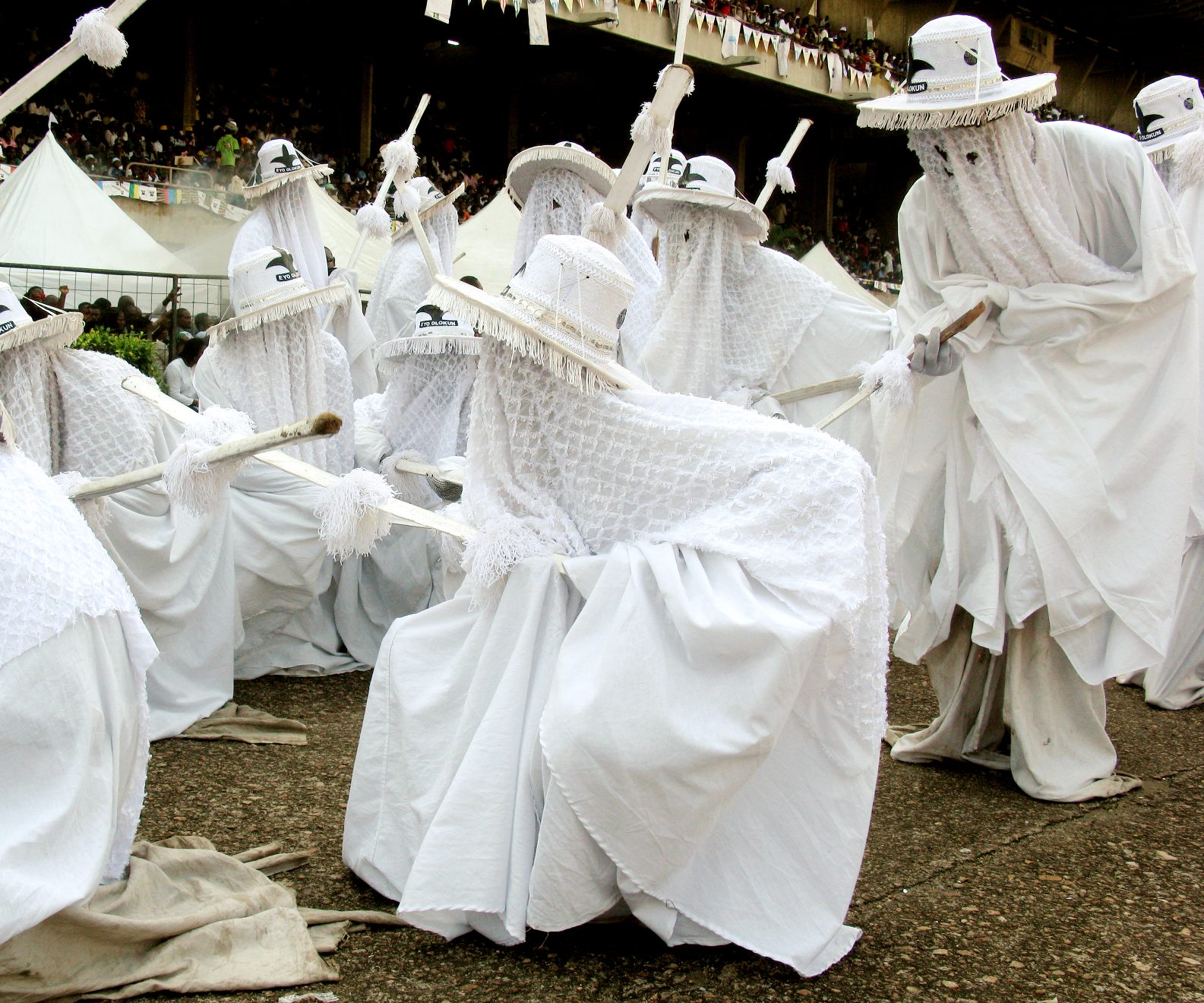
A scholarly examination of the Adamu Orisha Play of Lagos, detailing its mortuary ritual programme, deity conclaves, origin traditions, and contemporary socio-spatial dynamics.
The Ẹyọ festival, formally designated as the Àdàmú Òrìṣà Play, is a sacred mortuary and civic masquerade ritual native to the indigenous Yoruba communities of Lagos Island (Ìsàlẹ̀ Èkó) . Staged as a non-annual solemnity, its primary traditional function is to escort the departed soul of a deceased Ọba (King of Lagos) or a high-ranking chieftain into the ancestral realm, while ritually sanctifying the installation of a royal successor . Over the nineteenth and twentieth centuries, the performance expanded to commemorate the passing of illustrious statesmen and celebrate historic civic milestones, transforming the dense urban core of Lagos Island into a consecrated theatrical space dominated by thousands of figures robed in pristine white .
The historical origin of the Àdàmú Òrìṣà Play prior to the mid-nineteenth century is characterized by competing oral traditions and divergent scholarly perspectives. Because early written records are silent on the precise date of introduction, historians rely on dynastic genealogies and custodial accounts transmitted through chieftaincy lineages .
The most prominent historical tradition traces the cult to the Ijebu region of modern Ogun State . According to accounts documented by early Lagos chronicler John B. Losi and later amplified by Takiu Folami, two brothers named Ejilu and Malaki migrated from Ibefun (or Iperu-Remo) to Lagos . The brothers introduced the sacred rites during the funeral obsequies of an early Lagos monarch . In this tradition, the ritual transfer occurred because Olugbani, a royal consort of Ọba Adó, was related to Ejilu and Malaki, prompting the brothers to present the deity to assist in the royal funeral ceremonies .
Scholars disagree, however, on the precise chronology of this transfer . One strand of historical scholarship places the event during the reign of Ọba Adó in the early eighteenth century . Another scholarly position dates the arrival of Ejilu and Malaki later, situating the institutionalization of the festival in the late eighteenth century during the reign of Ọba Ologun Kutere .
A distinct historical counter-narrative claims a Western Niger Delta origin tied to the expansion of the Benin dynasty into coastal Lagos . This tradition maintains that the core deities central to the ritual structure: Òrìṣà Ògúnrán, Òrìṣà Èlégbà Ọ̀pọ̀pọ̀, and Àdàmú Òrìṣà: were brought directly from Benin during the reign of Ọba Adó by two high-ranking palace chiefs, Ọlọ́rọ̀gunagan Aṣagbemi and Ọlọ́rọ̀gunigbẹsule . While this tradition acknowledges the early consolidation of the rites in Ìsàlẹ̀ Èkó, it attributes the ritual authority not to Ijebu immigrants, but to the military and ceremonial retinue established under the early Lagos monarchy .
The earliest historically verified and documented public staging of the Àdàmú Òrìṣà Play on Lagos Island took place on February 20, 1854 . The performance was commissioned and staged by King Dosunmu to mark the final funeral rites and ancestral transition of his late father, Ọba Akítoyè . This 1854 event established the ceremonial paradigm for modern performances, confirming the festival's institutional role as a definitive state ritual of mortuary transition for the Lagos crown .
The execution of the Ẹyọ festival is governed by a tripartite institutional framework consisting of the sacred secret society, the royal palace, and the titled landed aristocracy .
                +---------------------------------+
                |           ỌBA OF LAGOS          |
                |   (Supreme Royal Custodian)     |
                +----------------+----------------+
                                 |
                                 v
                +---------------------------------+
                |          AWO ỌPÁ CULT           |
                |   (Sacred Conclave Authority)   |
                +----------------+----------------+
                                 |
                                 v
                +---------------------------------+
                |       WHITE CAP CHIEFS          |
                | (Ìdèjò, Akarigbere, Ọ̀gáládé,    |
                |            Àbàgbọ́n)             |
                +----------------+----------------+
                                 |
         +-----------------------+-----------------------+
         |                                               |
         v                                               v
+--------------------------------+       +--------------------------------+
|    ORÍṢÀ GBOBGBO (TOP FIVE)    |       |       ẸYỌ ÌGÁ (HOUSEHOLDS)     |
| 1. Ẹyọ Adimú (Àkínsìkú)        |       | • Ẹyọ Bajulaiye                |
| 2. Ẹyọ Lábá Ẹkùn (Palace)      |       | • Ẹyọ Olúmẹ̀gbọ́n               |
| 3. Ẹyọ Oníkò                  |       | • Ẹyọ Taiwo Olowo              |
| 4. Ẹyọ Ọlọ́gẹ̀dẹ̀              |       | • Ẹyọ Oshodi                   |
| 5. Ẹyọ Agẹrẹ                  |       | • Ẹyọ Oloto / Others           |
+--------------------------------+       +--------------------------------+
The esoteric authority governing the festival resides within the Awo Ọpá cult . This society exercises absolute spiritual custody over the sacred paraphernalia, nocturnal purifications, and liturgical procedures of the Àdàmú Òrìṣà rites . The Awo Ọpá validates all applications to stage the play, ensuring that the deceased individual possesses the required moral stature and customary eligibility within Lagos society .
The reigning Ọba of Lagos acts as the supreme civic and traditional patron of the festival . The monarch collaborates closely with the four traditional classes of White Cap Chiefs (Òkàrìbà / Ìjòkò), who hold distinct civic, judicial, and territorial responsibilities across Lagos Island:
The masqueraders are organized into a strict, non-negotiable spiritual and social hierarchy. At the summit of this structure stand the five premier deity conclaves (Oríṣà Gbogbo or Ẹyọ Òrìṣà), followed by numerous lineage-based palace groups (Ẹyọ Ìgá) representing indigenous chieftaincy families and royal ruling houses .
+------------------+--------------------+------------------------+------------------------------------+
| Conclave / Group | Hat Color (Àkètè)  | Spiritual Association  | Institutional / Ritual Function    |
+------------------+--------------------+------------------------+------------------------------------+
| 1. Ẹyọ Adimú     | Black and White    | Òrìṣà Adimú            | Custodian of the Agbere shrine     |
| 2. Ẹyọ Lábá Ẹkùn | Red (Alákètè Pupa) | Crown / Royal Stool    | Executive police arm of the Ọba    |
| 3. Ẹyọ Oníkò     | Yellow             | Òrìṣà Oníkò            | Ancestral nocturnal cleansing      |
| 4. Ẹyọ Ọlọ́gẹ̀dẹ̀  | Green              | Òrìṣà Ọlọ́gẹ̀dẹ̀        | Peace, agrarian fertility, renewal |
| 5. Ẹyọ Agẹrẹ     | Purple / Blue      | Òrìṣà Agẹrẹ            | Hunter rites, stilt performances   |
| 6. Ẹyọ Ìgá       | Lineage-Specific   | Household Ancestors    | Lineage representation and civic   |
|    (e.g., Oshodi)| (Varied Bands)     | (Chieftaincy Stools)   | solidarity across Isale Eko        |
+------------------+--------------------+------------------------+------------------------------------+
Below the five premier Ẹyọ Òrìṣà are dozens of lineage-based chieftaincy conclaves (Ẹyọ Ìgá) representing the historic ruling houses, landed aristocrats, and merchant families of Lagos . Prominent among these are:
These groups are distinguished by customized colors, patterns, and insignias woven into their hats, banners, and accoutrements, functioning as manifestations of lineage pride and civic solidarity .
The staging of the Àdàmú Òrìṣà Play unfolds across a rigorous, step-by-step procedural sequence spanning several weeks, moving from private sacred petitions to mass public processions .
+-------------------------------------------------------------------------+
|                  RITUAL PROGRESSION OF THE ẸYỌ FESTIVAL                 |
+-------------------------------------------------------------------------+
|  Stage 1: Ìkárọ̀                                                          |
|  Formal presentation of gifts, petitions, and ritual fees to the Ọba    |
|  and the Awo Ọpá conclave by the bereaved family.                       |
+-------------------------------------------------------------------------+
                                    |
                                    v
+-------------------------------------------------------------------------+
|  Stage 2: Gbálẹ̀ (The Sweeping / Purification)                           |
|  Nocturnal sanitization of Lagos Island one week prior by senior        |
|  initiates to spiritually clear evil and prepare sacred paths.          |
+-------------------------------------------------------------------------+
                                    |
                                    v
+-------------------------------------------------------------------------+
|  Stage 3: Ìjáde Ọ̀pá (Staff Procession)                                  |
|  Senior conclaves parade the consecrated royal staff (Ọ̀pá) along       |
|  customary palace routes to signal official clearance.                  |
+-------------------------------------------------------------------------+
                                    |
                                    v
+-------------------------------------------------------------------------+
|  Stage 4: The Àgòdò Consecration (Dawn on Festival Day)                 |
|  Consecration of the central sacred enclosure at Enu Owa / Idumota;     |
|  masqueraders don white robes (Agbada, Aropale) and receive Ọ̀pámbàtá.    |
+-------------------------------------------------------------------------+
                                    |
                                    v
+-------------------------------------------------------------------------+
|  Stage 5: Public Procession and Civic Taboos                            |
|  Daylight parade across Isale Eko; conferral of ancestral blessings;    |
|  strict enforcement of customary bans (no shoes, headgear, vehicles).  |
+-------------------------------------------------------------------------+
                                    |
                                    v
+-------------------------------------------------------------------------+
|  Stage 6: Closing and Ancestral Escort (Dusk)                           |
|  Return to the Àgòdò for concluding prayers, de-robing, and final       |
|  communion escorting the departed spirit to the ancestral realm.        |
+-------------------------------------------------------------------------+
The sequence opens when the family of a deceased dignitary petitions the Ọba of Lagos and the elders of the Awo Ọpá for permission to stage the festival . The petition is accompanied by Ìkárọ̀, a formal presentation of customary fees, kola nuts, schnapps, livestock, and ceremonial gifts . The council evaluates the deceased's social standing, contributions to the community, and lineage history. If approved, an auspicious date is selected, and formal notifications are dispatched to the various conclaves .
Exactly one week before the daylight performance, senior initiates perform the sacred nocturnal rite known as Gbálẹ̀ (literally, to sweep the ground) . Moving under cover of darkness through the streets of Ìsàlẹ̀ Èkó, initiates sweep the pathways, chant esoteric prayers, and deposit offerings at key crossroads (oríta) and boundary shrines . The spiritual objective is to exorcise malevolent forces, cleanse the community of moral impurities, and establish an unbroken protective cordon across Lagos Island .
In the days following the Gbálẹ̀, the senior Ẹyọ Òrìṣà groups carry out the Ìjáde Ọ̀pá (outing of the staff) . Initiates parade the sacred staff (Ọ̀pá) through established palace routes, visiting the traditional palaces (Ìgá) of the White Cap Chiefs and prominent lineages . This procession formally alerts the populace that the sacred calendar is active, signifying that royal and spiritual clearance has been granted for the impending public rites .
At pre-dawn on the day of the festival, the focus shifts to the Àgòdò, a consecrated temporary sacred enclosure constructed at Enu Owa or Idumota . Within the Àgòdò, priests administer secret consecration rites, invoke the primordial ancestors, and bless the regalia .
The masqueraders robe themselves entirely in pristine white garments:
+-------------------------------------------------------------------------+
|                  REGALIA OF THE ẸYỌ MASQUERADER                         |
+-------------------------------------------------------------------------+
|                                                                         |
|         [   ÀKÈTÈ   ]  --> Color-coded broad-brimmed hat denoting       |
|            |     |         specific conclave hierarchy                  |
|            |     |                                                      |
|         [ AṢỌ OJÚ ]   --> Translucent white veil concealing face         |
|               |                                                         |
|         [  AGBÁDÁ  ]   --> Voluminous white gown covering upper body    |
|            |     |                                                      |
|  [ Ọ̀PÁMBÀTÁ ]    |     --> Stripped, cured palm-frond staff held        |
|  (In hand)        |         in hand to confer ancestral blessings        |
|                   |                                                     |
|         [ ARÓPALẸ̀ ]   --> White lower wrap/skirt reaching ground       |
|               |                                                         |
|         [ BARE FEET ]  --> No footwear permitted under sacred taboo     |
|                                                                         |
+-------------------------------------------------------------------------+
Following the dawn egress from the Àgòdò, thousands of Ẹyọ masqueraders disperse into the avenues and alleys of Lagos Island . As they process, they perform synchronized, rhythmic strides, chanting sacred invocations and tapping spectators lightly with the ọ̀pámbàtá to impart ancestral blessings .
Throughout the festival day, strict traditional prohibitions (eewọ) are enforced across the public space :
Violations of these customary bans are met with immediate disciplinary strikes from the ọ̀pámbàtá wielded by the masqueraders, reflecting the absolute civic and spiritual authority asserted during the festival .
At dusk, as the sun sets over the Lagos lagoon, all conclaves converge back upon the Àgòdò . In a final, solemn liturgy, the high priests perform prayers to escort the deceased monarch's or dignitary's spirit into the company of the ancestral forebears . The masqueraders undergo formal de-robing within the enclosure, the sacred staffs are surrendered or ritually stored, and the temporary spiritual jurisdiction over Lagos Island is dissolved, restoring ordinary civic authority .
The ritual interactions between the Ẹyọ masquerader and the public are centered around consecrated spoken formulas designed to transfer health, spiritual longevity, and insight .
Original:
Ẹ hù tẹ́lẹtẹ́lẹ́,
Ẹ mọ̀gbọ́n.

Literal Gloss:
Ẹ          hù          tẹ́lẹtẹ́lẹ́,
You (pl.)  sprout/grow slenderly/gently,
Ẹ          mọ̀         ọgbọ́n.
You (pl.)  know/gain   wisdom.

Idiomatic English:
May you grow up gracefully and gently,
May you be endowed with profound wisdom.
(Transl. Corpus standard based on Osanyin, 2004 [S5])
What it means. The utterance is an ancestral benediction asserting that biological growth must be matched by ethical maturation and intellectual discernment . The verb hù (to sprout, germinate, or shoot forth) frames human life as an organic plant emerging from the earth, while tẹ́lẹtẹ́lẹ́ functions as an ideophone describing slender, unhurried, graceful, and unblemished upward progress .
What it is used for. The phrase serves as the formal ritual greeting and blessing delivered by the Ẹyọ masquerader to bystanders, community elders, and family members . It operates as a verbal seal during the physical act of touching or tapping an individual with the ọ̀pámbàtá, transferring spiritual protection from the ancestral realm (ọ̀run) to the living recipient (ayé) .
Illustrative Scenario. A market woman stands respectfully bareheaded and barefoot along the edge of Broad Street on Lagos Island as a group from the Ẹyọ Lábá conclave approaches. She bows her head slightly. A masquerader extends his ọ̀pámbàtá, lightly rests the tip of the palm-frond staff upon her right shoulder, and intones, "Ẹ hù tẹ́lẹtẹ́lẹ́, ẹ mọ̀gbọ́n." The woman cups her palms together, responds with gratitude ("Àṣẹ, a dupẹ o"), and drops a token voluntary offering into the escort's collection pouch. The encounter confirms civic solidarity, ancestral favor, and ritual goodwill .
Importance and Value. In indigenous Lagos Yoruba philosophy, physical prosperity without intellectual and moral grounding (ọgbọ́n) is regarded as dangerous and incomplete. By delivering this specific benediction, the ancestral spirits remind the living that longevity is meaningful only when guided by moral uprightness and understanding .
Tonality and Phonological Dynamics. The tonal contour of Ẹ hù tẹ́lẹtẹ́lẹ́ moves from mid (Ẹ) to low (hù), followed by four consecutive high tones (tẹ́-lẹ́-tẹ́-lẹ́). This rapid, high-pitched ideophonic cadence mimics light, delicate, and uninhibited upward movement. Stripping these tone marks reduces the phrase to a generic phonological sequence, obscuring the poetic association with graceful vegetative flourishing .
Notes on the Translation. The compound verb phrase mọ̀gbọ́n is a contraction of mọ̀ (to know) and ọgbọ́n (wisdom). In everyday speech, mọ̀gbọ́n can sometimes carry the colloquial connotation of being streetwise or cunning. In the sacred mortuary context of the Àdàmú Òrìṣà Play, however, ọgbọ́n refers strictly to spiritual maturity, ancestral discernment, and social responsibility .
While the Ẹyọ festival remains deeply rooted in traditional ancestral religion, its contemporary staging has evolved into a monumental civic spectacle, generating complex interactions between sacred custom, public logistics, and state tourism initiatives .
+-------------------------------------------------------------------------+
|          DRIVERS OF ẸYỌ FESTIVAL PARTICIPATION (75.34% TOTAL)           |
|                 (Agbabiaka, Omisore, & Olugbamila, 2023)                |
+-------------------------------------------------------------------------+
| Psycho-social Motivations:      [22.90%]  ####################          |
| Facility Availability:          [13.41%]  ############                  |
| Environmental/Cultural Factors: [12.20%]  ###########                   |
| Demographic Factors:            [10.65%]  ##########                    |
| Proximity / Mobility:           [ 9.93%]  #########                     |
| Health and Safety:              [ 6.25%]  ######                        |
+-------------------------------------------------------------------------+
Because the festival is non-annual and dependent upon royal mandates and the passing of eminent figures, long intervals often separate public stagings :
In an empirical study investigating tourism participation in major southwestern Nigerian traditional festivals, researchers demonstrated that 75.34% of the total variance in participation and attendance for the Ẹyọ Festival is explained by six primary factors :
The influx of hundreds of thousands of spectators into the restricted urban geography of Lagos Island introduces severe physical planning challenges . Research by Hafeez Idowu Agbabiaka on the spatial implications of the festival documents widespread street gridlock, vehicular diversions, temporary commercial displacement of local market traders, and immense post-event waste management and littering burdens across the historical corridors of Ìsàlẹ̀ Èkó . Conversely, the event stimulates intense short-term commercial trading, driving high revenues for local transport operators, fabric merchants, food vendors, and regional hospitality establishments during the international "Detty December" tourism window .
A sustained scholarly and civic debate persists regarding the commercialization and packaging of the Ẹyọ festival as an international tourist mega-event .
Traditional custodians, headed by the Awo Ọpá elders and the White Cap Chiefs, insist that the festival is primarily a sacred mortuary ritual requiring absolute adherence to ritual taboos, including mandatory footwear removal, vehicular bans, and traditional discipline .
Conversely, municipal tourism planners and modernization advocates propose modifying the festival into a regularly scheduled, ticketed civic pageant held in enclosed sporting arenas such as Tafawa Balewa Square . They argue this shift avoids urban paralysis, mitigates security vulnerabilities, and maximizes international tourism revenue . Traditionalists resist complete relocation, maintaining that the spiritual efficacy of the Àdàmú Òrìṣà Play requires physical movement through the consecrated streets, ancestral shrines, and royal palaces of Ìsàlẹ̀ Èkó .
Official agencies, including the Lagos State Ministry of Tourism, Arts and Culture and the National Bureau of Statistics (NBS), do not publish disaggregated, ticketed turnstile headcounts for the festival . Because the processions move freely across open municipal thoroughfares, total attendance numbers across modern editions remain broad estimates based on venue capacity approximations rather than exhaustive empirical counts .
What oríkì are, the different kinds, who performs them and why, and how they carry history that written records do not.
What Egúngún actually is, why it is a lineage institution rather than an orisa cult, how the costume and the taboo on touching it work, and how the tradition has been misrepresented.
The historical development of Lagos Èkó from its Awori foundations and Benin dynastic origins to its institutional structures, royal succession, and nineteenth-century political transformation.
A comprehensive scholarly examination of Gẹ̀lẹ̀dẹ́ masquerade performance, its cosmological veneration of female mystical power, ritual structure, iconography, origin traditions, and contemporary heritage status.
An exhaustive scholarly analysis of the Yoruba Egúngún festival, detailing ritual choreography, institutional offices, origin historiography, typological variants, and contemporary tourism dynamics.
An annual seventeen-day royal festival in Ọ̀wọ̀ commemorating Queen Ọ̀rọ́nsẹ̀n, characterized by iron gongs, the complete prohibition of drums, and cross-gender royal regalia.