Sacred Beadwork Regalia and Chromatic Cosmology: Adé, Àpèpè, Agbáda Ilẹ̀kẹ̀
An analysis of Yorùbá sacred royal beadwork regalia, examining the beaded conical veiled crown (adé ńlá), royal thrones and footstools (àpèpè), beaded ceremonial gowns (agbáda ilẹ̀kẹ̀), and the tripartite chromatic cosmology of funfun, pupa, and dúdú.
intermediatehigh28 min de lectura·24 fuentes
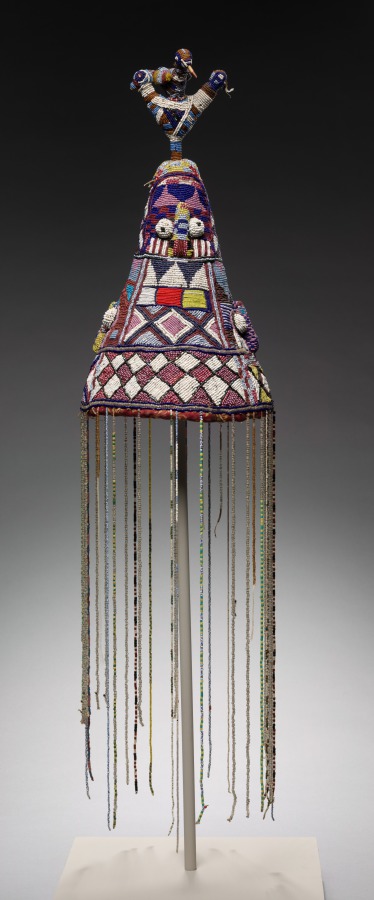
Crown (adéńlá)Andrew R. and Martha Holden Jennings FundThe Cleveland Museum of Art · CC0
Sacred beadwork regalia constitutes the premier visual and spiritual instrument of sovereign authority across Yorùbá polities . In Yorùbá thought, glass and stone beads are not decorative accessories, but physical conductors of metaphysical authority (àṣẹ, vital power or generative force) and divine presence . Encasing a monarch's physical person in consecrated beadwork transforms the human sovereign (ọba, crowned king) into a living vessel for royal ancestors and divinities (òrìṣà, spiritual emissaries of the supreme deity) .
This file examines the cosmological, visual, and technical architectures of Yorùbá royal beadwork. It analyzes the tripartite chromatic system (àwọ̀ funfun, àwọ̀ pupa, and àwọ̀ dúdú) that organizes Yorùbá aesthetics and religious thought . It details the construction and iconographic schema of the veiled conical crown (adé ńlá), royal throne seats and footstools (àpèpè), and beaded ceremonial robes (agbáda ilẹ̀kẹ̀) . Finally, it traces the historical shifts in raw bead manufacturing, guild organization, and ceremonial practice from medieval Ilé-Ifẹ̀ to contemporary post-colonial courts and Atlantic diaspora contexts .
Chromatic Cosmology: Àwọ̀ Funfun, Àwọ̀ Pupa, and Àwọ̀ Dúdú
Yorùbá color theory does not correspond to Newtonian spectrum divisions or modern western chromatic wheels . Instead, colors are categorized into three broad chromatic clusters: funfun (cool, white, translucent, pale), pupa (hot, red, brilliant, warm), and dúdú (dark, cool, mediating, deep) . In Yorùbá aesthetics, àwọ̀ (color, skin, outward surface; etymologically linked to covering and character) serves as an index of temperament, spiritual temperature, and primordial metaphysical disposition .
Funfun encompasses white, silver, clear, cream, pale grey, and light pastel hues . It embodies the spiritual temperature of tútù (coolness), quietude, patience, clarity, and ritual purity . Cosmologically, funfun corresponds to the Òrìṣà Funfun (the cool or white deities), preeminently Ọbàtálá (the arch-divinity and sculptor of human physical form) and Òrìṣà-Oko (divinity of agriculture and the earth) .
In beaded royal regalia, funfun elements convey moral character (ìwà tutu, cool and composed character) and the detachment demanded of an elder sovereign . It is represented physically by chalk (ẹfun), lead (òjé), cowrie shells (owó ẹyọ), and clear or milky white seed beads (ṣẹ́ṣẹ́ ẹfun) .
Àwọ̀ Pupa (The Red Chromatic Realm)
Pupa encompasses red, crimson, deep scarlet, orange, coral pink, and intensely saturated warm yellow . It expresses the spiritual temperature of gbígbóná (heat), passion, martial danger, aggression, and swift decisive transformation . Divinities categorized under pupa include Ògún (god of iron, metallurgy, and warfare), Ṣàngó (god of thunder, lightning, and royal power), and Ọya (goddess of tempests and transformation) .
Within royal regalia, pupa beads signal the sovereign's capacity for fierce retribution, physical dominion, and protective wrath . Materially, this cluster is anchored by precious marine coral (ìyùn), imported Mediterranean coral branches, red jasper, and tubular carnelian stone beads (lantana) ground and polished in imperial northern workshops .
Àwọ̀ Dúdú (The Dark and Mediating Chromatic Realm)
Dúdú encompasses black, indigo blue, dark navy, deep forest green, charcoal grey, and earth browns . It is neither purely hot nor purely cold, but represents a mediating, containing, and mysterious force (lo wọ́ọ́rọ́, moderate warm-cool equilibrium) . Dúdú is associated with Òrúnmìlà (the master of Ifá divination and custodian of cosmic destiny), Èṣù (the divine trickster and guardian of the crossroads), and deep aquatic depths ruled by Olókun (divinity of oceans, wealth, and primordial beads) .
The visual tension in royal beaded regalia relies on juxtapositions of funfun, pupa, and dúdú . By bringing opposing chromatic temperatures into geometric balance across the surface of a crown or gown, the bead artist visually manifests the king's ability to balance conflicting cosmic forces, cooling the volatile heat of pupa with the serene purity of funfun, held in equilibrium by the grounded mystery of dúdú .
The Sacred Crown (Adé Ńlá): Structural Anatomy and Metaphysics
The beaded conical veiled crown (adé ńlá, literally "great crown"; derived from adé, crown, and ńlá, large or great) is the single most sacred physical attribute of Yorùbá dynastic kingship . Under classical constitutional law, only an ọba who traces direct descent from Odùduwà (the mythical progenitor of the Yorùbá race and first sacred ruler of Ilé-Ifẹ̀) is legally and spiritually permitted to wear the veiled adé . Subordinate rulers, provincial vassals, and territorial chiefs (baálẹ̀ or olójà) wear coronets or caps without veils, known as àkòró .
                     [ BIRDS AT THE APEX ]
           (Ọ̀kín / Eye: Mystical mediation, female power,
                 Awon Ìyá Mi Òṣòrọ̀ngà, ancestral flight)
                               |
                               v
                     [ CONICAL PROJECTION ]
            (Oki ti: Elevation of spiritual head, Orí Inú;
             Inner cavity contains herbal/mineral àṣẹ packet)
                               |
                               v
                 [ EMBROIDERED FRONTAL FACES ]
            (Ojú: All-seeing ancestral presence, Odùduwà,
             dynastic lineage, dissolution of private ego)
                               |
                               v
               [ INTERLACING GEOMETRIC PATTERNS ]
             (Braid/knot motifs: Continuity, dynastic seal,
                      interconnection of cosmos)
                               |
                               v
                   [ BEADED FRINGE / VEIL ]
           (Aba: Masks ruler's physical eyes, shields subjects
            from dangerous aura, merges monarch into dynasty)
The Interior Spiritual Chamber (Oògùn Àṣẹ)
A sacred crown is not merely a headpiece; it is an active consecrated altar and an òrìṣà in its own right . Before the crown is beaded, its armature is constructed from a conical framework of stiff vegetable fibers, palm leaf ribs, or bent cane, lined with multiple layers of hand-woven cotton cloth adhered with paste made from cooked cassava or cornstarch .
At the apex of this interior cavity, high-ranking ritual specialists sew a sealed packet containing potent medicinal substances, mineral charges, and sacred botanical preparations (oògùn àṣẹ) . When the crown is lowered onto the monarch's head during coronation rites, this medicine rests in immediate physical proximity to the king's fontanelle, the physical locus of his spiritual inner head (orí inú, the metaphysical essence of individual destiny) .
Because the interior contains this intense concentrate of spiritual power, an ọba never looks directly inside his own crown . Doing so is traditionally believed to bring immediate madness or blindness, as human eyes cannot withstand the raw radiance of the unmediated ancestral presence .
The Beaded Veil (Àbà)
Suspended from the bottom rim of the conical structure is a dense curtain of beaded strands (àbà or ìbòjú) hanging down between ten and eighteen inches . This veil covers the monarch's entire face during state appearances .
The veil serves two distinct theological functions :
Depersonalization and Dynastic Absorption: It erases the personal, biological identity of the mortal individual sitting on the throne . The individual human being disappears, replaced by the collective lineage of all past ọba who have occupied the royal stool . As art historian Robert Farris Thompson observed, veiling diminishes individuality so that the ruler becomes the living embodiment of the dynasty itself .
Radiation Shielding: In Yorùbá cosmology, the gaze (ojú) of a consecrated monarch carries active metaphysical electricity that can strike or harm ordinary mortals . The veil diffuses this gaze, protecting subjects from the lethal radiance of the king while shielding the ruler from malevolent spiritual glances, curses, and evil eye projections (ojú burúkú) .
The Frontal Ancestral Faces (Ojú)
The surface of the adé features large, stylized human faces rendered in raised polychrome beadwork . Depending on regional stylistic traditions, a crown may display a single monumental face, a paired set (front and back), or four faces oriented toward the four cardinal directions .
Scholarly interpretations of these faces focus on three primary ancestral dimensions :
They represent Odùduwà, the primordial ancestral father and first wearer of the crown .
They represent Olókun, the deity of the sea and owner of beads, whose wealth empowers the crown .
They signify the all-seeing, omnipresent vision of the royal ancestors, looking outward into the four corners of the universe to protect the kingdom .
The Pinnacle Birds (Ẹyẹ Adé)
Surmounting the peak of every classical crown is a sculptured bead-covered bird, often accompanied by smaller birds lining the slope of the cone or flanking the brow . Oral traditions describe this avian figure as the royal bird ọ̀kín (the peacock or royal crested crane), symbolizing elegance and majesty .
In esoteric Yorùbá ontology, however, the birds carry a far deeper meaning: they represent the mystical power of women and elderly matriarchs, collectively known as Àwọn Ìyá Mi Òṣòrọ̀ngà (Our Mothers, the ancient custodians of cosmic balance and mystical potency) . Birds possess the capacity to navigate between the terrestrial realm (ayé) and the celestial realm (ọ̀run) through flight . By crowning the king's summit with avian sculptures, the crown proclaims that the male sovereign cannot rule effectively without propitiating, honoring, and aligning himself with the innate, supreme mystical power wielded by women .
+-------------------------------------------------------------------------+
|                  ANATOMICAL TAXONOMY OF THE ADÉ ŃLÁ                     |
+---------------------+-------------------+-------------------------------+
| Component           | Yorùbá Term       | Cosmological Function         |
+---------------------+-------------------+-------------------------------+
| Conical Structure   | Orí Adé / Òkìtì   | Shields and elevates Orí Inú  |
| Medicinal Apex Core | Àṣẹ / Oògùn Adé   | Houses ancestral power packet |
| Pinnacle Bird(s)    | Ẹyẹ Adé (Ọ̀kín)    | Mediates with female power    |
| Beaded Face Motifs  | Ojú Adé           | All-seeing ancestral gaze     |
| Beaded Veil/Fringe  | Àbà / Ìbòjú       | Depersonalizes; blocks glare  |
| Interlace Ribbons   | Ẹsẹ̀ Èbìtì / Ọ̀já   | Signifies dynastic eternity   |
+---------------------+-------------------+-------------------------------+
Royal Beaded Paraphernalia: Àpèpè, Agbáda Ilẹ̀kẹ̀, Bàtà Ilẹ̀kẹ̀, and Ìrùkẹ̀rẹ̀
While the adé crowns the sacred head, a Yorùbá monarch's entire physical presence during state rituals is encased within an integrated suite of beaded garments and furniture . This total coverage isolates the consecrated body from direct contact with the profane earth, preserving the monarch's purity and amplifying the concentration of àṣẹ .
The àpèpè is a ceremonial wooden seat, bench, or footstool entirely wrapped in bead-embroidered textile panels . Derived etymologically from royal seat designations in eastern and southern Yorùbá dialects (frequently interchangeable with apètè or orí-àpèpè), the throne serves as the physical foundation upon which the crowned king sits in state .
The surfaces of the àpèpè feature interlocking geometric configurations, diamond lozenges, and zoomorphic representations such as leopards (ẹkùn), chameleons (agẹmọ), and mudfish (ẹja àrọ̀) . The leopard signifies absolute physical and judicial dominance, while the chameleon represents infinite adaptability and chromatic mastery . Placing the royal feet upon a beaded footstool ensures that the monarch never steps directly on bare soil while vested with divine authority, maintaining an insulating boundary between celestial àṣẹ and the terrestrial floor .
The Beaded Robe (Agbáda Ilẹ̀kẹ̀ / Ẹ̀wù Ilẹ̀kẹ̀)
The agbáda ilẹ̀kẹ̀ (or ẹ̀wù ilẹ̀kẹ̀, beaded tunic/gown; derived from agbáda, voluminous wide-sleeved male robe, and ìlẹ̀kẹ̀, bead) represents an extraordinary feat of tailoring and textile embroidery . Conventional Yorùbá agbáda robes are woven from hand-spun strip cloth (aṣọ-òkè) such as indigo-dyed ẹlẹ́yà, silk sányán, or rich crimson àlàárì . In contrast, the royal agbáda ilẹ̀kẹ̀ is covered across its exterior surface with hundreds of thousands of micro-glass seed beads sewn directly onto a heavy backing canvas .
Due to the immense weight of the glass, an agbáda ilẹ̀kẹ̀ can weigh between twenty and forty pounds (nine to eighteen kilograms) . Wearing the robe requires slow, deliberate, and majestic posture . The garment employs what art historians classify as an "aesthetic of bigness," billowing around the king's torso to visually expand his spatial footprint in the palace courtyard . Prominent surviving examples, such as the famous beaded gown worn by the Dèjì of Àkúrẹ́ (documented in mid-twentieth-century palace portraits), feature three-dimensional sculptural beaded birds attached directly to the shoulder seams and torso panels .
+-------------------------------------------------------------------------+
|                  SUITE OF ROYAL BEADED REGALIA OBJECTS                  |
+-------------------+----------------------+------------------------------+
| Object Name       | Literal Gloss        | Ceremonial/Symbolic Function |
+-------------------+----------------------+------------------------------+
| Adé Ńlá           | Great beaded crown   | Consecrates and shields head |
| Àpèpè / Apètè     | Beaded royal stool   | Elevates body above ground   |
| Agbáda Ilẹ̀kẹ̀     | Beaded grand robe    | Visual expansion of dignity  |
| Òdìgbà / Ẹjìgbà   | Beaded neck collar   | Dynastic rank and lineage    |
| Bàtà Ilẹ̀kẹ̀       | Beaded royal shoes   | Prevents contact with soil   |
| Ọ̀pá Àṣẹ           | Beaded staff/scepter | Directs metaphysical command |
| Ìrùkẹ̀rẹ̀          | Beaded fly-whisk     | Gesture of royal benediction |
+-------------------+----------------------+------------------------------+
Supporting Regalia: Bàtà Ilẹ̀kẹ̀, Òdìgbà, and Ìrùkẹ̀rẹ̀
Beaded Footwear (Bàtà Ilẹ̀kẹ̀): Beaded slippers or boots with leather soles, decorated with royal faces and floral or interlace patterns . They protect the ruler's feet and validate the formal greeting addressed to sovereigns: Kádé pé lórí, kí bàtà pé lẹ́sẹ̀ ("May the crown endure long on your head, may shoes endure long on your feet") .
Beaded Collars (Òdìgbà or Ẹjìgbà): Heavy, multi-strand necklaces made of dense cylindrical red jasper, carnelian, or ancient tubular blue segí beads . The òdìgbà hangs across the chest and down to the lap, physically weighing down the ruler to remind him of the heavy civic responsibilities attached to the office .
Beaded Fly-Whisk (Ìrùkẹ̀rẹ̀): Fashioned from horse or elephant tails bound to an elaborately beaded handle . The monarch points or waves the ìrùkẹ̀rẹ̀ during processions to bestow silent royal benedictions upon cheering subjects .
Scepter of Authority (Ọ̀pá Àṣẹ or Ọ̀pá Ilẹ̀kẹ̀): A tall, wooden staff entirely encased in chevron and diamond beadwork, topped with a beaded bird or human figure, carried during formal state ceremonies to anchor judicial decrees .
Beadworking Guilds, Materials, and Technology: From Ancient Segi to Seed Beads
Yorùbá bead embroidery is an elite, specialized guild craft traditionally practiced by trained male artisans operating under royal patronage .
                [ HISTORICAL GLASS BEAD SOURCES ]
                                |
        +----------------------+----------------------+
        |                                               |
  (11th - 15th Century)                           (Late 19th - 20th C.)
  ANCIENT ILÉ-IFẸ̀                                 EUROPEAN SEED BEADS
        |                                               |
  * Igbo Olokun crucibles                         * Venetian & Bohemian imports
  * High-Lime, High-Alumina (HLHA)                * Micro-glass beads (1-2 mm)
  * Indigenous cobalt glass                       * Vast color range (funfun,
  * Tubular dichroic blue *segí*                    pupa, dúdú, yellows, blues)
  * Drawn cane and wound glass                    * Threaded on palm fiber/cotton
Indigenous Glass Production at Ilé-Ifẹ̀
Early European colonial theorists postulated that all glass beads in West Africa were imported from Venice, Egypt, or the Mediterranean . Archaeological excavations led by Frank Willett, Omotoso Eluyemi, and subsequent comprehensive compositional analyses by Abidemi Babalola at the Igbo Olokun site in Ilé-Ifẹ̀ have refuted this diffusionist assumption .
Archaeologists recovered over 13,000 glass beads, glass-encrusted crucibles, and drawn glass canes dating between the eleventh and fifteenth centuries CE . Chemical analysis confirms that Ifẹ̀ glass possesses a distinct High-Lime, High-Alumina (HLHA) compositional signature using local quartz-rich sand and plant ash fluxes that matches no other glassmaking tradition in Europe, the Near East, or Asia .
Among these indigenous creations, two varieties stood paramount:
Segí (or Ṣẹgí): Cylindrical, translucent, dichroic blue-green glass beads prized for their depth of color and aquatic resonance with Olókun .
Ìyùn: Reddish-brown or jasper-colored cylindrical beads polished from local minerals or manufactured using heated red glass pastes .
Guild Workshops: Èfọ̀n-Alààyè, Ọ̀yọ́, and Ìlá-Ọ̀ràngún
In the late nineteenth and twentieth centuries, the availability of tiny, uniform European glass seed beads (manufactured in Venice and Bohemia) sparked a major renaissance in Yorùbá bead embroidery . Specialized workshops formed around hereditary artist lineages:
Èfọ̀n-Alààyè (Ekiti Region): The most renowned center for royal crown and regalia embroidery in eastern Yorùbáland . The famous Adéṣínà family workshop in Èfọ̀n-Alààyè, celebrated equally for master woodcarvers such as Agbọ́nbiòfẹ (died 1945), produced exquisite beaded crowns with high-relief sculpted birds and expressive frontal faces that were commissioned by monarchs across Yorùbáland .
Ọ̀yọ́-Ilé and New Ọ̀yọ́: Palace beadworkers attached directly to the court of the Aláàfin of Ọ̀yọ́ operated under the ritual administration of the Ìyá Kéré (a high-ranking female palace official who held physical custody of the king's crowns and royal treasures) .
Ìlá-Ọ̀ràngún, Ìperù-Rẹ́mọ, and Ìbàdàn: Major commercial and artistic centers where master embroiderers developed distinct styles, ranging from tightly wound geometric diamond chains to figurative anthropomorphic panels .
The Technical Stitching Process
Yorùbá bead embroidery employs a couching and threading technique called ọ̀nà omúmún . The artisan threads beads onto a flexible cord (historically fine raffia or twisted native cotton, modernly nylon thread) .
Working from the exterior surface, the artist lays the beaded strand across the stiffened cloth armature and uses a secondary needle and thread to secure the strand to the fabric at regular intervals (every two to four beads) . To create three-dimensional relief for the eyes, noses, and lips of ancestral faces, the beadworker rolls layers of scrap cotton cloth soaked in starch paste, stitches them directly onto the canvas, and then beads over these padded structural contours .
History and Evolution
The historical trajectory of Yorùbá sacred beadwork reflects deep shifts in material trade networks, dynastic centralization, civil warfare, colonial intervention, and contemporary cultural politics .
11th-15th C.  Indigenous glassmaking at Ilé-Ifẹ̀ (Igbo Olokun); Segi beads [S7]
     |
16th-18th C.  Ọ̀yọ́ Empire hegemony; Aláàfin centralizes royal bead trade [S11][S13]
     |
19th C.       Ọ̀yọ́ collapse, 19th-c. civil wars; European seed bead influx [S1][S8]
     |
1890s-1960    Colonial Indirect Rule; British regulate crown disputes [S4][S14]
     |
1960s-Present Post-colonial proliferation of crowns; Atlantic diaspora adoption [S2][S4]
Medieval Ilé-Ifẹ̀ (11th to 15th Century CE)
During the Classical Ifẹ̀ period, the production of glass beads was centralized at industrial workshops near Igbo Olokun . Glass and polished stone beads served as prime commodities of prestige and foreign exchange along trade routes reaching into the Niger bend and across West Africa . Terra-cotta and copper-alloy portrait sculptures excavated at Ifẹ̀, dating to the twelfth to fourteenth centuries, depict royal figures adorned with elaborate multi-tiered beaded diadems, tasseled neck collars, and heavily beaded armatures, confirming the antiquity of beadwork as a marker of divine kingship .
The Ọ̀yọ́ Imperial Era (16th to Late 18th Century CE)
With the political ascent of the Ọ̀yọ́ Empire, the Aláàfin of Ọ̀yọ́ and his administrative apparatus transformed royal dress into an instrument of imperial control . Ọ̀yọ́ established extensive trade links northward to the Hausa kingdoms and trans-Saharan routes, securing high volumes of red lantana (jasper and carnelian) stone beads from northern quarries and early European Venetian glass via coastal trade . The custody of imperial beads was strictly regulated inside the Ọ̀yọ́ palace by female titleholders like the Ìyá Kéré, ensuring that subordinate vassal rulers could only wear royal beads by direct imperial charter .
Nineteenth-Century Civil Warfare and the Seed Bead Revolution (c. 1800 to 1890s)
The collapse of Old Ọ̀yọ́ (Ọ̀yọ́-Ilé) in the early nineteenth century and the ensuing five decades of intra-Yorùbá wars radically altered the geopolitical landscape . New militarized city-states, such as Ìbàdàn, Àbẹ́òkúta, and Ìjàyè, emerged . Simultaneously, the expansion of transatlantic and coastal legitimate commerce flooded the interior with inexpensive, highly colored European micro-glass seed beads .
Master artists across Ekiti (notably Èfọ̀n-Alààyè) and Ìjẹ̀bú seized upon these vivid chromatic materials, inventing the densely beaded adé ńlá with complex narrative panels and fully beaded royal robes (agbáda ilẹ̀kẹ̀) . These garments allowed newly emerging rulers to assert ancestral legitimacy through visual splendor during an era of extreme political instability .
Missionary Contact and Colonial Rule (1890s to 1960)
The imposition of British colonial rule and the system of Indirect Rule under Frederick Lugard altered the political significance of the beaded crown . The colonial administration relied on traditional rulers (ọba) to enforce local governance and collect taxes . Consequently, numerous minor territorial chiefs and village heads (baálẹ̀) sought to elevate their administrative status and salaries by claiming the right to wear veiled beaded crowns (adé ńlá), citing contested oral genealogies tracing back to Odùduwà .
This sparked bitter litigations and political disputes across southwestern Nigeria . In 1903, the British Governor William MacGregor intervened by inviting the Ọ̀ọ̀ni of Ilé-Ifẹ̀, Ọba Adelekan Olubuse I, to Lagos to deliver an authoritative legal testimony on which dynastic lines possessed legitimate ancestral rights to the adé . The colonial government established chieftaincy committees that attempted to fix, freeze, and regulate royal regalia privileges through bureaucratic gazettes .
Independence, Post-Colonial Era, and Atlantic Diaspora (1960 to Present)
In the post-independence era, Nigerian ọba lost their direct constitutional executive authority, but their symbolic, cultural, and spiritual prestige expanded significantly . Contemporary Yorùbá monarchs continue to commission master beadworkers in cities like Ìlá-Ọ̀ràngún, Ọ̀yọ́, and Ìbàdàn, integrating modern metallic threads, sequins, and synthetic beads alongside classic glass seed beads .
Simultaneously, through the transatlantic dispersion of Yorùbá religious traditions (notably Cuban Santería/Lucumí, Brazilian Candomblé Ketu, and North American Òrìṣà revival movements), Yorùbá beadwork cosmology experienced a global rebirth . Initiates in Havana, Salvador da Bahia, Miami, and New York construct consecrated bead necklaces (collares or élèkès), beaded scepters, and ceremonial crown caps (gorros) that strictly maintain the traditional tripartite chromatic rules of funfun, pupa, and dúdú to honor the òrìṣà .
Textual Exegesis and Royal Oral Poetry
In Yorùbá oral literature, beaded regalia is celebrated through royal panegyrics (oríkì), divination verses (ẹsẹ̀ Ifá), and social proverbs .
Proverb: The Dynastic Crown and Chieftaincy Beads
Original Yorùbá:
Adé là ń fi mọ ọba,Ìlẹ̀kẹ̀ là ń fi mọ ìjòyè.
Literal Gloss:
Adé [Crown] | là [is that] | ń [we] | fi [use] | mọ [know/recognize] | ọba [the king],
Ìlẹ̀kẹ̀ [Beads] | là [is that] | ń [we] | fi [use] | mọ [know/recognize] | ìjòyè [the titled chiefs].
Idiomatic English:
"The crown is the distinct mark by which a king is recognized; beads are the distinct mark by which chiefs are known." (Rendered from Yorùbá oral tradition , confidence: high).
What it means: The proverb establishes an unyielding constitutional boundary between sovereign monarchy and subordinate chieftaincy titles. While chiefs are entitled to wear beaded necklaces and wristlets, the veiled crown remains the exclusive, indivisible prerogative of the crowned monarch.
What it is used for: It is cited during chieftaincy installation disputes, constitutional debates in town councils, or civic gatherings to rebuke chiefs who overstep their legal authority or attempt to usurp royal prerogatives.
Scenario: A village head (baálẹ̀) appears at an inter-district assembly wearing a beaded cap that resembles a monarchical crown. A senior court orator stands up and chants this proverb into the talking drum, immediately reminding the chief and the public of his proper subordinate status.
Importance and value: It protects the ancestral hierarchy established by the Odùduwà dynastic charter and prevents political anarchy resulting from unregulated royal pretension.
Variants: A common regional variant from the Ọ̀yọ́ district states: Adé lẹlẹ́yinjú ọba, ìrùkẹ̀rẹ̀ ni tàwọn ìjòyè ("The crown is the pupil of the king's eye; the fly-whisk belongs to the chiefs") .
Tonality: The contrasting high-mid tones on Adé ($/-' /$) versus the low-low tones on ọba ($/_ _ /$) create a rhythmic symmetry that echoes the structural stability of the political order.
Notes on the translation: English terms like "chief" flatten the layered hierarchy of the Yorùbá ìjòyè, who represent ancestral lineage heads rather than mere political appointees.
Royal Coronation Benediction: The Longevity of the Regalia
Original Yorùbá:
Kádé pé lórí,Kí bàtà pé lẹ́sẹ̀,Kí gbédù ọba kédùrù dẹ́yìn.
Literal Gloss:
Kí [May] | adé [the crown] | pé [endure/last long] | lórí [on the head],
Kí [May] | bàtà [the shoes] | pé [endure/last long] | lẹ́sẹ̀ [on the feet],
Kí [May] | gbédù [the sacred state drum] | ọba [of the king] | kédùrù [resound deep and strong] | dẹ́yìn [unto the very end].
Idiomatic English:
"May the crown endure long upon your head; may the beaded shoes endure long upon your feet; may the royal gbédù drums continue to resound in peace throughout your days." (Attributed to royal court liturgy , confidence: high).
What it means: A comprehensive prayer for political longevity, biological health, civil peace, and unbroken dynastic reign for a newly installed or reigning sovereign.
What it is used for: Spoken or sung as the primary royal salute whenever subjects, dignitaries, or visiting monarchs greet an ọba in public or private audience.
Scenario: Delivered by elders and palace priestesses while prostrating (ìwọ́fà) or kneeling (ìkúnlẹ̀) before the ọba during the annual Ọdún Ọba (King's Festival).
Importance and value: In Yorùbá thought, an ọba whose crown leaves his head prematurely has suffered either dynastic deposition, biological death, or spiritual catastrophe. Wishing longevity to the regalia is wishing life to the entire commonwealth.
Variants: In Ekiti communities, the phrase is often extended: Kí ìrùkẹ̀rẹ̀ dọ̀kín, kí ọ̀pá àṣẹ gun régé ("May the fly-whisk transform into a peacock feather, may the scepter stand perfectly upright") .
Tonality: The repetition of the high verb pé (to last long / to endure) reinforces the metaphysical desire for permanence and vitality.
Notes on the translation:Gbédù is not an ordinary drum, but the massive, sacred state drum carved with royal reliefs and beaten exclusively for monarchs and Ogboni elders. Translating it simply as "drum" obscures its sacred constitutional character.
Verses from Ẹsẹ̀ Ifá: Odù Ìwòrì Méjì (The Creation of Beads by Olókun)
Original Yorùbá:
Olókun a gbé omi ró,Ó pèsè ìlẹ̀kẹ̀ fún ọmọ aráyé;Segí lẹwà omi,Ìyùn lẹwà ọba.
Literal Gloss:
Olókun [Owner of the Oceans] | a [who] | gbé [carries/establishes] | omi [water] | ró [upright/standing],
Ó [He/She] | pèsè [provides/creates] | ìlẹ̀kẹ̀ [beads] | fún [for] | ọmọ aráyé [children of the world];
Segí [The blue glass bead] | lẹwà [is the beauty of] | omi [the deep water],
Ìyùn [The red coral bead] | lẹwà [is the beauty of] | ọba [the crowned king].
Idiomatic English:
"Olókun, who holds the vast ocean waters in place, brought forth beads as a divine gift to humanity; Segí blue glass is the splendour of the marine depths, red coral is the glorious majesty of the king." (Translated and exegeted by Wande Abimbola and Roland Abiodun , confidence: high).
What it means: The verse establishes the metaphysical and economic genealogy of beads, tracing their primordial origin to the marine deity Olókun and defining blue and red beads as the cosmic foundation of monarchical splendour.
What it is used for: Recited by diviners (babaláwo) during consultations for wealth, royal appointments, or chieftaincy selections, reassuring the client that ancestral prosperity and dignity will manifest in their lineage.
Scenario: An aspirant to a royal stool consults Ifá before the kingmakers meet. The diviner casts Ìwòrì Méjì, recites this verse, and prescribes sacrifices to Olókun and the royal ancestors involving blue segí and red ìyùn beads.
Importance and value: It anchors the legitimacy of beads in primordial theology, confirming that material wealth (ajé) and political sovereignty (ọlá) are inextricably linked to aquatic cosmology and divine favor.
Variants: A variant from the Ọ̀yọ́ Ifá corpus replaces the second line with: Ó fi segi kọ́lálé, ó fi ìyùn wẹwù ọba ("He decorated the palace with segi and clothed the king in garments of red coral") .
Tonality: The tonal shift between Segí ($/' _ /$, high-low) and Ìyùn ($/_ _ /$, low-low) mirrors the chromatic complementary pairing of dark aquatic dúdú and luminous royal pupa.
Notes on the translation:Ọmọ aráyé literally means "children of the earth/world," an idiom denoting mortal human beings in contrast to ara ọ̀run (beings of the spirit realm).
Scholarly Debates and Methodological Caveats
The study of Yorùbá sacred beadwork features several active debates among art historians, archaeologists, and indigenous cultural scholars:
The Bird Iconography Debate: Royal Power vs. Female Mystical Authority
A prominent debate concerns the primary symbolic referent of the beaded birds atop the adé ńlá. Robert Farris Thompson and early ethnographic writers argued that the birds primarily represent royal transcendence, communication with celestial powers, and the royal crane ọ̀kín .
In contrast, Babatunde Lawal, Henry John Drewal, and Rowland Abiodun argue that the birds are an explicit cosmological visual metaphor for the mystical authority of women (Àwọn Ìyá Mi, Our Mothers) . In their reading, the crown embodies a profound constitutional paradox: while the crowned monarch is an earthly male sovereign, his authority is spiritually dependent upon the propitiation and protective oversight of female metaphysical power .
The Monopoly of Beaded Regalia: Imperial Imposition vs. Polycentric Tradition
Scholars disagree over the historical centralization of beaded crown privileges:
The Pan-Yorùbá Hegemony Position: Historians following Samuel Johnson and early colonial commissions maintain that only sixteen original princes sent out from Ilé-Ifẹ̀ by Odùduwà were granted the sacred right to wear the veiled adé ńlá .
The Polycentric Revisionist Position: Art historian Cornelius Adepegba and political historian Toyin Falola argue that this sixteen-crowned-rulers model is an ideological construct codified in the late nineteenth and early twentieth centuries under colonial administrative pressures . They demonstrate that independent regional kingdoms (such as those in Ekiti, Ondo, and Ìjẹ̀bú) maintained indigenous beadworking and sacred headgear traditions that predated or developed autonomously from Ọ̀yọ́-centralized narratives .
Initiate Knowledge and Ritual Secrecy
A critical methodological boundary must be maintained regarding the interior consecrated contents (oògùn àṣẹ) of the adé ńlá . The exact botanical formulas, mineral admixtures, incantations (ọfọ̀), and sacrificial rites used by palace priests to consecrate a crown are strictly held esoteric secrets (awo) protected by royal oaths .
Scholarly literature documents the existence and anatomical location of the power packet within the crown's apex, but the full operative liturgy is non-public . In accordance with corpus standards, these ritual secrets are acknowledged as initiate-held knowledge rather than filled with speculative claims.
Fuentes
[1]Robert Farris Thompson, "The Sign of the Divine King: An Essay on Yoruba Bead-Embroidered Crowns with Veil and Bird Decorations," African Arts 3, no. 3 (1970), pp. 8-17, 74-80. https://www.jstor.org/stable/3334489
[2]Henry John Drewal and John Mason, Beads, Body, and Soul: Art and Light in the Yoruba Universe (Los Angeles: UCLA Fowler Museum of Cultural History, 1998), pp. 15-48, 185-235.
[7]Abidemi Babalola, "The Glass Industry of Medieval Ile-Ife, Nigeria: An Archaeological and Technological Perspective," Journal of African Archaeology 15, no. 2 (2017), pp. 147-167. https://doi.org/10.1163/21915784-12340010
[8]Cornelius O. Adepegba, Yoruba Art: A Systematic Study in Style, Sub-Styles, and Terminology (Ibadan: Institute of African Studies, University of Ibadan, 1995), pp. 45-68.
[12]Wande Abimbola, Ifá: An Exposition of Ìfá Literary Corpus (Ibadan: Oxford University Press Nigeria, 1976), pp. 78-102.
[13]Samuel Johnson, The History of the Yorubas: From the Earliest Times to the Beginning of the British Protectorate (Lagos: C.M.S. Bookshops, 1921), pp. 40-54, 150-175.
[14]G. J. Afolabi Ojo, Yoruba Palaces: A Study of Afins of Yorubaland (London: University of London Press, 1966), pp. 22-49.
[15]John Pemberton III, "Art and Rituals for Yoruba Sacred Kings," Art Institute of Chicago Museum Studies 15, no. 2 (1989), pp. 96-111, 174-175. https://www.jstor.org/stable/4108749
[16]William Fagg, Yoruba Beadwork: Art of Nigeria (New York: Rizzoli, 1980), pp. 18-35.
[17]Babatunde Lawal, "Orí: The Significance of the Head in Yoruba Sculpture," Journal of Anthropological Research 56, no. 4 (2000), pp. 499-526. https://www.jstor.org/stable/3631076
[18]Henry John Drewal and Margaret Thompson Drewal, Gẹlẹdẹ: Art and Female Power among the Yoruba (Bloomington: Indiana University Press, 1983), pp. 8-28.
[19]Deborah Stokes, "Beaded Elegance: Yoruba Agbáda Ilẹ̀kẹ̀ and Royal Identity," African Arts 33, no. 2 (2000), pp. 60-69.
[20]Jeffrey Hammer and Deborah Stokes, Body Art in Africa (Chicago: Columbia College Art Gallery, 1998), pp. 12-24.
[21]Isaac O. Delano, Owe l'Esin Oro: Yoruba Proverbs, Their Meaning and Usage (Ibadan: Oxford University Press, 1966), pp. 42-58.
[22]Frank Willett, Ife in the History of West African Sculpture (London: Thames and Hudson, 1967), pp. 98-115.
[23]Abidemi Babalola, Susan McIntosh, and Thilo Rehren, "Ile-Ife and Igbo Olokun in the History of Glass in West Africa," Antiquity 91, no. 357 (2017), pp. 732-750. https://doi.org/10.15184/aqy.2017.33