An examination of the mathematical and linguistic structure of Ifá numeration, tracing the vigesimal morphology of mẹ́rìndínlógún, the derivation of the 256 Odù matrix, casting arithmetic, sixteen-cowrie divination, and computational interpretations.
advancedhigh28 min de lectura·16 fuentes
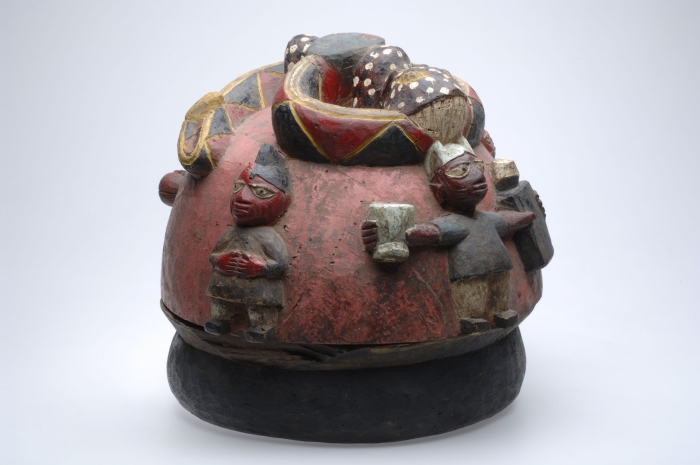
Ronde doos met deksel, gebruikt bij het Ifa orakelCollectie Stichting Nationaal Museum van WereldculturenWikimedia Commons · CC BY-SA 3.0
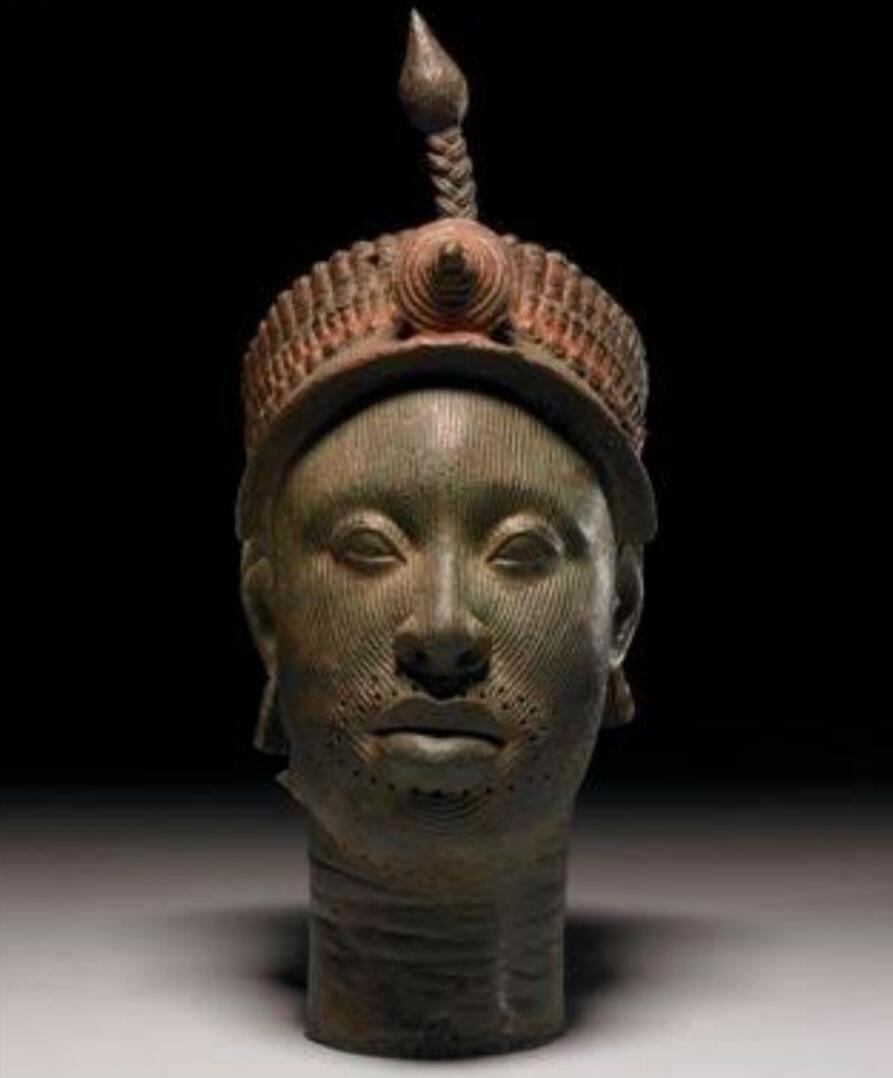
The Ife Head
Self-photographed by PaulAdogaOgbolo, 2020-02-10 17:56:50
Wikimedia Commons · CC BY-SA 4.0
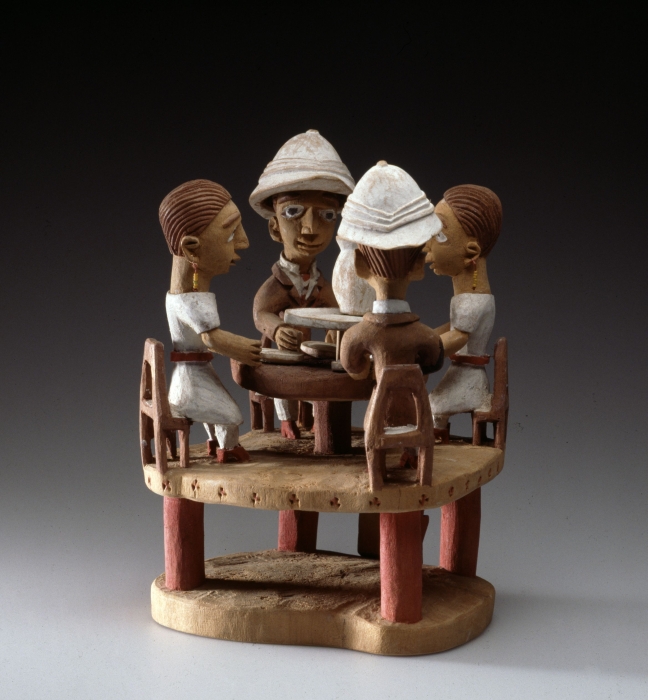
Houten miniatuurvoorstelling van twee Europese echtparen aan de maaltijdCollectie Stichting Nationaal Museum van WereldculturenWikimedia Commons · CC BY-SA 3.0
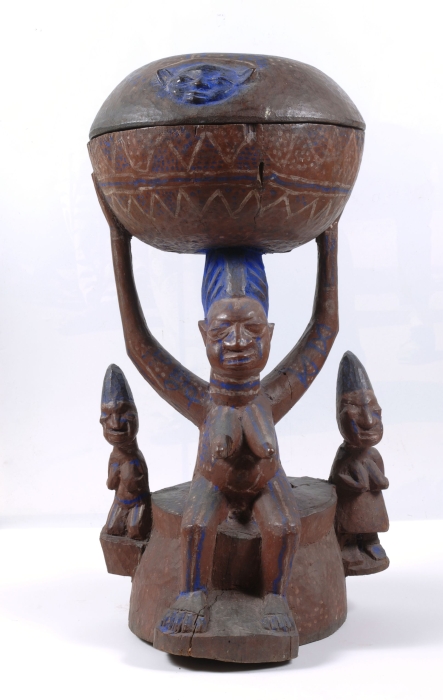
Bak voor het bewaren van medicijnen van een waarzeggerCollectie Stichting Nationaal Museum van WereldculturenWikimedia Commons · CC BY-SA 3.0
Olielamp met bijbehorend deksel, gemaakt van een melkpoederblikCollectie Stichting Nationaal Museum van WereldculturenWikimedia Commons · CC BY-SA 3.0
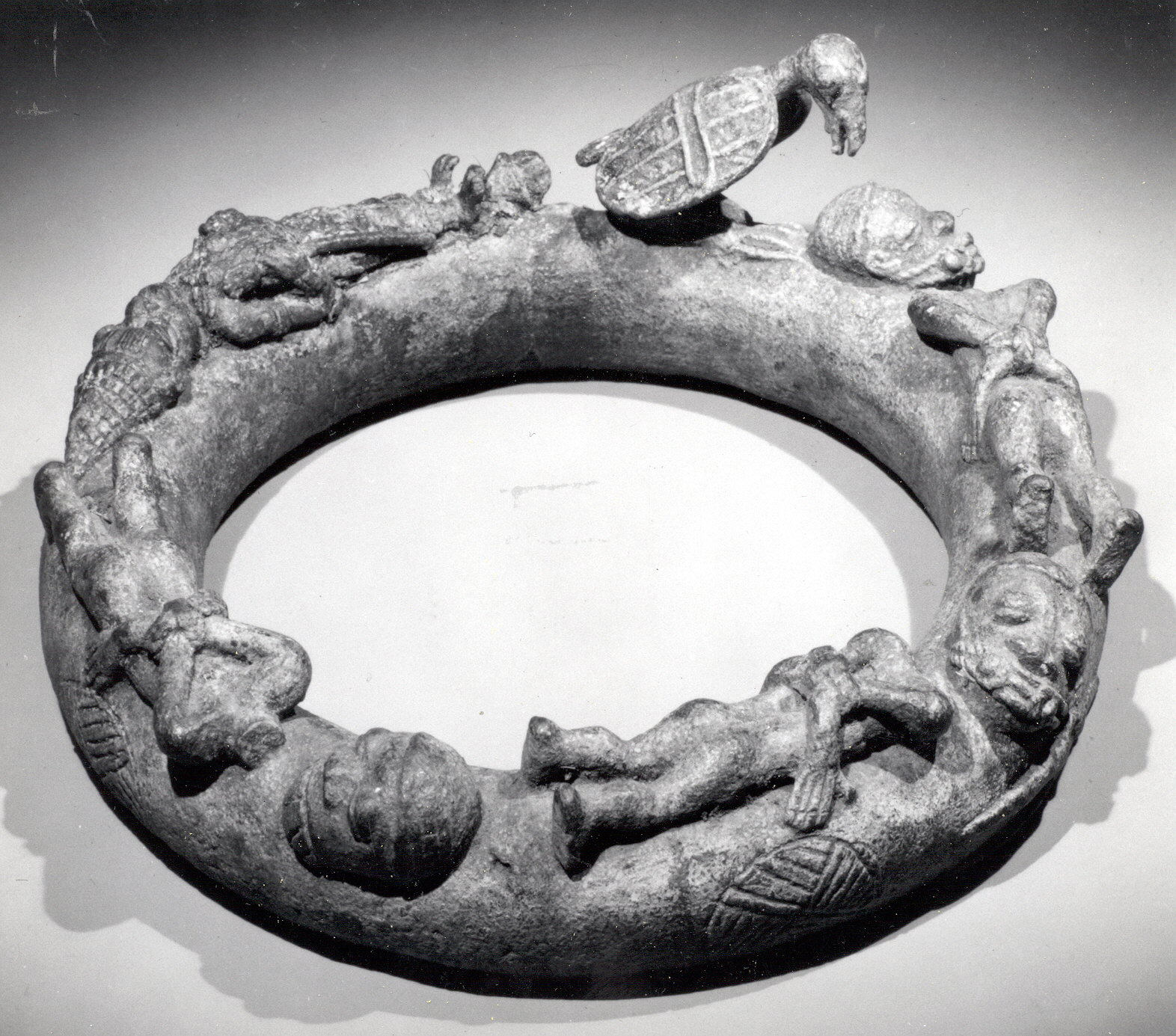
Altar RingThis file was donated to Wikimedia Commons as part of a project by the Metropolitan Museum of Art. See the Image and Data Resources Open Access PolicyWikimedia Commons · CC0
Ifá divination is structured from its smallest operational unit to its macro-canonical architecture by a rigorous arithmetic of powers of two, organized through the base-twenty vigesimal counting system of the Yorùbá language [S1, S8]. The core matrix consists of sixteen primary signs (Ojú Odù mẹ́rìndínlógún), which pair across two four-position columns to generate exactly 256 composite chapters (ẹsẹ Odù) [S1, S10]. Every phase of divination practice, including manipulating sacred palm nuts, casting the chain, determining binary lot tokens, and counting sacrificial fees in cowrie shells, operates as an embodied mathematical calculation [S7, S8, S11].
This file sets out the linguistic derivation of Yorùbá number words central to Ifá, documents the combinatorial arithmetic of the sixteen-by-sixteen system, analyzes the operational counting procedures across different divination instruments, examines the numerical structures encoded in ẹsẹ Ifá texts, and evaluates modern scholarly debates regarding binary computation and algorithmic models [S8, S11, S14].
History and evolution
The numerical framework of Ifá represents one of the oldest systematic mathematical traditions in West Africa [S8, S14]. Oral narratives within the tradition maintain that the knowledge of number and cosmic order was delivered by Ọ̀rúnmìlà (the divinity of wisdom and destiny, also referred to as Ẹlẹ́rìí Ìpín, witness of destiny) at the primordial center of Ilé-Ifẹ̀ [S10, S16]. According to historical and sociological accounts recorded by Samuel Johnson and N. A. Fadipe, Ifá divination was institutionalized across the Ọ̀yọ́ Empire during the late fifteenth and early sixteenth centuries, notably during the reign of Alaafin Onigbogi, whose mother Arugba was credited with bringing Ifá specialists into royal patronage [S6, S7]. Under the imperial administration of Ọ̀yọ́, the ranking and arithmetic of the sixteen Ojú Odù were standardized across metropolitan and tributary territories to maintain theological and judicial consistency [S6, S10].
During the nineteenth-century Yorùbá civil wars, the displacement of populations and the destruction of central shrines led to the dispersal of babaláwo (Ifá diviners, literally "fathers of secrets", from baba, father, ní, having, and awo, esoteric mystery) into regional strongholds such as Ìbàdàn, Abẹ́òkúta, and Ìjẹ̀bú [S6, S10]. This period coincided with the first systematic European and missionary documentations of Yorùbá numerals and divination mathematics [S2, S3, S4]. Pioneer linguist and Anglican bishop Samuel Ajayi Crowther published the first morphological analyses of the vigesimal number system in 1843 and 1852, documenting how subtractive number formation operated in words like mẹ́rìndínlógún . Thomas Jefferson Bowen in 1858 and the German missionary Adolphus Mann in 1887 produced detailed monographs on the cowrie-counting methodology and the computational mechanics underlying Yorùbá calculation [S3, S4].
Under British colonial rule and the introduction of sterling currency, the traditional cowrie-based numeral system faced severe economic displacement [S4, S8]. However, the arithmetic of Ifá survived intact because its liturgy, sacrificial prescriptions, and divinatory matrices remained strictly bound to traditional numerical structures [S1, S10]. Following Nigerian independence in 1960, scholars such as Robert G. Armstrong (1962), Wande Abimbola (1976), and S. A. Ekundayo (1977) formalized the grammatical and mathematical rules of the vigesimal system and its Ifá applications [S8, S9, S10]. In the African diaspora, through Cuban Santería (Lucumí) and Brazilian Candomblé Ketu, the sixteen-by-sixteen Odù matrix and the sixteen-cowrie divination system (ẹ́ẹ́rìndínlógún) were preserved with high liturgical fidelity, retaining the original numeral names and parity checks despite surrounding Romance language environments [S1, S10].
The Morphology of Mẹ́rìndínlógún and the Vigesimal Subtractive Principle
The number sixteen occupies a foundational position in Yorùbá cosmology and divination [S1, S8]. In Yorùbá grammar, the number sixteen is formed through a subtractive morphological process characteristic of the higher decades of the vigesimal system [S8, S9].
+------------------------------------------------------------------------------------+
| Morphological Derivation of Sixteen in Yorùbá                                      |
+------------------------------------------------------------------------------------+
| Base elements:      mẹ́rin   +   dín   +   ní    +   ogún                       |
| Gloss:              four    +  less   +  from   +  twenty                          |
| Phonological rule:  Vowel deletion and vowel assimilation at morpheme boundaries   |
| Surface form:       mẹ́rìndínlógún (cardinal/attributive: "sixteen")                |
| Absolute count:     ẹ́ẹ́rìndínlógún / ẹẹrindinlogun (numeral used in isolation)      |
+------------------------------------------------------------------------------------+
The morpheme dín means "to be less" or "to subtract", while ogún represents the primary vigesimal base, twenty [S8, S9]. The particle ní functions as a locative-prepositional marker meaning "in" or "from" . Thus, mẹ́rìndínlógún translates literally as "four less from twenty" .
Historical and Dialectal Attestations
The lexical forms for sixteen and its derived cowrie values have been documented across two centuries of linguistic literature:
Samuel Ajayi Crowther (1843, 1852) printed the cardinal form as mẹrindiñloguñ and the noun form as erindinlogun, defining it as the number 16 and demonstrating the subtraction $20 - 4$ .
Thomas Jefferson Bowen (1858) recorded merindilogun (attributive) and erindilogun (cardinal), noting that all numbers from 15 to 19 derive by subtraction from ogun (20) .
Adolphus Mann (1887) recorded erindinlogun on pages 60 to 62 of his study on cowrie arithmetic, demonstrating that five cowries formed a basic bunch (owó ẹyọ), and four bunches made twenty, from which four individual shells were removed to yield sixteen .
Levi Leonard Conant (1896) analyzed the Yorùbá numeral erindinlogun in The Number Concept (p. 112) as an archetype of a subtractive quinary-vigesimal hybrid system .
Samuel Johnson (1921) listed ẹrindinlogun (16) and its monetary equivalent ẹrindinlogun owo (16 cowries) in the introductory grammatical notes to The History of the Yorubas .
R. C. Abraham (1958) documented the modern tonal patterns in his Dictionary of Modern Yoruba, specifying the High-Low-High-High pitch sequence: mẹ́rìndínlógún and the nominalized absolute form ẹ́ẹ́rìndínlógún .
Robert G. Armstrong (1962) provided the first generative syntactic derivation of mẹ́rìndínlógún in Yoruba Numerals, contrasting its subtractive deep structure with the additive structure of mọ́kàndínlógún (19) and mẹ́tàdínlógún (17) .
J. R. Hurford (1975) analyzed the word mẹ́rìndínlógún in The Linguistic Theory of Numerals, formulating the semantic rule as $[[4 \text{ dín}] \text{ lógún}] \rightarrow (20 - 4)$ .
S. A. Ekundayo (1977) verified that the rule of subtraction applied systematically to all numerals terminating in 5, 6, 7, 8, and 9 above each decade threshold .
Ayọ Bamgbọṣe (1984, 1992) standardized the modern academic orthography in Yoruba Metalanguage (Èdè-Ìperí Yorùbá), confirming mẹ́rìndínlógún as the standard mathematical and grammatical term .
Where earlier European sources omitted subdots or tone marks (printing erindilogun or merindinlogun), modern Yorùbá linguistic standard strictly requires the subdots under ẹ and full tone accents: mẹ́rìndínlógún . For the full linguistic framework of the vigesimal base, see language-numeracy-and-measurement.
The Number 256: Sixteen by Sixteen in Yorùbá Numeral Derivation
In Ifá metaphysics and oral liturgy, the total number of divination configurations is 256 [S1, S10]. This number is expressed in traditional theological discourse as odù mẹ́rìndínlógún lọ́nà mẹ́rìndínlógún (literally, "sixteen odù in sixteen pathways") .
Linguistic Formulas for 256
In formal Yorùbá counting, 256 is derived through the vigesimal structure using additive or subtractive baseline combinations [S8, S9]:
Additive derivation from 200 (igba):
Spoken form: Igba lé mẹ́rìndínlọ́gọ́ta (or Igba àti mẹ́rìndínlọ́gọ́ta).
Morphological breakdown: igba (200) + lé (exceeding/plus) + mẹ́rìndínlọ́gọ́ta (56, which is $60 - 4$).
Arithmetic: $200 + (60 - 4) = 256$.
Subtractive derivation from 300 (ọ̀dúnrún / ẹ̀gbẹ̀ta):
Morphological breakdown: òjì-dín-ní-ẹ̀gbẹ̀ta (forty-four less than three hundred).
Arithmetic: $300 - 44 = 256$.
Multiplicative calculation in cowrie transactions:
Spoken form: Ẹgbàáwọ́wọ́ or Ẹgbàájì-ó-dín-mẹ́rìnlélọ́gọ́jọ in historical currency counts [S4, S8].
The linguistic system does not natively generate a single uncompounded root for 256. Instead, it computes the value dynamically through base-twenty reference points ($200$ and $300$) or through operational multiplication ($16 \times 16$) [S8, S9].
+------------------------------------------------------------------------------------+
| The Odù Matrix Hierarchy                                                           |
+------------------------------------------------------------------------------------+
| Level 1: 16 Ojú Odù (Principal Odù / Kings / Mothers)                             |
|          Each consists of identical paired columns (e.g., Ogbe Meji, Oyeku Meji)   |
| Level 2: 240 Ọmọ Odù / Àmúlù (Secondary Odù / Children / Mixed Signs)             |
|          Formed by pairing two distinct Principal Odù (e.g., Ogbe-Yẹku, Òdí-Gbè)   |
| Total:   16 + 240 = 256 Odù Ifá (16 × 16)                                          |
+------------------------------------------------------------------------------------+
Scholarly and traditional sources agree completely on the total of 256 chapters [S1, S10, S11]. For a structural analysis of the order and pairing rules, see ifa-256-odu and ifa-binary-structure.
The Binary Column of Four Positions and Stroke Counting
The generation of an Odù pattern on the divination tray (ọpọ́n Ifá, from ọpọ́n, carved wooden tray, and Ifá) is an act of physical counting and digital recording [S7, S10]. The surface of the tray is dusted with ìyẹ̀ròsùn (fine yellowish wood dust produced by termites in the iroko tree or Baphia nitida camwood, from ìyẹ̀, powder, and òsùn, camwood) [S1, S10].
Every Odù signature consists of two vertical columns, and each column contains exactly four vertical positions [S1, S11]. At each of the four vertical positions, the diviner imprints either a single vertical stroke or a double vertical stroke :
Single stroke (|): Called ẹyọ (single) or ọ̀kàn (one). In mathematical terms, this corresponds to an odd outcome (value 1) [S11, S14].
Double stroke (||): Called ìbejì (twins) or méjì (two). In mathematical terms, this corresponds to an even outcome (value 2 or 0) [S11, S14].
+------------------------------------------------------------------------------------+
| Visual Representation of the Column Formation                                      |
+------------------------------------------------------------------------------------+
| Position 1 (Top)      :    |        or        ||                                   |
| Position 2 (Upper-mid):    |        or        ||                                   |
| Position 3 (Lower-mid):    |        or        ||                                   |
| Position 4 (Bottom)   :    |        or        ||                                   |
|                                                                                    |
| Number of possible states per column: 2 × 2 × 2 × 2 = 2⁴ = 16 combinations         |
| Number of possible states for two columns: 16 × 16 = 2⁸ = 256 configurations       |
+------------------------------------------------------------------------------------+
The Spatial Direction of Inscription
The spatial inscription on the tray follows a strict operational sequence [S10, S11]:
The right-hand column is cast and marked first (apá ọ̀tún, the right side, representing seniority and solar presence).
The left-hand column is cast and marked second (apá òsì, the left side, representing junior pairing and receptive presence).
Within each column, the positions are marked sequentially from top to bottom (Position 1 down to Position 4) [S10, S11].
The act of marking in the dust is a tally of discrete physical states. The four positions establish a four-bit register, and the two paired columns form an eight-bit data word [S11, S14].
The Sixteen Ikin and the Odd Nut Rule
The most sacred and authoritative instrument of Ifá divination is the set of sixteen palm nuts (ikin Ifá) [S1, S10]. These are not ordinary oil palm nuts; they are collected from a specific variety of palm (Ọ̀pẹ Ìfá, scientifically Elaeis guineensis var. idolatrica), whose nuts typically exhibit four or more germ pores (eyes) on their base [S1, S7].
+------------------------------------------------------------------------------------+
| The Composition of the Ikin Divination Set                                         |
+------------------------------------------------------------------------------------+
| Active nuts:    16 ikin (manipulated in the diviner's hands during casting)        |
| Witness nuts:   1, 3, or 5 additional nuts kept in the container (àtèlé or ẹlẹ́rìí) |
| Total in bowl:  17, 19, or 21 nuts                                                 |
+------------------------------------------------------------------------------------+
While 16 nuts are held and manipulated during the ritual, a functional set always contains extra nuts called àtèlé (followers) or ẹlẹ́rìí (witnesses) [S1, S10]. The record indicates regional variation: some lineages maintain a total of 17 nuts (16 active plus 1 witness), while others maintain 19 or 21 nuts [S7, S10].
The Mechanics of the Grip
The diviner places the sixteen active ikin in both cupped hands, shakes them, and then attempts to grasp all sixteen firmly with the right hand in a single upward snatching motion (dida Ifá) [S10, S11]. The outcome is determined by counting the number of nuts remaining behind in the open left palm:
Exactly one nut left in the left palm ($n = 1$):
The diviner records a double stroke (||) in the ìyẹ̀ròsùn on the tray [S1, S10].
Exactly two nuts left in the left palm ($n = 2$):
The diviner records a single stroke (|) in the ìyẹ̀ròsùn on the tray [S1, S10].
Zero nuts left ($n = 0$), or three or more nuts left ($n \ge 3$):
The snatch is null and void (òfo / kò já). No mark is made, and the diviner immediately recasts the nuts [S1, S10].
+------------------------------------------------------------------------------------+
| Mathematical Inversion in Ikin Marking                                             |
+------------------------------------------------------------------------------------+
| Remainder in Palm (N)   | Tonal/Symbolic Name     | Inscription on Tray            |
+-------------------------+-------------------------+-------------------------------+
| 1 nut left              | Ọ̀kan / Ẹyọ (Odd)        | ||  (Double line / Two strokes)|
| 2 nuts left             | Èjì / Méjì (Even)       | |   (Single line / One stroke) |
| 0 or ≥ 3 nuts left      | Òfo (Empty / Invalid)   | [No mark; recast]              |
+-------------------------+-------------------------+-------------------------------+
Scholars of Yorùbá ritual logic, such as Wande Abimbola and William Bascom, emphasize that this inversion, where an odd remainder of one yields a double stroke and an even remainder of two yields a single stroke, is an ancient, fixed liturgical rule [S10, S11]. For full details on the procedural performance of this ritual, see ifa-divination-procedure.
The Counting of Casts: Ikin vs Ọ̀pẹ̀lẹ̀
To obtain a complete Odù containing eight marks across two columns, the diviner must perform multiple counting operations depending on whether ikin or the divining chain (ọ̀pẹ̀lẹ̀) is used [S1, S10].
+------------------------------------------------------------------------------------+
| Operational Complexity: Ikin versus Ọ̀pẹ̀lẹ̀                                          |
+------------------------------------------------------------------------------------+
| Feature                 | Ikin Divination         | Ọ̀pẹ̀lẹ̀ Divination               |
+-------------------------+-------------------------+-------------------------------+
| Primary instrument      | 16 sacred palm nuts     | Chain with 8 seed half-pods    |
| Physical manipulations  | 8 valid snatches (min.) | 1 single throw                 |
| Total grasps with voids | Typically 15 to 30      | Exactly 1                      |
| Output generated        | 1 mark per valid grasp  | Entire 8-bit sign instantly    |
| Context of usage        | Grave inquiries, annual | Daily inquiries, rapid client  |
|                         | rites, initiations      | consultations                  |
+-------------------------+-------------------------+-------------------------------+
The Geometry of the Ọ̀pẹ̀lẹ̀ Chain
The ọ̀pẹ̀lẹ̀ consists of eight half-pods (often from the Schrebera arborescens tree or ọ̀pẹ̀lẹ̀ tree, or fashioned from brass, bone, or turtle shell) joined by links of brass or iron chain [S1, S10]. The chain is held at its center point and thrown forward onto a clean mat or tray:
The chain falls into two parallel branches of four pods each: a right branch (apá ọ̀tún) and a left branch (apá òsì) .
Each half-pod has a concave inner surface (light, smooth) and a convex outer surface (dark, rough) [S1, S11].
A pod landing with its smooth concave side facing upward represents a single stroke (|) .
A pod landing with its rough convex side facing upward represents a double stroke (||) .
Thus, a single throw of the ọ̀pẹ̀lẹ̀ executes an instantaneous parallel computation of $2^8 = 256$ states, replacing the eight iterative sequential grasps required by the ikin [S11, S14].
The Sixteen-Cowrie Divination (Ẹ́ẹ́rìndínlógún) and Its Seventeen Outcomes
The sixteen-cowrie divination system (Ẹ́ẹ́rìndínlógún, also spelled ẹrindinlogun or merindinlogun) is the primary divination system employed by priests and priestesses of Òrìṣà other than Ifá, such as Ọ̀ṣun, Ṣàngó, Yemọja, and Ọbàtálá [S1, S7, S11].
In this system, sixteen prepared cowrie shells (owó ẹyọ, whose convex backs have been filed or ground flat to expose the internal hollow) are cast together upon a circular flat basket or mat (awo ẹ́ẹ́rìndínlógún) [S1, S11].
+------------------------------------------------------------------------------------+
| Mechanics of the Sixteen-Cowrie Divination (Ẹ́ẹ́rìndínlógún)                         |
+------------------------------------------------------------------------------------+
| Total shells cast:      16 cowries                                                 |
| Measurable state:       Aperture / slit pointing upward ("open" / "talking")       |
| Total possible sums:    17 distinct outcomes (from k = 0 to k = 16 open shells)    |
| Canonical Odù names:    16 named active chapters + 1 silent/negative state (Òpìrà) |
+------------------------------------------------------------------------------------+
The Seventeen Combinatorial Outcomes
The number of open cowries determines which Odù speaks [S1, S11]:
When zero cowries land open ($k = 0$), the outcome is called Òpìrà (from ò-pì-rà, meaning completely collapsing, extinguished, or wiped out) [S1, S11]. In Òpìrà, the cowries refuse to speak to the diviner. The priest must perform propitiatory prayers to Èṣù, touch the cowries to the earth, wash them with herbal infusions (àgbo), or immediately refer the client to a fully initiated babaláwo for an ikin consultation .
Thus, while ikin and ọ̀pẹ̀lẹ̀ produce an exact space of $2^8 = 256$ equally probable binary permutations, the Ẹ́ẹ́rìndínlógún generates a discrete probability distribution over 17 combinatorial sums, where each sum $k$ has the binomial coefficient $\binom{16}{k}$ combinations [S11, S14].
The Ìbò and the Logic of Seniority Determinations
Once the primary Odù is established, the diviner determines specific orientations (blessing, ire, versus misfortune, osó / ibi) through binary lot-casting called ìbò (from bò, to cover or conceal) [S1, S10].
+------------------------------------------------------------------------------------+
| Primary Ìbò Implements and Their Symbolic Polarities                              |
+------------------------------------------------------------------------------------+
| 1. Cowrie shell pair (ẹyọ owó): Represents Wealth, Life, Affirmative ("Yes")       |
| 2. Piece of animal bone (egungun): Represents Death, Loss, Negative ("No")         |
| 3. Smooth quartz stone (okúta): Represents Longevity, Immortality, Firm Health     |
| 4. Broken pot shard (àkókó / pẹpẹ): Represents Defeat of Enemies, Victory          |
| 5. Black seed / snail shell (ipín): Represents Darkness, Spiritual Impediment      |
+------------------------------------------------------------------------------------+
The Spatial Rule: Ọ̀tún Awo lÓsì Adíbò
During ìbò casting, the client holds two contrasting tokens, one concealed in each closed fist, without revealing to the babaláwo which token is in which hand .
The diviner casts the ọ̀pẹ̀lẹ̀ twice in succession to obtain two Odù :
First cast yields $Od\grave{u}_A$.
Second cast yields $Od\grave{u}_B$.
The diviner compares the seniority (ipò àgbà) of $Od\grave{u}_A$ and $Od\grave{u}_B$ according to the strict canonical hierarchy of the sixteen Ojú Odù [S10, S11]:
+------------------------------------------------------------------------------------+
| Seniority Decision Matrix in Ìbò                                                   |
+------------------------------------------------------------------------------------+
| Condition                               | Selected Hand                            |
+----------------------------------------+------------------------------------------+
| First Odù is senior (Odù_A > Odù_B)     | Client's RIGHT hand                      |
| Second Odù is senior (Odù_B > Odù_A)    | Client's LEFT hand                       |
+----------------------------------------+------------------------------------------+
The diviner announces: Ọ̀tún awo, lósì adíbò ("The right hand of the diviner is the left hand of the one who holds the lot") . This geometric inversion ensures that spatial perspective across the divination mat does not distort the objective mathematical outcome of the seniority calculation .
Numbers in Ẹsẹ Ifá as Text: Sacrifices, Time Cycles, and Cowrie Denominations
Inside the poetic verses of Ifá (ẹsẹ Ifá), numbers operate as core thematic markers that structure ritual action, economic costs, and cosmological intervals .
Standard Sacrificial Counts and Number Sets
Sacrificial prescriptions (ẹbọ) in ẹsẹ Ifá recur in fixed sacred quantities :
3,200 cowries = ẹgbẹ̀rìndínlógúnwó ($4,000 - 800$, or sixteen heaps of 200) [S4, S8].
20,000 cowries = ọ̀kẹ́ kan (one complete sack or bag of currency) [S4, S6].
Temporal and calendar intervals:
3 days (ọjọ́ mẹ́ta): Immediate ritual response interval .
7 days (ọjọ́ méje): Intermediate propitiation period .
16 days (ọjọ́ mẹ́rìndínlógún): A full lunar phase and divination retreat cycle [S8, S10].
17 days (ọ̀sẹ̀ mẹ́rin / 17-day cycle): The traditional Yorùbá religious month composed of four 4-day ọ̀sẹ̀ weeks counted inclusively ($4 \times 4 + 1 = 17$) [S8, S10].
Example Verse: Ẹsẹ Ifá from Òtúrá Méjì
The following verse from Òtúrá Méjì illustrates the explicit integration of vigesimal cowrie amounts, sacrificial tallies, and numerical validation within Ifá poetry:
Original
A pèé ní gégé, ó jẹ́ gégé;
A pèé ní gàgà, ó jẹ́ gàgà;
A pèé ní gégégégé,
Ó jẹ́ gégégégé.
A dífá fún Ọ̀rúnmìlá,
Ifá ń lọ rèé fẹ́ Olówó, ọmọ Olókùn.
Wọ́n ní kí ó rúbọ:
Ẹyẹlé mẹ́rìndínlógún,
Àkùkọ adìyẹ mẹ́rìndínlógún,
Òkúwó owó mẹ́rìndínlógún,
Àti ẹgbàáwàá owó tíí ṣe ọ̀kẹ́ kan.
Ọ̀rúnmìlá gbébọ, ó rúbọ;
Ó wá di pé:
Ẹ wá bá ni ní àrìkí,
Ẹ wá bá ni ní àìkú kangiri.
Literal gloss
We call it precise, it answered precisely;
We call it tall/erect, it answered tall/erect;
We call it exact-exact-exact-exact,
It answered exact-exact-exact-exact.
Cast divination for Ọ̀rúnmìlá,
Ifá was going to marry Olówó (Rich One), child of Olókùn (Ocean Deity).
They said that he should offer sacrifice:
Pigeons sixteen,
Cocks sixteen,
Dead-heaps-of-money [tied strings of cowries] sixteen,
And ten-thousand [two thousand times ten] cowries which make one bag (ọ̀kẹ́ kan).
Ọ̀rúnmìlá heard the sacrifice, he performed the sacrifice;
It now became:
Come meet us in continuous celebration,
Come meet us in everlasting long life.
Idiomatic English
We named it precise, and it proved precise;
We named it upright, and it proved upright;
We pronounced it perfectly exact,
And it answered with absolute perfection.
Divined for Ọ̀rúnmìlá,
When Ifá was going to take Wealth, the daughter of Olókun, in marriage.
He was instructed to make a sacrifice:
Sixteen pigeons,
Sixteen roosters,
Sixteen tied bundles of cowries,
And twenty thousand cowries, which make one full bag of currency.
Ọ̀rúnmìlá complied and offered the prescribed sacrifice;
And so it came to pass:
Come find us celebrating good fortune,
Come find us in robust and enduring long life.
(translated by Wande Abimbola)
Notes on the translation
The ideophones gégé and gàgà express acoustic and spatial exactness, setting up the computational precision of the divination act before any narrative unfolds . The phrase òkúwó owó mẹ́rìndínlógún refers to sixteen tied strings of cowries (òkúwó, dead/fixed strings), while ẹgbàáwàá ($2,000 \times 10 = 20,000$) explicitly equals ọ̀kẹ́ kan (one standard sack of cowrie money) [S4, S8, S10]. This demonstrates how Ifá verses systematically preserved specific banking and currency denominations across oral transmission centuries before modern fiat currencies [S4, S8].
Algorithmic Claims, Ethnomathematics, and Bascom's Corrective
In the late twentieth and early twenty-first centuries, the mathematical architecture of Ifá attracted substantial attention from ethnomathematicians, anthropologists, and computer scientists [S11, S14, S15].
+------------------------------------------------------------------------------------+
| Scholarly Perspectives on Ifá Computation                                          |
+------------------------------------------------------------------------------------+
| Scholar              | Major Work                   | Core Thesis / Finding        |
+----------------------+------------------------------+------------------------------+
| William Bascom       | Ifa Divination (1969)        | Corrected 4,096 error;       |
|                      |                              | established finite 256 matrix|
| Claudia Zaslavsky    | Africa Counts (1973)         | Vigesimal and binary parity  |
|                      |                              | in African systems           |
| Ron Eglash           | African Fractals (1999)      | Ifá as deterministic binary  |
|                      |                              | recursion and algorithm      |
| Helen Verran         | Science and an African Logic | Relational logic of Yorùbá   |
|                      | (2001)                       | numbering and materiality    |
+----------------------+------------------------------+------------------------------+
The 4,096 Overclaim and Bascom's Arithmetic Correction
In colonial and early anthropological literature, several European writers erroneously asserted that Ifá contained 4,096 distinct Odù signs . This error originated from a mathematical misunderstanding: writers observed that there were 256 Odù and that each Odù could be paired with 16 variants, leading them to calculate $256 \times 16 = 4,096$, or squaring 256 ($256 \times 256 = 65,536$) .
William Bascom decisively refuted this error in Ifa Divination: Communication Between Gods and Men in West Africa (1969) :
The mathematical system of Ifá consists of an ordered space of $2^8 = 256$ Odù signatures, organized into 16 principal Ojú Odù and 240 paired Ọmọ Odù .
The figure of 4,096 is a misattribution that conflates the finite combinatorial matrix of Odù with the expansive, open-ended corpus of individual ẹsẹ (verses) recited under each Odù .
Each of the 256 Odù contains numerous ẹsẹ (ranging from a few dozen remembered by junior priests to over eight hundred mastered by master babaláwo), making the total verse repertoire virtually inexhaustible, but the sign matrix itself remains strictly fixed at 256 [S10, S11].
Ethnomathematics and Algorithmic Recursion
Ethnomathematician Ron Eglash demonstrated that the process of generating Ifá signatures and related West African geomantic arrays constitutes an indigenous base-two binary system . Eglash demonstrated that:
The four vertical positions operate as binary digits (bits) where single strokes represent 1 and double strokes represent 0 (or vice versa) .
The procedural generation of secondary signs via parity addition (as seen in related systems like Sikidy in Madagascar and West African sand divination) represents one of the earliest known cultural implementations of deterministic binary algorithms .
Helen Verran's epistemological study, Science and an African Logic (2001), analyzed Yorùbá numeral logic not as an imperfect approximation of Western decimal counting, but as an elegant, relational logic that integrates bodily action, material tokens, and base-twenty modular arithmetic . Verran demonstrated that Yorùbá children and traditional practitioners negotiate number as an active, emergent performance of grouping, decomposing, and recombining sets, a cognitive practice directly mirrored in the physical manipulation of the ikin and ìbò .
Fuentes
[1]R. C. Abraham, Dictionary of Modern Yoruba (University of London Press, 1958), pp. 177, 276, 458.
[2]Samuel Ajayi Crowther, A Vocabulary of the Yoruba Language (Seeleys, 1843; 2nd ed. 1852), pp. 45-52.
[3]T. J. Bowen, Grammar and Dictionary of the Yoruba Language (Smithsonian Institution, 1858), pp. 56-69.
[4]Adolphus Mann, "Notes on the Numeral System of the Yoruba Nation," Journal of the Anthropological Institute of Great Britain and Ireland, Vol. 16 (1887), pp. 59-64.
[5]Levi Leonard Conant, The Number Concept: Its Origin and Development (Macmillan & Co., 1896), pp. 112-115.
[6]Samuel Johnson, The History of the Yorubas: From the Earliest Times to the Beginning of the British Protectorate (CMS Bookshops, 1921; Routledge & Kegan Paul, 1969), pp. l-lii, 126-130.
[7]N. A. Fadipe, The Sociology of the Yoruba (Ibadan University Press, 1970), pp. 269-285.
[8]Robert G. Armstrong, Yoruba Numerals (Oxford University Press for NISER, 1962), pp. 11-28.
[9]S. A. Ekundayo, "Vigesimal Numeral Derivational Morphology: Yoruba Grammatical Competence Epitomized," Anthropological Linguistics, Vol. 19, No. 9 (1977), pp. 436-453.
[10]Wande Abimbola, Ifá: An Exposition of Ìfá Literary Corpus (Oxford University Press Nigeria, 1976), pp. 18-42, 106-118.
[11]William Bascom, Ifa Divination: Communication Between Gods and Men in West Africa (Indiana University Press, 1969), pp. 11-50.
[12]J. R. Hurford, The Linguistic Theory of Numerals (Cambridge University Press, 1975), pp. 211-224.
[13]Ayọ Bamgbọṣe (ed.), Yoruba Metalanguage (Èdè-Ìperí Yorùbá): A Glossary of English-Yoruba Technical Terms, Vol. 1 (NERDC / University Press Limited, 1984), pp. 84-96.
[14]Ron Eglash, African Fractals: Modern Computing and Indigenous Design (Rutgers University Press, 1999), pp. 89-106.
[15]Helen Verran, Science and an African Logic (University of Chicago Press, 2001), pp. 54-88, 260.
[16]Jacob K. Olupona, City of 201 Gods: Ilé-Ifẹ̀ in Time, Space, and the Imagination (University of California Press, 2011), pp. 142-168.