Egúngún masquerade ensembles, sartorial stratigraphy and ritual ẹbọ · Ìpilẹ̀ṣẹ̀
Egúngún masquerade ensembles, sartorial stratigraphy and ritual ẹbọ
An analytical examination of the multi-layered textile architecture, historical accumulation of cloth, ritual consecration, and sacrificial mechanics governing Yorùbá Egúngún ancestral masquerade ensembles.
advancedhigh32 min de lecture·24 sources
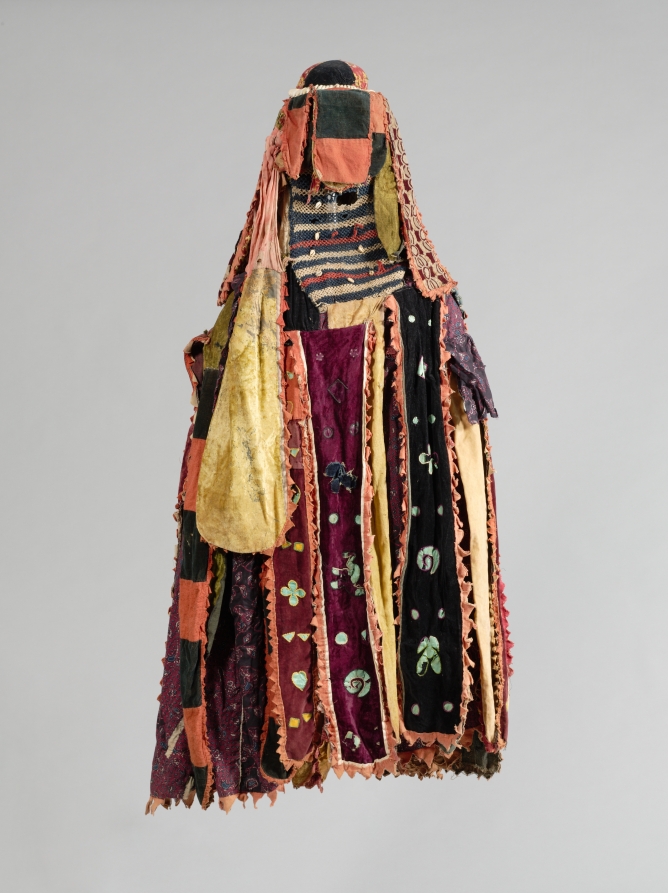
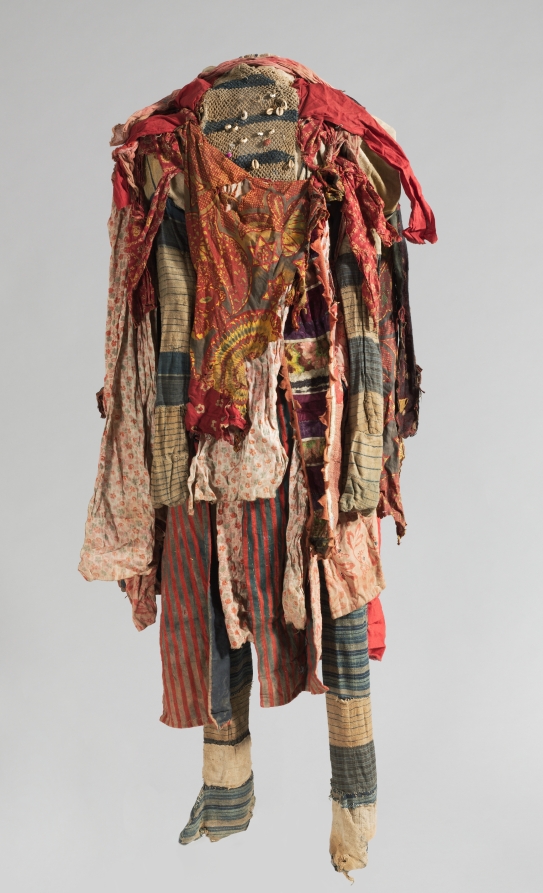
Egúngún Masquerade Dance CostumeGift of Katherine C. WhiteThe Cleveland Museum of Art · CC0
Egúngún Masquerade Dance Costume
Gift of Katherine C. White
The Cleveland Museum of Art · CC0
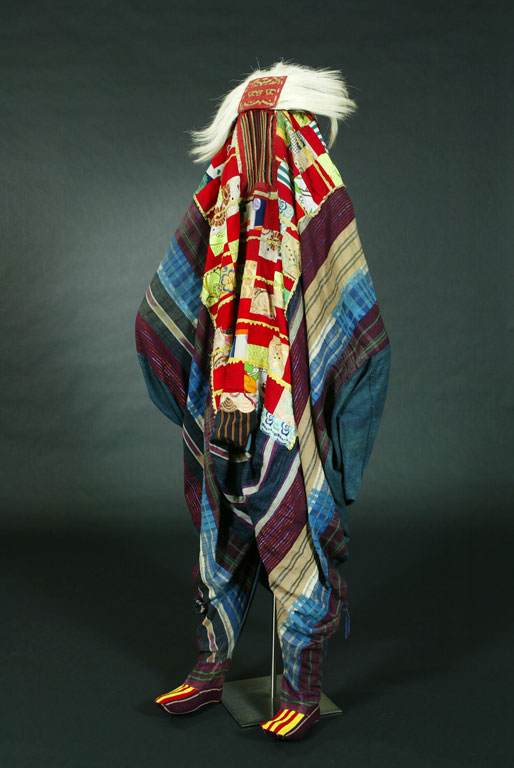
Egungun masquerade dance garmentWendy KaveneyWikimedia Commons · CC BY-SA 3.0
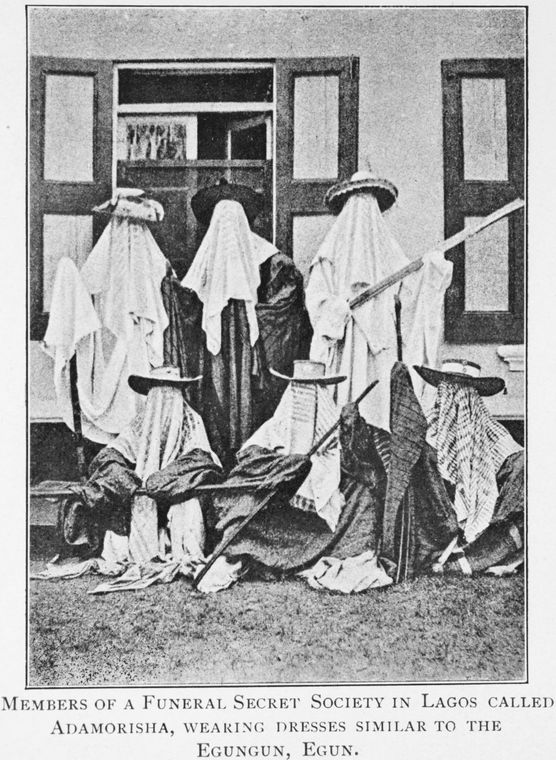
Members of a Funeral Secret Society in Lagos called Adamorisha, wearing dresses similar to the Egungun, Egun.From The New York Public LibraryThe New York Public Library (Schomburg Center for Research in Black Culture) · Public Domain
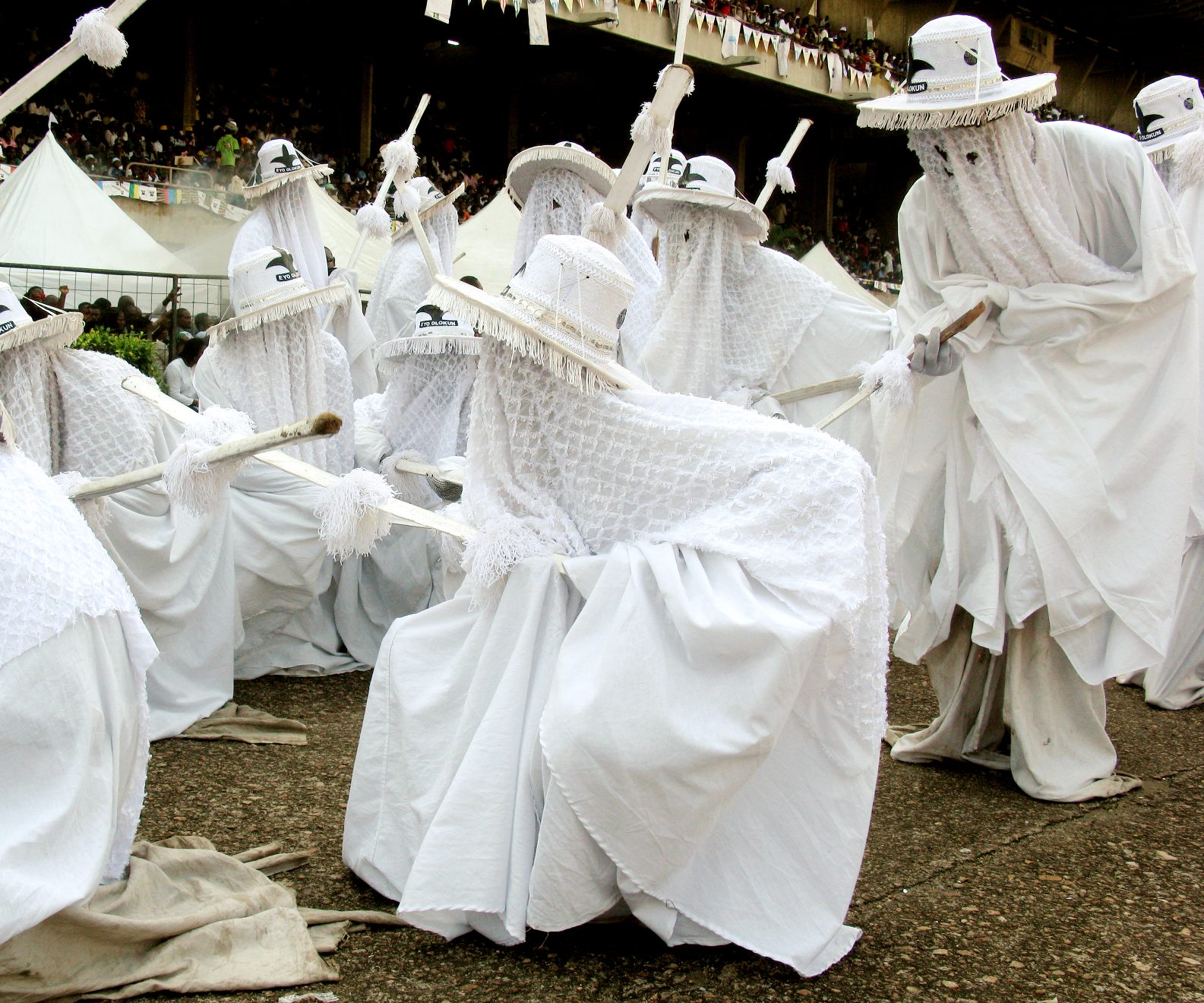
Eyo Olokun.jpgSlashme, CC BY-SA 3.0, via Wikimedia CommonsWikimedia Commons · CC BY-SA 3.0
An Egúngún masquerade ensemble is a sacred, multi-layered textile garment through which the spirits of deceased ancestors (ara ọ̀run, literally "citizens of heaven") materialize among the living . Far from serving as a simple theatrical costume, the ensemble, known in Yorùbá as the ẹkú Egúngún (ancestral masquerade garment, from ẹkú, ritual casing or sacred vestment), constitutes a consecrated cosmological medium that physically encapsulates supernatural potency (àṣẹ) . Through the dense layering of fabrics spanning multiple generations, the ensemble operates as a living historical archive, a visual genealogy of lineage wealth, and a site of ongoing sacrificial negotiation (ẹbọ) between mortal descendants and ancestral forces .
This study examines the architectural anatomy of the ẹkú Egúngún, the principles of sartorial stratigraphy that govern its physical expansion over decades, the sacrificial rites required to commission and animate the cloth, and the aesthetic choreographies through which ancestral blessings are disbursed .
History and evolution
Oral traditions preserved in the Ifá divination corpus, specifically within the odù Òtúrupọ̀n Méjì and Ọ̀kànràn Ògúndá, trace the genesis of the masquerade to the primordial necessity of clothing the returned dead so that their exposed bodily decay would not terrify the living . According to canonical Ọ̀yọ́ traditions recorded by Samuel Johnson, the institutionalization of Egúngún as an imperial state organ occurred during the fifteenth and sixteenth centuries . During the reign of Aláàfin Ofinran, following the temporary displacement of the Ọ̀yọ́ court to Kusu and Gbongbo due to military pressure from the Nupe (Tapa), the masking complex was integrated into the imperial administrative apparatus under the hereditary leadership of the Alápìnnì lineage . The Alápìnnì, alongside other high-ranking titles such as the Alágbàá and Ọ̀jẹ̀, transformed ancestral cloth veneration into a centralized mechanism of judicial arbitration, dynastic validation, and funerary governance .
During the eighteenth-century zenith of the Ọ̀yọ́ Empire, the expansion of commercial networks and tributary flows brought unprecedented quantities of prestige textiles into central Yorùbáland . Narrow-strip handwoven cloths (aṣọ-òkè) such as silk sányán, crimson-dyed àlàárì, and indigo-checked ètù were combined with imported European velvets, Indian Madras cottons, and damasks to expand the visual grandeur of lineage ensembles . The collapse of Old Ọ̀yọ́ (Ọ̀yọ́-Ilé) in the 1830s and the subsequent nineteenth-century civil wars precipitated massive population relocations toward southern military emporiums like Ìbàdàn, Abẹ́òkúta, Ìjàyè, and Ògbómọ̀ṣọ́ . In these cosmopolitan war camps, refugee lineages reconstructed their ancestral ẹkú from salvaged heirloom fragments while adopting militarized masquerade typologies, such as Egúngún Ẹlẹ́rù and Egúngún Olóòlù, designed to fortify civic morale and wage psychic warfare against rival coalitions .
The arrival of Christian missionary societies in the 1840s and the formal imposition of British colonial rule in 1893 initiated sustained ideological and legal assaults on Egúngún institutions . Colonial district officers attempted to regulate festival schedules and penalize secret society tribunals, while mission schools prohibited converts from handling masquerade cloth . Despite these pressures, lineage custodians preserved the tradition by incorporating imported industrial textiles, metallic braids, and plastic trims into the ẹkú, converting colonial consumer commodities into ancestral prestige goods . In the post-independence era, particularly from the 1970s oil boom onward, the Egúngún complex expanded into vibrant municipal spectacles celebrated in metropolitan centers like Lagos, Ìbàdàn, and Ọ̀yọ́, alongside transnational manifestations in the African diaspora . In Salvador da Bahia (specifically on the island of Itaparica in Brazil) and in Cuba, descendants of enslaved Yorùbá preserved ancestral masking rites within the Candomblé Ketu and Santería (Lucumí) complexes, sustaining the theological requirement that the spirit must remain completely veiled within consecrated cloth .
                                CHRONOLOGY OF EGÚNGÚN SARTORIAL EVOLUTION

  15th, 16th Century       Old Ọ̀yọ́ Court (Kusu / Gbongbo)
                          Imperial institutionalization under Aláàfin Ofinran; hereditary Alápìnnì
                          oversight; foundational use of handspun indigo cloth and funerary shrouds.
                                             |
                                             v
  18th Century            Ọ̀yọ́ Imperial Climax & Trade Expansion
                          Incorporation of luxury aṣọ-òkè (sányán, àlàárì, ètù), imported Indian
                          Madras, European velvets, and brass adornments into lineage ensembles.
                                             |
                                             v
  19th Century (1830s)    Collapse of Ọ̀yọ́-Ilé & 19th-Century Civil Wars
                          Migration south (Ìbàdàn, Abẹ́òkúta, Ògbómọ̀ṣọ́); rise of fierce warrior
                          masquerades (Ẹlẹ́rù, Olóòlù); incorporation of protective medicinal talismans.
                                             |
                                             v
  Colonial Period         Missionary Contact & British Regulation (1893-1960)
                          Suppression of masquerade judicial powers; resilient adaptation through
                          incorporation of factory prints, metallic sequins (tánṣá), and machine sewing.
                                             |
                                             v
  Post-Independence       Contemporary Urban Pageantry & Transnational Diaspora
  to Present              Biennial festivals across Yorùbáland; preservation in Brazilian Terreiros
                          (Ilê Agbôulâ, Itaparica) and Lucumí lineages; use of modern luxury brocades.
The Architectural Anatomy of the Ẹkú Egúngún
The fabrication of an ẹkú Egúngún is governed by a strict structural logic designed to achieve two indispensable theological imperatives: the absolute concealment of every millimeter of the human carrier's body, and the creation of an aerodynamic, multi-tiered kinetic sculpture . The ensemble consists of concentric garments assembled from the inside out .
                     CROSS-SECTIONAL STRATIGRAPHY OF THE ẸKÚ

        +-------------------------------------------------------------+
        |  OUTER SARTORIAL LAYER: Hanging Lappets (Àbálà / Ẹrẹrẹ)     |
        |  - Serrated edges, metallic trims, trade velvets, brocades  |
        |  - Whirling panels generating the "Breeze of Blessing"      |
        +-------------------------------------------------------------+
                                      |
        +-------------------------------------------------------------+
        |  STRUCTURAL MASK / VIEWING APERTURE (Ojú Ẹkú / Àwọ̀n)       |
        |  - Wooden carved headdress, animal skulls, or beaded cap   |
        |  - Cowrie embroidery and tightly woven net face screen      |
        +-------------------------------------------------------------+
                                      |
        +-------------------------------------------------------------+
        |  INTERMEDIATE MEDICINAL TUNIC (Jẹpẹ / Àwọ̀tẹ́lẹ̀)             |
        |  - Fitted tunics lined with leather amulets (òndè, tírà)    |
        |  - Empowered herbal preparations (oògùn) providing àṣẹ      |
        +-------------------------------------------------------------+
                                      |
        +-------------------------------------------------------------+
        |  INNER FOUNDATIONAL SACK (Àgo / Aṣọ Ìsìnkú)                 |
        |  - Heavy handwoven strip-cloth (kíjìpá / ètù)               |
        |  - Integral head-to-toe envelope enclosing feet and hands   |
        +-------------------------------------------------------------+
                                      |
                               [ Human Carrier ]
The Inner Envelope (Àgo or Jẹpẹ)
The innermost foundational garment, worn directly against the body of the carrier (ẹlẹ́kù, literally "owner/carrier of the sacred casing"), is known as the àgo (shroud casing) or jẹpẹ (fitted ritual tunic) . This garment is an undivided envelope constructed from thick, handwoven indigo cotton strip-cloth (kíjìpá or ètù) . The àgo encloses the dancer completely from head to toe, terminating in integrated cloth gloves and tailored cloth shoes (bàtá ẹkú) .
This base sack mirrors the ritual shroud (aṣọ ìsìnkú) used in Yorùbá mortuary rites to wrap the deceased corpse before subterranean interment . If even a single fingernail, wrist, or ankle of the dancer were exposed during a public performance, the ontological boundary separating the ancestral realm (ọ̀run) from the earthly sphere (ayé) would rupture, placing the masquerader and bystanders under extreme spiritual hazard .
The Facial Screen (Ojú Ẹkú or Àwọ̀n)
Because the dancer's facial features must remain invisible while retaining outward visibility and airflow, the anterior head section of the àgo is fitted with a specialized visual portal called the ojú ẹkú (literally "the eye of the masquerade") or àwọ̀n (netting) . The ojú ẹkú is fabricated from open-mesh netted textile cordage, perforated trade fabric, or dense patterns of interlaced cowrie shells (owó ẹyọ) . This netting allows the performer to see the physical terrain and orient himself toward the lead drummer while preventing observers from discerning human eyes within the darkened cavity .
The Outer Kinetic Lappets (Àbálà, Ẹrẹrẹ, or Pẹkà)
Attached to the structural yoke of the upper torso and headpiece are dozens, sometimes hundreds, of long, narrow rectangular streamers called lappets, designated variably as àbálà, ẹrẹrẹ, or pẹkà . These lappets vary in length from thirty centimeters to several meters, cascading from the shoulders and spine down to the dust of the ground .
Each lappet is individually constructed by basting together longitudinal strips of disparate fabrics, lined along the edges with triangular pinking, sawtooth fabric notches, metallic ribbons, and sequins (tánṣá) . The weight and texture of the lappets are carefully balanced: heavier velvets and broadcloths are counterweighted against lighter silks and damasks so that when the dancer initiates rapid spinning turns, the panels fly outward horizontally in a centrifugal vortex .
Sartorial Stratigraphy: Cloth as Lineage Archive
Art historians Henry John Drewal and John Pemberton III coined the analytical concept of "sartorial stratigraphy" to describe the structural and chronological accumulation of textiles within an ẹkú Egúngún . Unlike secular clothing, which is routinely discarded when worn out, an ancestral ẹkú is never discarded; it is continually refurbished, augmented, and entombed within newer strata of cloth .
When a lineage prepares its ẹkú for an upcoming festival (ọdún Egúngún), the family elder (baálé) and the masquerade custodian inspect the integrity of the garment . If an outer panel has decayed or faded, it is not stripped away and thrown into the trash; rather, a new panel of prestigious, contemporary fabric is stitched directly over the older layer . Consequently, peeling back the concentric strata of an heirloom ẹkú involves traveling backward across centuries of global and regional textile trade :
The Deepest Basal Stratum: The innermost hidden core retains ancient fragments of hand-spun, indigenous wild-silk sányán, heavy unbleached cotton kíjìpá, and early indigo strip-cloth, representing the earliest founding generations of the lineage .
The Nineteenth-Century Middle Strata: Intermediate layers reveal crimson silk àlàárì, indigo-checked ètù, early European import trade felts, and cowrie-studded cotton canvas acquired during the era of the trans-Atlantic trade and the Ọ̀yọ́ civil wars .
The Late Twentieth-Century Strata: Upper-middle layers feature machine-printed Wax Dutch hollandais, velveteens, lurex braids, plastic mirrors, and metallic sequins introduced during the colonial and early post-independence periods .
The Uppermost Contemporary Stratum: The visible exterior displays the latest prestige textiles available in global markets, including computerized Austrian lace, heavy jacquards, Swiss voiles, and imported synthetic satins .
By preserving previous layers intact beneath newer additions, the ẹkú functions as an empirical visual genealogy . The ancestral spirit is understood to literally wear the cumulative economic prosperity, aesthetic devotion, and familial piety of its mortal descendants .
Typological Varieties of Egúngún Ensembles
The structural configuration of the ẹkú varies significantly across functional and regional categories within Yorùbá society :
+-------------------------+----------------------------------+----------------------------------+
| Egúngún Typology         | Primary Textile Composition       | Symbolic & Ritual Function        |
+-------------------------+----------------------------------+----------------------------------+
| Egúngún Alábàlá          | Tiered multi-colored cloth        | Lineage praise, public pageantry, |
|                          | lappets (àbálà), velvet, satin,  | genealogical celebration, and     |
|                          | embroidered borders, dance panels | disbursement of family blessings  |
+-------------------------+----------------------------------+----------------------------------+
| Egúngún Ọlọ́jọ̀wọ́n        | Sumptuous brocades, damasks, lace,| Demonstration of exceptional clan |
|                          | heavy metallic sequins (tánṣá)    | wealth, aesthetic prestige, and   |
|                          | and delicate cowrie face nets     | aristocratic lineage standing     |
+-------------------------+----------------------------------+----------------------------------+
| Egúngún Ẹlẹ́rù / Alágbo   | Heavy indigo kíjìpá sack crowned  | Communal medicine carrier,        |
|                          | with a massive superstructure of  | anti-witchcraft pacification,     |
|                          | carved masks, horns, and skulls   | and civic epidemic purification   |
+-------------------------+----------------------------------+----------------------------------+
| Egúngún Layewu           | Handwoven cotton integrated with  | Guild identity of big-game        |
|                          | animal pelts, antelope skins,     | hunters (*ọdẹ*), displaying skull |
|                          | horns, and leather medicine cases | trophies and forest potency       |
+-------------------------+----------------------------------+----------------------------------+
| Egúngún Dánàfójúrá       | Thick, magically treated textile  | Display of esoteric invulnerability;|
|                          | layers saturated with anti-fire   | dances unscathed through raging   |
|                          | medicinal infusions and charcoal  | physical bonfires in public       |
+-------------------------+----------------------------------+----------------------------------+
The Tailoring of Power: Ritual Ẹbọ, Consecration, and Medicine
In Yorùbá thought, an ẹkú Egúngún cannot be created through mere mechanical sewing; the assembly of cloth constitutes a continuous sacrificial offering (ẹbọ) to cosmic powers . The process of cutting, basting, and empowering an ensemble requires precise ritual mediation between the tailor, the divination priesthood (babalawo), the ancestral society elders (Alágbàá, Alápìnnì), and the matriarchal spirit realm (Àwọn Ìyá Wa) .
                RITUAL CONSECRATION PATHWAY FOR THE ẸKÚ EGÚNGÚN

    1. DIVINATORY CONSULTATION (Ifá Oracle)
       - Prescribes the auspicious Odù, textile colors, and required animal offerings
                                     |
                                     v
    2. SACRED FABRICATION IN THE GROVE (Igbó Ìgbàlẹ̀)
       - Initiated tailors sew the inner àgo, lappets, and facial net in seclusion
                                     |
                                     v
    3. INSERTION OF MEDICINAL REPOSITORIES (Àṣẹ & Oògùn)
       - Sealing of leather talismans (òndè, tírà) and animal horns containing medicines
                                     |
                                     v
    4. SACRIFICIAL APPEASEMENT (Ẹbọ to Èṣù & Àwọn Ìyá Wa)
       - Blood of roosters, goats, or rams poured on sacred lineage stones (ojúbọ)
                                     |
                                     v
    5. OBI DIVINATION OF ACCEPTANCE (Àṣẹ Acceptance)
       - Four-lobed kolanut cast; confirms ancestors have entered the textile vessel
The Sacred Enclosure (Igbó Ìgbàlẹ̀) and Consecration Rites
The manufacture and storage of an ẹkú take place strictly within the igbó ìgbàlẹ̀ (the sacred grove of the Egúngún society) or an isolated, windowless ancestral room (ilée gégé) within the lineage compound . Non-initiates and uninitiated youths are strictly barred from entering these sanctums .
Before a single cut is made into the fabric, the lineage consults the Ifá oracle through a babalawo to determine whether the ancestral spirit accepts the proposed cloth colors, which specific ancestral personality will animate the ensemble, and what sacrifices must precede construction . The prescribed ẹbọ typically entails the offering of a male goat (òbúkọ), a rooster (àkùkọ), kolanuts (obì àbàtà), bitter kola (orógbó), palm oil (epo pupa), and dry gin (otí) at the lineage shrine (ojúbọ) . The blood of the sacrificial victims is applied to the foundational altar stones and the wooden structural yoke of the headpiece, transferring biological vitality (ẹ̀mí) into the inanimate wood and textile fibers .
The Integration of Amuletic Potencies (Àṣẹ and Oògùn)
An ẹkú Egúngún is an offensive and defensive spiritual fortress . Because a dancing masquerader is vulnerable to competitive magical attacks, sorcery (àjẹ́), and psychic hostility from rival lineages or witches, herbalists and priests sew specialized medicine packets (oògùn) directly into the textile layers .
These empowerments include:
Leather Amulets (Òndè and Tírà): Small cylindrical or rectangular leather packets containing pulverized roots, consecrated soils, incantations inscribed on paper, and metallic minerals, stitched directly along the inside waistband and spine of the jẹpẹ tunic .
Horns and Gourdlets (Ìwó and Àdó): Miniature animal horns (such as miniature antelope or goat horns) packed with black medicinal soap (oṣẹ dudu) and sealed with wax and cowries, tied among the outer hanging lappets to neutralize negative spells launched from the surrounding crowd .
Mirrors and Metallic Sequins (Tánṣá): Reflective glass mirrors and shimmering foil disks attached to the face panel and upper lappets. In Yorùbá ritual semiotics, the mirror does not merely sparkle; it deflects the malevolent psychic gaze of sorcerers back upon themselves, disorienting spectral entities that seek to pierce the cloth .
The Gendered Paradox: The Hidden Hand of Women
A fundamental tenet of Egúngún masking across Yorùbáland is the formal, absolute prohibition against living women donning the ẹkú or touching the dancer inside the grove . A widespread proverb warns:
Awo Egúngún lobìnrin le ṣe,
Awo Gẹ̀lẹ̀dẹ́ lobìnrin le mọ̀,
Tóbìnrin bá fojú d'Orò,
Orò a gbe e lọ.
Women may know the mysteries of Egúngún and Gẹ̀lẹ̀dẹ́, but if an uninitiated woman looks directly upon the secret of Orò, Orò will consume her .
Yet, this ostensible male exclusivity masks a profound cosmological interdependence documented by Babatunde Lawal and Karin Barber . Men manufacture and wear the cloth, but they do so only under the spiritual license of senior female initiates holding titles such as Ìyá Àgan (Mother of the Sacred Grove), Ìyá Mọ̀dá, and Ìyá Àgbà Ọ̀jẹ̀ . In Yorùbá mythology recorded in the odù Òsá Méjì, the primordial secret of masking originally belonged to women (Àwọn Ìyá Wa, "Our Mothers," the cosmic witches) . Men were permitted to adopt the cloth only after swearing perpetual reverence and submitting the masquerade to female spiritual surveillance .
When the masquerader emerges into the public arena, it is the elder women who stand at the front of the procession chanting the ancestral oríkì (lineage praise poetry) . The oríkì acts as an acoustic key: the vibration of the female voices, naming the heroic deeds and personal idiosyncrasies of the deceased forebears, activates the àṣẹ embedded in the textile layers, causing the spirit to awaken fully within the dancer .
Choreographic Mechanics and the Aerodynamics of Blessing
The visual and spiritual efficacy of an ẹkú Egúngún is realized only through kinetic motion . When hanging motionless on a mannequin in a Western ethnographic museum, the ẹkú is structurally dead, an empty husk deprived of breath (ẹ̀mí) and centrifugal velocity .
                     KINETIC ACTIVATION OF SARTORIAL LAPPETS

    [ Static State: Hanging Vertically ]
             |
             |  (Dancer initiates violent spinning turn to Bàtá rhythm)
             v
    [ Dynamic State: 360-Degree Centrifugal Vortex ]
             |
             +---> Lappets rise horizontally, revealing hidden underside layers
             +---> Metallic tánṣá and mirrors flash, catching ambient sunlight
             +---> Generates the "Breeze of Blessing" (Afẹ́fẹ́ Ìbùkún) across spectators
The "Breeze of Blessing" (Afẹ́fẹ́ Ìbùkún)
When an Egúngún Alábàlá executes its characteristic rapid whirling step (yíyí), driven by the polyrhythmic cross-beats of the bàtá drum orchestra, the heavy textile lappets fly outward at right angles to the performer's body . This rapid spinning causes the underside linings of the lappets, deliberately constructed from contrasting, saturated colors, to flash against the outer fabrics .
This centrifugal rotation generates a physical current of air that washes over the gathered spectators . In Yorùbá cosmology, this displacement of air is known as the afẹ́fẹ́ ìbùkún (breeze of blessing) . Henry John Drewal notes that this ritual wind is theologically linked to the goddess Ọya, the divinity of tempests and transformation who is married to Ṣàngó and controls the gates between life and death . As the wind sweeps over the audience, it cleanses the communal space of pestilence (àrùn), sudden death (ikú), and ancestral displeasure, while imparting vitality and reproductive fertility (ọmọ) to women who lean forward to receive the draft .
Acoustic Instrumentation and Kinetic Balance
The sartorial apparatus is an auditory instrument as much as a visual one . Sown into the borders of the ẹkú are hundreds of brass bells (saworo), hollow bronze cones, rattling cowrie fringes, and dried seed pods . As the performer bounds, leaps, and stamps his feet, these metallic and organic resonators emit a complex, continuous acoustic hiss that syncopates with the master drummer's ìyáàlù bàtá . The dancer's bodily weight is considerably augmented by the heavy wet-spun cloth, which can weigh between twenty and forty kilograms, requiring exceptional athletic conditioning and esoteric training within the igbó ìgbàlẹ̀ to prevent physical exhaustion or accidental tripping, which would be interpreted as a catastrophic omen .
Key Texts, Chants, and Philosophical Formulations
The theology of Egúngún textiles is embedded in canonical oral literature . Below, key stanzas from the Ifá corpus, ancestral chants (ìwì Egúngún), and proverbs are rendered in the standard three-layer presentation, accompanied by comprehensive analytical layers.
Text 1: The Consecration of the Masquerade Shroud (Òtúrupọ̀n Méjì)
Òtúrupọ̀n Méjì, Ifá wí:
Aṣọ la bá lórí aró,
Ẹ̀wù la bá lórí ọ̀pá,
Aṣọ l'ẹkú, a kì í f'ẹkú bọ́ra lásán.
Díá fún Ọ̀rúnmìlà,
Bàbá nṣawo lọ sílé Alápìnnì,
Wọ́n ní kí Baba rúbọ,
Kí gbogbo ara ọ̀run ó lè gbẹ́jẹ́ gbẹ́mù.
Ó gb'ẹ́bọ, ó rú'bọ.
Nígbà tí ẹkú dé'lẹ̀,
Ayé di tútù, ikú fò lọ.
Literal gloss:
Òtúrupọ̀n Méjì, Ifá says:
Cloth is what we find upon the dye-pot,
A garment is what we find upon the clothes-post,
Cloth is the sacred casing, we do not cover ourselves with the casing in vain.
Cast divination for Ọ̀rúnmìlà,
Father was traveling on a spiritual mission to the house of Alápìnnì,
They told Father to offer sacrifice,
So that all the citizens of heaven could receive food and drink.
He heard of the sacrifice, he performed the sacrifice.
When the sacred cloth casing touched the ground,
The world became cool and tranquil, death flew away.
Idiomatic English (trans. Wande Abimbola and Henry John Drewal):
Òtúrupọ̀n Méjì declares: We find the dyed cloth upon the indigo pot, and we find the flowing robe hanging from the staff. Cloth is the ancestral casing; no one dons the sacred casing without solemn purpose. This divination was cast for Ọ̀rúnmìlà when he journeyed to the palace of the Alápìnnì. He was instructed to make sacrifice so that the ancestors in heaven might accept our offerings. Ọ̀rúnmìlà complied and made the offering. When the holy cloth touched the earth, peace descended on the community, and death took flight .
Notes on the translation
The Yorùbá term ẹkú is translated idiomatically as "sacred casing" rather than merely "costume." The phrase ayé di tútù employs the root tutu (cool, temperate, peaceful), contrasting with gbígbóná (hot, volatile, chaotic), signifying that the correct sacrificial dressing of the masquerade neutralizes cosmic danger .
Depth Analysis:
What it means: The verse establishes that cloth (aṣọ) is the essential mediating technology through which ancestral spirits are calmed and death is driven out of the human realm .
What it is used for: Chanted by babalawo during the preliminary consecration of new cloth destined for the igbó ìgbàlẹ̀, confirming the efficacy of the offering .
Worked Scenario: A wealthy family in Ọ̀yọ́ commissions an expensive velvet ẹkú to honor a late patriarch. The officiating babalawo chants this verse as palm oil and the blood of a ram are touched to the hem of the lowest lappet, affirming that the garment is transformed from secular cloth into an instrument of life-lengthening peace .
Importance and value: Formulates the foundational Yorùbá philosophy that social order and cosmic coolness (ìtútù) are maintained through the material wrapping of invisible spiritual entities .
Tonality: The tonal distinction between ẹkú (high-high: masquerade casing) and eku (mid-mid: rat/rodent) is vital; flattening the tone completely destroys the esoteric attribution to ancestral wrapping .
Text 2: The Sacred Mystery of Cloth Concealment (Ọ̀kànràn Ògúndá)
Òkè l'ẹyẹ n fò sí, kò f'ẹsẹ̀ tẹ'lẹ̀,
Díá fún Égúndèyí, ọmọ ará ọ̀run kìn-ìn-kìn.
Wọ́n ní: "A kì í rí ìdí ẹkú,
Ẹni tó bá f'ojú rí ìdí ẹkú,
A d'ẹni ará ọ̀run l'ọ́jọ́ náà."
Ọ̀rúnmìlà ní àṣírí l'aṣọ,
Aṣọ ní í bo gbogbo abùkù ayé mọ́lẹ̀.
Literal gloss:
The mountain is where the bird flies toward, it does not touch the ground with its feet,
Cast divination for Égúndèyí, the offspring of the noble citizen of heaven.
They said: "We never see the bottom/secret inside of the sacred casing,
Whoever sees the bottom/secret inside of the sacred casing with their eyes,
Becomes a citizen of heaven on that very day."
Ọ̀rúnmìlà said cloth is a keeper of secrets,
Cloth is what covers all the blemishes/defects of the world underneath.
Idiomatic English (trans. Rowland Abiodun):
High above the hills the bird takes flight, never letting its feet graze the soil. Divination was cast for Égúndèyí, child of the illustrious citizen of heaven. The elders proclaimed: "The inner interior of the masquerade casing must never be seen. Whoever dares to look inside the secret casing shall become a citizen of heaven that very day." Ọ̀rúnmìlà answered that cloth is the supreme keeper of secrets; it is cloth that covers every deformity and shame on earth .
Notes on the translation
The word ìdí possesses a double entendre in Yorùbá, denoting both the physical bottom or anatomical buttocks and the metaphorical secret, root origin, or hidden core of an esoteric mystery . The phrase a d'ẹni ará ọ̀run (becomes a citizen of heaven) is a formal euphemism for immediate physical demise .
Depth Analysis:
What it means: The visual opacity of cloth is equated with moral dignity, aesthetic propriety, and the absolute boundary separating mortals from the deceased .
What it is used for: Recited by the Alágbàá as an oath of secrecy (ìmùlẹ̀) administered to young male carriers during their initiation in the grove .
Worked Scenario: Prior to stepping into the àgo sack, a novice masquerade carrier bites a bitter kola nut and repeats this incantation, affirming his vow under pain of ancestral punishment never to reveal his human identity or permit the cloth to slip during dance .
Importance and value: Enforces the civic discipline and psychological illusion that sustains the Egúngún institution across generations .
+----------------------------------------------------------------------------------------------------+
|                                    PROVERBIAL CORPUS ON CLOTH & ẸKÚ                                |
+----------------------------------------------------------------------------------------------------+
| Yorùbá Original:                                                                                   |
| Eni tí ó bá wọ ẹkú l'ó di Egúngún; b'ọ́mọdé bọ́ sí inú aṣọ, ó d'ara ọ̀run.                         |
+----------------------------------------------------------------------------------------------------+
| Literal Gloss:                                                                                     |
| Person who enters the sacred casing is the one who becomes Egúngún; if a child slips inside the   |
| cloth, he becomes a citizen of heaven.                                                             |
+----------------------------------------------------------------------------------------------------+
| Idiomatic English (trans. Rowland Abiodun):                                                        |
| It is the one who enters the sacred casing that transforms into the ancestor; even if a small      |
| child slips inside the consecrated cloth, he becomes an inhabitant of heaven [S2].                 |
+----------------------------------------------------------------------------------------------------+
| Philosophical Import:                                                                              |
| Demonstrates that ancestral authority resides not in the mortal human flesh of the carrier, but   |
| within the ritually consecrated textile casing (ẹkú) itself [S2][S3].                              |
+----------------------------------------------------------------------------------------------------+
Scholarly Debates and Theoretical Interpretations
The interpretation of Egúngún masquerade textiles has generated substantial scholarly debate within African art history, anthropology, and indigenous philosophy .
                     SCHOLARLY DISPUTES ON EGÚNGÚN TEXTILE PHENOMENOLOGY

    +----------------------------------------------------------------------+
    | Visual Semiotics & Stratigraphy:                                      |
    | Drewal & Pemberton (Accumulative historical archive & global trade)   |
    |   vs.                                                                 |
    | Rowland Abiodun (Esoteric concealment: aṣọ as container of invisible àṣẹ)|
    +----------------------------------------------------------------------+
                                        |
    +----------------------------------------------------------------------+
    | Gender, Power, and Cult Secrecy:                                      |
    | S. O. Babayemi (Strict patriarchal judicial institution & male monopoly)|
    |   vs.                                                                 |
    | Babatunde Lawal & Oyeronke Oyewumi (Hidden matriarchal foundation:    |
    | oversight of Ìyá Àgan & sonic activation via female oríkì chants)     |
    +----------------------------------------------------------------------+
Visual Semiotics versus Esoteric Concealment
Henry John Drewal and John Pemberton III emphasize the outward, communicative dimension of the ẹkú, analyzing the accumulation of trade fabrics as a visible barometer of lineage wealth (ọlá), cosmopolitan prestige, and artistic inventiveness . They argue that the masquerade operates as an open-air dynamic canvas that intentionally exhibits the family's ability to acquire the rarest global textiles, from Manchester wools to Swiss laces .
In contrast, Rowland Abiodun cautions against overly Western, retinal-centered readings of Yorùbá sacred art . Abiodun contends that the paramount theological function of the ẹkú is not decorative exhibitionism, but radical concealment (ìbòjú / aṣírí) . In Abiodun's formulation, cloth in Yorùbá thought is essentially an ontological veil designed to trap, contain, and shield humanity from raw, unmediated àṣẹ . The exterior beauty (ẹwà) of the lappets is merely an aesthetic lure that pacifies observers while the true esoteric work occurs within the dark, concealed interior of the àgo .
The Theatrical Secularization Thesis
Joel Adedeji posits that the contemporary Egúngún Aláré or Egúngún Arókin (the traveling acrobatic and satiric masquerade troupes) represents a secularized historical offshoot from the earlier religious ancestral cult . According to Adedeji, beginning in the late sixteenth century under the patronage of the Ọ̀yọ́ court, certain masquerade guilds specialized in dramatic entertainment, comedic mimicry (parodying Europeans, Hausas, drunkards, and animals), and secular acrobatics, thereby emancipating the theatrical form from ritual sacrificial constraints .
This secularization thesis is contested by S. O. Babayemi and Babatunde Lawal, who argue that even the most comedic or acrobatic Aláré masquerade never fully sheds its sacral nature . Babayemi demonstrates that acrobatic troupes must still carry consecrated oògùn inside their waistbands, perform foundational libations to Èṣù and the Alágbàá before stepping into the town square, and maintain total body coverage . For Babayemi, entertainment (eré) and religious reverence (ẹbọ) are not mutually exclusive binary categories in Yorùbá cosmology, but complementary dimensions of a unified ancestral continuum .
Gender Dynamics and the Politics of Secrecy
A central historiographical debate concerns the gendered ownership of the masking complex . Early colonial ethnographers and missionary accounts described Egúngún as a patriarchal secret society devised by men to terrorize women and enforce male domestic dominance .
Scholars such as Babatunde Lawal, Oyeronke Oyewumi, and Margaret Thompson Drewal dismantled this colonial interpretation, demonstrating that women are the ultimate spiritual arbiters of the tradition . Oyewumi points out that Western observers imposed Victorian binary gender hierarchies onto Yorùbá institutions where seniority (ọjọ́ orí) and ritual initiation outrank biological sex . Without the ritual consent of the Ìyá Àgan, the sacrificial blood applied to the cloth is ritually invalid, and without the lineage praise poetry chanted by women elders, the cloth remains inert . Thus, the visible male performance under the cloth is entirely dependent upon an invisible female spiritual mandate .
Sources
[1]Henry John Drewal, "Pageantry and Power in Yoruba Costuming," in The Fabric of Culture: The Anthropology of Clothing and Adornment, ed. Justine M. Cordwell and Ronald A. Schwarz (Mouton Publishers, 1979), pp. 189-230.
[2]Rowland Abiodun, Yoruba Art and Language: Seeking the African in African Art (Cambridge University Press, 2014), pp. 45-82.
[3]S. O. Babayemi, Egungun among the Oyo Yoruba (Board Publications, 1980), pp. 1-64.
[4]John Pemberton III, "Egungun Masquerades of the Igbomina Yoruba," African Arts, Vol. 11, No. 3 (1978), pp. 40-47, 99-100.
[5]Babatunde Lawal, The Gẹ̀lẹ̀dẹ́ Spectacle: Art, Gender, and Social Harmony in an African Culture (University of Washington Press, 1996), pp. 180-210.
[6]Margaret Thompson Drewal, Yoruba Ritual: Performers, Play, Agency (Indiana University Press, 1992), pp. 89-112.
[7]Wande Abimbola, Ifá: An Exposition of Ìfá Literary Corpus (Oxford University Press, 1976), pp. 115-152.
[8]Ulli Beier, "The Egungun Cult among the Yoruba," Anthropos, Bd. 51, H. 3./4. (1956), pp. 380-392.
[9]Samuel Johnson, The History of the Yorubas: From the Earliest Times to the Beginning of the British Protectorate (Routledge & Kegan Paul, 1921), pp. 28-35, 160-178.
[10]Joel A. Adedeji, "The Origin of the Yoruba Masque Theatre: The Alarinjo," African Notes, Vol. 6, No. 1 (1970), pp. 70-86.
[11]Robin Law, The Ọyọ Empire c. 1600-c. 1836: A West African Imperialism in the Era of the Atlantic Slave Trade (Clarendon Press, 1977), pp. 200-245.
[12]Henry John Drewal and John Pemberton III, with Rowland Abiodun, Yoruba: Nine Centuries of African Art and Thought (Center for African Art and Harry N. Abrams, 1989), pp. 105-135.
[13]Toyin Falola, Yoruba Gurus: Indigenous Knowledge and Western Science in Nineteenth- and Twentieth-Century West Africa (Africa World Press, 1999), pp. 67-94.
[14]J. D. Y. Peel, Religious Encounter and the Making of the Yoruba (Indiana University Press, 2000), pp. 123-156.
[15]Judith Perani and Norma H. Wolff, Cloth, Dress and Art Patronage in Africa (Berg Publishers, 1999), pp. 85-118.
[16]Robert Farris Thompson, Flash of the Spirit: African and Afro-American Art and Philosophy (Random House, 1983), pp. 163-195.
[17]Jacob K. Olupona and Terry Rey, eds., Òrìṣà Devotion as World Religion: The Globalization of Yorùbá Religious Culture (University of Wisconsin Press, 2008), pp. 210-238.
[18]Lisa Aronson, "Ijebu Yoruba Aso-Olona: A Contextual and Historical Overview," African Arts, Vol. 25, No. 3 (1992), pp. 52-69.
[19]Henry John Drewal, "The Arts of Egungun among Yoruba Peoples," African Arts, Vol. 11, No. 3 (1978), pp. 18-19, 97-98.
[20]Henry John Drewal and Margaret Thompson Drewal, Gelede: Art and Female Power among the Yoruba (Indiana University Press, 1983), pp. 35-72.
[21]Oyeronke Oyewumi, The Invention of Women: Making an African Sense of Western Gender Discourses (University of Minnesota Press, 1997), pp. 121-156.
[22]Karin Barber, I Could Speak Until Tomorrow: Oriki, Women, and the Past in a Yoruba Town (Edinburgh University Press, 2003), pp. 183-224.
[23]Rowland Abiodun, "Understanding Yoruba Art and Aesthetics: The Concept of Ase," African Arts, Vol. 27, No. 3 (1994), pp. 68-78.
[24]Barry Hallen and J. Olubi Sodipo, Knowledge, Belief, and Witchcraft: Analytic Experiments in African Philosophy (Stanford University Press, 1997), pp. 40-75.