Ayò Ọlọ́pọ́n: The Counting and Strategy Vocabulary, and Its Diaspora Forms · Ìpilẹ̀ṣẹ̀
Ayò Ọlọ́pọ́n: The Counting and Strategy Vocabulary, and Its Diaspora Forms
A comprehensive scholarly study of the mathematical, strategic, and tactical lexicon of ayò ọlọ́pọ́n, the counting registers of master players, computational and combinatorial complexity proofs, and transatlantic diaspora continuities.
advancedhigh32 min to read·21 source dem
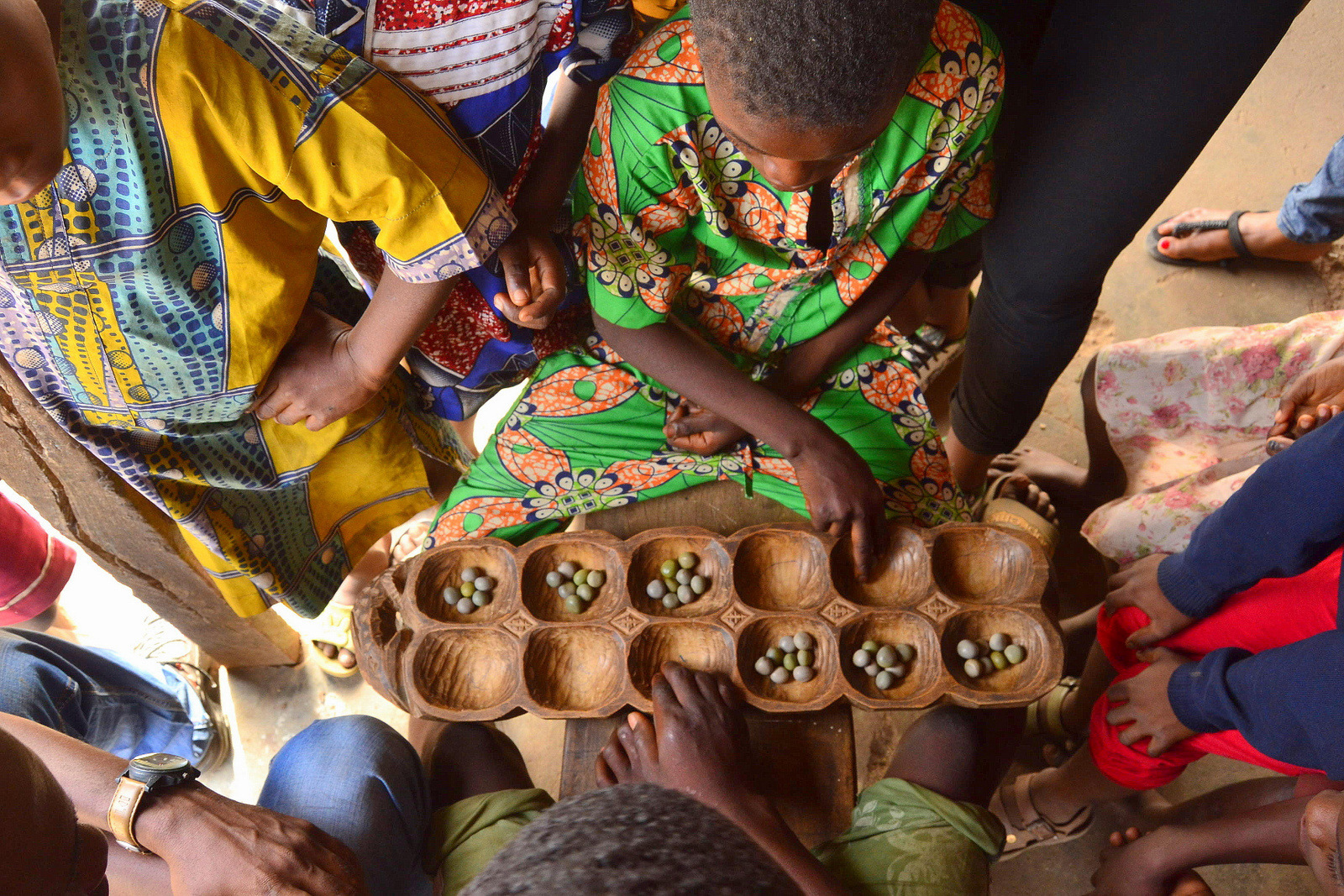
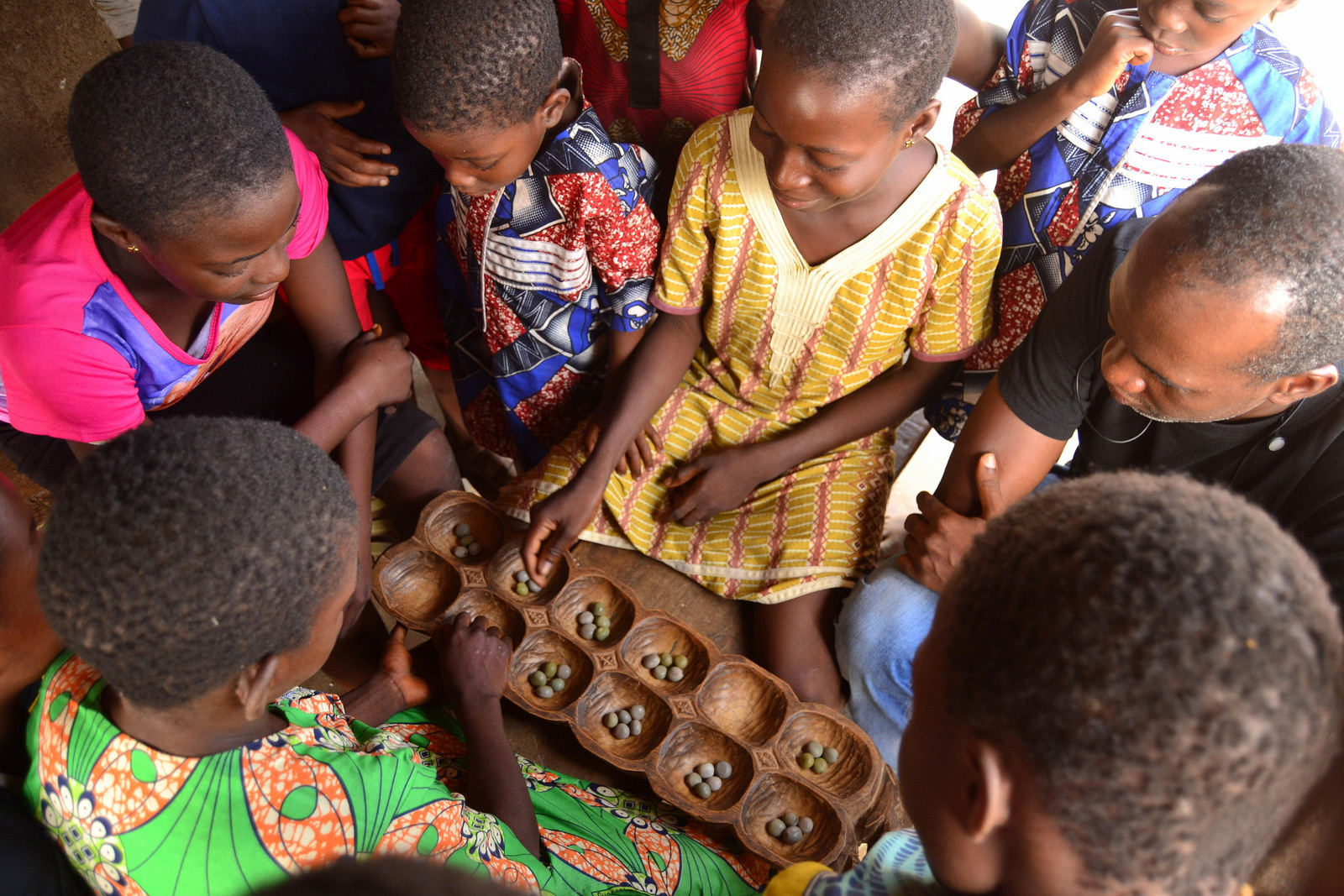
Children gather over a game of AyoOwn workWikimedia Commons · CC BY-SA 4.0
Ayò ọlọ́pọ́n is the classical Yorùbá two-row pit-and-pebbles board game, played with forty-eight seeds distributed across twelve pits, in which victory is determined entirely by arithmetic foresight, distributive sowing, and exact counting [S1, S8]. The game functions simultaneously as a rigorous arena of mental computation and as an embodied linguistic register, possessing a specialized vocabulary for every phase of play, board topology, tactical movement, and mathematical trap [S1, S10]. Beyond the Yorùbá homeland, cognate variations of this two-row count-and-capture game survived the Transatlantic slave trade, persisting across the Caribbean, South America, and West Africa under names such as Warri, Oware, and Awalé [S11, S21].
This file investigates the exact numerical and strategic vocabulary of ayò ọlọ́pọ́n, analyzes the counting talk and cognitive chunking of master players, examines the combinatorial complexity of the game as determined by modern computer science, and documents the historical and structural continuities across Atlantic diaspora variants. For board morphology, social rites, antiquity arguments, and foundational rules, see games-ayo-olopon [S1, S10]. For the structural derivation of the vigesimal base system and cowrie arithmetic, see language-numeracy-and-measurement [S3, S7, S9].
History and evolution
The historical trajectory of ayò ọlọ́pọ́n reflects the socio-political transformations of the Yorùbá world and its wider Atlantic sphere [S1, S5, S11].
Earliest record and archaeological context
The practice of two-row mancala games in the West African forest belt is attested archaeologically through rock-cut boards and ceramic gaming pits dating back many centuries, with comparative regional lithic evidence showing two-row configurations across West and Central Africa [S10, S21]. In Yorùbá oral traditions, ayò is depicted as an primordial art bestowed with cosmic wisdom (ọgbọ́n) and strategic acumen (ìmọ̀ràn), frequently referenced in sacred Odù Ifá poetry as an activity shared between kings, warriors, and divinities [S1, S5].
The classical Ọ̀yọ́ period
Under the expansion of the Ọ̀yọ́ Empire during the seventeenth and eighteenth centuries, ayò ọlọ́pọ́n became an elite court pastime as well as a popular civic engagement [S5, S10]. In Old Ọ̀yọ́ (Ọ̀yọ́-Ilé), the game was played in the outer courtyards of the Ààfin (palace) and at military encampments . Skill in ayò was regarded as an index of a commander's ability to calculate logistic risks, manage troop distributions, and execute strategic encirclement without falling victim to sudden attrition [S5, S10].
The nineteenth-century wars
During the nineteenth-century Yorùbá civil wars following the collapse of Ọ̀yọ́-Ilé, ayò ọlọ́pọ́n flourished in war camps (ibùdó ogun) such as Ibadan and Ijaye . Samuel Johnson records that prominent warlords and generals maintained portable carved boards (ọpọ́n ayò) in camp to test the wits of subordinates and relieve tension between campaigns . The rapid mental arithmetic demanded by the game mirrored the tactical maneuvers of field commanders navigating shifting alliances and localized skirmishes [S5, S10].
Missionary contact and early linguistic codification
With the arrival of Christian missionaries and the return of Sàró (liberated Yorùbá captives from Sierra Leone) in the mid-nineteenth century, ayò entered the written lexicographical record [S1, S2]. Samuel Ajayi Crowther documented core vocabulary items for the game in his seminal vocabularies of 1843 and 1852, providing definitions for the board, seeds, and verbs of play . Thomas Jefferson Bowen corroborated these lexical items in 1858, categorizing the game as one of the primary intellectual exercises of the people . Later in the century, Adolphus Mann analyzed the numerical underpinnings of Yorùbá trade and games before the Royal Anthropological Institute in 1886 to 1887 .
Colonial rule and ethnological documentation
Under British colonial administration in the early twentieth century, European ethnographers and linguists began systematic studies of West African games [S4, S8]. P. C. Kehoe, R. C. Abraham, and later H. J. R. Murray catalogued the exact capturing rules, sowing mechanics, and dialectal naming variations of ayò across southern Nigeria [S6, S8, S21]. Missionary and colonial observers frequently noted the astonishing speed of calculation displayed by illiterate traders and elders, marveling at their ability to compute complex modular distributions instantly without writing or counting physical pieces one by one [S3, S4, S10].
Independence, national sports festivals, and modern codification
Following Nigerian independence in 1960, ayò ọlọ́pọ́n was formally embraced as a national intellectual sport . It was standardized and integrated into the National Sports Festival, university intramural games, and state cultural competitions . Modern regulatory bodies, such as the Traditional Sports Federation of Nigeria (TSFN), established unified competition rules, chess-clock timing, and formal tournament brackets, bridging traditional street play with institutional athletics .
The Atlantic diaspora
Through the middle passage, enslaved Africans carried the mathematical rules and tactical principles of ayò across the Atlantic [S10, S11, S21]. The game survived in Antigua, Barbados, and across the Caribbean as Warri (or Wari), in the Guyanas as Awari, in Brazil as A-i-ú, and in Cuba among Afro-Cuban Lucumí communities [S10, S11, S21]. While physical wooden boards were often replaced by holes dug directly into Caribbean soil or carved from salvaged plantation timber, the sixty-four-millimeter seed counts, the two-by-six topological matrix, and the fundamental capture rules (àjẹjù, single-lap sowing, feeding requirements) remained identical [S10, S21].
+----------------------------------------------------------------------------+
|               HISTORICAL TRAJECTORY OF AYÒ ỌLỌ́PỌ́N                           |
+----------------------------------------------------------------------------+
| Archaic Era    : Lithic boards, Ifá oral corpus, cosmic strategy lore       |
| 17th-18th C.   : Ọ̀yọ́ imperial courts, military logistic training           |
| 19th C. Wars   : Ibadan war camps, military encampment recreation (Johnson) |
| 1843-1887      : Codification by Crowther, Bowen, and Adolphus Mann        |
| 20th C.        : Ethnological surveys (Murray, Abraham), diaspora study     |
| Post-1960      : Modern standardization, TSFN tournaments, national sports  |
| 1990s-Present  : Computational game theory solutions, AI solving (Bal)      |
+----------------------------------------------------------------------------+
The Mathematical Topography of the Board
The standard ayò board is a sculpted rectangular block of wood known as the ọpọ́n ayò (literally "the carved trough/tray of ayò", from ọpọ́n, tray or bowl, and ayò, the game) [S1, S8].
                    PLAYER B (North / Ọ̀tá)
             [ 12 ] [ 11 ] [ 10 ] [  9 ] [  8 ] [  7 ]
   [ Oju-ori ]                                         [ Oju-ori ]
    (Store)  [  1 ] [  2 ] [  3 ] [  4 ] [  5 ] [  6 ]   (Store)
                    PLAYER A (South / Olúwa)
             <--- Direction of Sowing (Counter-Clockwise)
The board contains twelve playing holes arranged in two parallel rows of six pits, flanked by two larger end compartments:
Ojú ayò (or ojú ọpọ́n, literally "the eyes of the board", from ojú, eye/aperture/surface, and ọpọ́n, wooden tray): The individual cylindrical or hemispherical depressions that hold the seeds during play [S1, S8].
Ilé (literally "house" or "home"): An alternative term for a pit on a player's own side of the board [S6, S8].
Orí ọpọ́n (or ojú-orí, literally "head of the tray"): The large outer carved basins at the extreme left and right ends of the board where captured seeds (ọmọ tí a jẹ) are stored until the final tally [S6, S8].
Ọmọ ayò (literally "children of ayò", from ọmọ, child/offspring): The forty-eight smooth, round, extremely durable seeds used as playing counters [S1, S8]. Botanically, these are the greyish or greenish seeds of the àyò plant, Caesalpinia bonduc (also classified as Guilandina bonduc) [S1, S8]. In the diaspora, these are often replaced by grey nicker nuts, marbles, or small sea pebbles [S11, S21].
The Lexicon of Action and Strategy
Every physical action and tactical concept in ayò ọlọ́pọ́n possesses a precise, monosyllabic or compound Yorùbá verb root [S1, S2, S6, S8].
+-------------------+----------------------------+------------------------------------+
| Yorùbá Term        | Literal Gloss               | Strategic Function in Play         |
+-------------------+----------------------------+------------------------------------+
| Ta (tá)            | to shoot / propel / cast    | To lift and sow seeds from a pit   |
| Jẹ (jẹ)            | to eat / consume            | To capture two or three seeds      |
| Ṣá (ṣá)            | to pick / gather up / slash | To scoop seeds out cleanly         |
| Pwọ́n / Pọ́n (pọ́n)    | to bank / accumulate        | To hoard seeds in a deep pit (ẹlẹ́) |
| Fún (fún)          | to give / feed              | To feed an empty opponent's row    |
| Bọ́ (bọ́)            | to nourish / drop into      | To supply a starving player        |
| Gbá (gbá)          | to sweep / strike           | To capture a cascading run of pits |
| Ró (ró)            | to click / resound          | The acoustic drop of a hard seed   |
| Pa (pa)            | to kill / strike down       | To defeat or capture decisive sets |
| Òpò (òpò)          | empty / shut-out / barren   | A total whitewash (24-0 / 48-0)    |
| Ẹlẹ́ (ẹlẹ́)          | the hoarded store           | A pit containing 12 or more seeds  |
+-------------------+----------------------------+------------------------------------+
Verbal categories of play
1. Ta (tá)
Etymology and Morphology: Monosyllabic verb root ta, carrying a High tone in transitive contexts [S1, S8].
Functional Meaning: "To play a move", "to sow seeds", or "to distribute pieces along the board" [S1, S8]. When a player reaches their turn, an onlooker or opponent says: Ta ayò rẹ ("Play your move") . The verb conveys rapid, precise manual dispatch.
2. Jẹ (jẹ)
Etymology and Morphology: Monosyllabic verb root jẹ, Mid tone [S1, S8].
Functional Meaning: "To eat", "to capture", or "to take possession of opponent counters" [S1, S8]. A capture occurs when the final seed sown lands in an opponent's pit containing one or two seeds, raising the total count to exactly two (èjì) or three (ẹ̀ta) [S6, S8]. The player "eats" (jẹ) those seeds and deposits them into their orí ọpọ́n .
3. Ṣá (ṣá)
Etymology and Morphology: Monosyllabic verb root ṣá, High tone [S1, S8].
Functional Meaning: "To gather up", "to lift", or "to scoop out" [S1, S8]. It denotes the decisive, sweeping hand motion of lifting all four, eight, or twelve seeds from a single pit before beginning the counter-clockwise distribution (ìtànkálẹ̀) [S6, S8].
4. Pwọ́n / Pọ́n (pọ́n)
Etymology and Morphology: Monosyllabic verb root pọ́n (in archaic Ọ̀yọ́ dialect orthography written pwọ́n), High tone [S1, S2, S8].
Functional Meaning: "To accumulate", "to hoard", or "to build up a massive reserve" [S1, S8]. It refers to deliberately allowing a single pit to accumulate a large number of seeds (ten, twelve, sixteen, or more) across multiple rotations, setting up a long-distance sweeping attack [S6, S8].
5. Gbá (gbá)
Etymology and Morphology: Monosyllabic verb root gbá, High tone [S1, S8].
Functional Meaning: "To sweep" or "to clear out in succession" [S1, S8]. If a player captures seeds in pit n, and the preceding pit (n-1) on the opponent's side also contains two or three seeds, that pit is captured as well in a retrograde sweep [S6, S8]. This cascading chain of multi-pit captures is termed gbá ayò ("sweeping the game") .
6. Fún (fún) and Bọ́ (bọ́)
Etymology and Morphology: Monosyllabic verb roots fún (to give) and bọ́ (to feed/nourish), both High tone [S1, S8].
Functional Meaning: "To feed the opponent" [S6, S8]. In standard Yorùbá ayò rules, if the opponent's entire row of six pits becomes empty (ṣófo), the active player is ethically and legally bound by the rules of the game to play a move that sows at least one seed into the opponent's territory, if such a move is possible [S6, S8]. Leaving the opponent without seeds when a feeding move exists constitutes an illegal move (ìréjẹ) [S6, S8].
Tactical Formations and Positional Nomenclature
Master players classify board configurations into named strategic states that describe accumulation, threat, equilibrium, and catastrophic loss [S6, S8, S10].
1. Ẹlẹ́ (Ẹ-lẹ́)
Etymology: Formed from the nominalizing prefix è- and the verb lẹ́ (to accumulate/exceed), yielding ẹlẹ́ (Mid-High tone) [S6, S8].
Meaning: A pit containing twelve or more seeds [S6, S8]. Because the board has twelve pits, sowing twelve seeds completes an entire circuit of the board, leaping over the original starting hole (which must remain empty during the distribution) and landing back in opponent territory [S6, S8]. An ẹlẹ́ represents a formidable long-range offensive weapon capable of hitting back-rank targets that the opponent thought were safe [S6, S10].
2. Òpò (Ò-pò)
Etymology: Formed with Low-Low tone, òpò signifies an empty vessel, a total dearth, or barrenness [S1, S8].
Meaning: A complete shut-out or zero-score defeat [S6, S8]. In competitive match play, if a player wins all forty-eight seeds or leaves the opponent with zero captures in a set, the loser is said to have suffered òpò [S6, S8]. The social stigma of òpò is intense: spectators taunt the loser with songs and proverbs celebrating their complete strategic obliteration .
3. Ọ̀tá (Ọ̀-tá)
Etymology: Nominal root ọ̀tá, Low-High tone, meaning "adversary" or "enemy" [S1, S8].
Meaning: The opponent sitting across the board [S1, S6]. Strategically, the six pits facing the player are ilé ọ̀tá ("the enemy's houses") .
4. Dọ́gbadọ́gba (Dọ́gba-dọ́gba)
Etymology: Reduplication of the verb dọ́gba (to be equal, High-Mid tone), meaning "exactly equal" [S1, S8].
Meaning: A draw [S6, S8]. A full game consists of forty-eight seeds. If both players capture exactly twenty-four seeds (ogún-ó-le-mẹ́rin), the match ends in dọ́gbadọ́gba [S6, S8].
The Mathematical Decision Rules: The Arithmetic of Capture
Ayò ọlọ́pọ́n is governed by strict numerical thresholds that determine capture conditions and game termination [S6, S8, S10].
+----------------------------------------------------------------------------+
|                     THE CAPTURE MATRIX IN AYÒ ỌLỌ́PỌ́N                        |
+----------------------------------------------------------------------------+
| Pre-landing Count : 1 seed   ---> Final Count: 2 seeds ---> CAPTURE (Èjì)   |
| Pre-landing Count : 2 seeds  ---> Final Count: 3 seeds ---> CAPTURE (Ẹ̀ta)   |
| Pre-landing Count : 3 seeds  ---> Final Count: 4 seeds ---> NO CAPTURE      |
| Pre-landing Count : 0 seeds  ---> Final Count: 1 seed  ---> NO CAPTURE      |
|                                                                             |
| Cascading Capture : If pit n captures, evaluate pit n-1 on opponent side.  |
| Termination Count : 24 vs 24 = Draw (Dọ́gbadọ́gba)                            |
| Winning Threshold : 25 or more captured seeds (Àjẹjù)                       |
+----------------------------------------------------------------------------+
The rule of two and three
A capture is strictly valid if and only if the final seed in hand lands in an opponent's pit and produces an exact total of either two (èjì) or three (ẹ̀ta) seeds [S6, S8]. If it produces four seeds (ẹ́rin), five seeds (àrún), or one seed (ọ̀kan), no pieces are taken [S6, S8].
The grand sweep and starvation prohibition
A critical arithmetic rule in classical Yorùbá ayò is the absolute prohibition against completely stripping an opponent of all pieces if the move immediately terminates the game without allowing the opponent a response, unless such a capture takes all remaining seeds and achieves the twenty-five-seed winning threshold (àjẹjù) outright [S6, S8, S10]. If a capture would leave the opponent with zero seeds on their side and zero legal moves, but the capturer has not yet attained twenty-five seeds, standard Yorùbá rules require that the capture be forfeited or the seeds left on the board to sustain the cycle of play [S6, S10].
Attested Number Lexicon in the Arithmetic of Play
The execution of ayò requires mastery of the counting registers of standard and dialectal Yorùbá [S1, S2, S3, S7, S9, S15]. Below is the verified number lexicon used in the tracking of board seeds, from one to forty-eight, showing historical spellings from missionary, colonial, and modern linguistic authorities.
Orthographic and morphological notes on numeral citations
Where sources diverge in phonological realization or dialectal derivation, both forms represent documented native usage [S3, S7, S9]:
For fifteen (15), Crowther (1852: 204) and Mann (1887: 62) document eédógún (from àrún-dín-lógún, literally "five subtracted from twenty") [S1, S3].
For twenty-four (24), the exact halfway mark of the forty-eight seeds, Abraham (1958: 462) records ogún-ó-le-mẹ́rin (literally "twenty plus four"), while standard vigesimal compounding also admits ẹẹ́rinlélógún [S7, S8, S9].
For forty-eight (48), the total seed count of the board, Armstrong (1962: 22) records oókàndínláàdọ́ta (literally "two subtracted from fifty", where fifty is ẹẹ́dọ́ta, or sixty less ten), while counting talk among players frequently uses ogòjì-ó-le-mẹ́jọ ("forty plus eight") [S7, S8, S10].
Counting Talk and Cognitive Chunking of Expert Players
Fieldwork by ethnomathematicians and cognitive anthropologists reveals that expert ayò players rarely count seeds one by one during a game [S10, S12, S15]. Instead, they employ specialized "counting talk" (ọ̀rọ̀ onka) and rapid visual perceptual chunking [S10, S12, S15].
+----------------------------------------------------------------------------+
|                      THE VISUAL SUBITIZING MATRIX                           |
+----------------------------------------------------------------------------+
| Physical Piles in Pit  | Visual Cluster Recognized  | Arithmetic Action     |
| 1 to 3 seeds           | Immediate subitizing       | Instant target/threat |
| 4 seeds                | Base equilibrium (Ìbẹ̀rẹ̀)   | Standard cycle step   |
| 6 to 8 seeds           | Bilateral half-cluster     | Mid-range sweep       |
| 12 seeds (Ẹlẹ́)         | Full-board lap (Yípo)      | Long-range lap hit    |
+----------------------------------------------------------------------------+
1. Rapid subitizing and seed patterns
Experienced players immediately recognize visual groupings of one, two, three, four, and six seeds within a pit without tactile counting [S10, S12]. A pit with four seeds (ẹ́rin) represents the resting base state (ìbẹ̀rẹ̀) [S6, S10]. A pit with one (ọ̀kan) or two (èjì) seeds is immediately flagged as a potential capture target (ojú tí ó ṣe é jẹ) [S6, S10].
2. Modulo-11 and Modulo-12 mental arithmetic
When an expert lifts a large cluster of seeds (such as an ẹlẹ́ containing sixteen seeds), the mental computation does not trace sixteen individual steps [S10, S12, S16]. The player calculates modulo-11 arithmetic: sixteen seeds will make one complete lap around the eleven remaining holes (16 minus 11 = 5), landing exactly five pits beyond the origin hole [S10, S16]. The player executes this mental projection in a fraction of a second before the hand even touches the seeds [S10, S12].
3. Taunting rhymes and distraction chants
In traditional settings, counting talk is accompanied by playful banter designed to unsettle the opponent's calculations . Players recite rhyming formulas as they sow, timing the release of seeds to rhythmic cadence:
Traditional ayò gaming verse
Original
Ayò l’à ń tá,
A kì í b’ayò jà;
Ẹni tí ó bá jẹ́kí á jẹ ẹ́,
Òun ní ń gb’ayò.
Literal gloss
Ayò [is what] we are playing,
We do not with ayò fight;
Person who allows that we eat him,
He is the one who wins ayò.
Idiomatic English
Ayò is what we play,
We do not fight over ayò;
The player who yields the seeds gracefully,
Is the true master of the game. (translated by O. B. Lawal, )
Notes on the translation
The verb b'ayò jà (literally "to fight with ayò") plays on the double meaning of physical quarreling and contentious, petty calculation. The line jẹ́kí á jẹ ẹ́ (literally "let us eat him") uses the standard capture verb jẹ to express tactical sacrifice: a master deliberately permits an opponent to capture small seeds in order to lure them into an inescapable ẹlẹ́ trap .
Proverbial commentary on ayò arithmetic
Original
A kì í kánjú tá ayò,
A kì í f’ojú kéré ọmọ ẹ̀fà. [S1, S5]
Literal gloss
We do not hurry play ayò,
We do not take eye look small child six.
Idiomatic English
One does not play ayò in a reckless rush,
Nor does one despise a pit holding six small seeds. (translated by Samuel Johnson, )
Notes on the translation
The phrase f'ojú kéré (literally "to look upon with small eyes") is a classical Yorùbá idiom for contemptuous underestimation. The "six seeds" (ọmọ ẹ̀fà) represent a critical accumulation that can cross the center line and sweep an opponent's flank in a single move [S5, S10].
Regional Names and Dialect Variations across Yorùbáland
While ayò ọlọ́pọ́n is the standard term across central and western Yorùbáland, distinct dialect areas historically employed specific designations for the board, seeds, and the game itself [S1, S8, S10].
+------------------+----------------------+----------------------+-------------------+
| Region / Dialect | Name of Game          | Name of Seeds        | Name of Board      |
+------------------+----------------------+----------------------+-------------------+
| Ọ̀yọ́ / Ìbàdàn     | Ayò Ọlọ́pọ́n           | Ọmọ ayò              | Ọpọ́n ayò           |
| Ẹ̀gbá / Ìjẹ̀bú     | Ayò                   | Ẹ̀sọ́ ayò / Ọmọ ayò    | Ọpọ́n ayò           |
| Èkìtì / Ìjẹ̀ṣà    | Àyò / Ọlọ́wàrẹ́        | Ọmọ àyò              | Apá àyò            |
| Òkùn (Kabba/Ìgbómìnà)| Ayò                | Ọmọ ayò              | Ọpọ́n-itá           |
| Àwórì / Lagos    | Ayò Ọlọ́pọ́n           | Ọmọ ayò              | Ọpọ́n ayò           |
+------------------+----------------------+----------------------+-------------------+
In eastern Yorùbá communities (Èkìtì and Ìjẹ̀ṣà), the name Ọlọ́wàrẹ́ (or Wàrẹ́) appears in archaic oral poetry, demonstrating a direct linguistic cognate with the Akan Oware (Ɔware) across the Dahomey gap in modern Ghana [S10, S11, S21].
Combinatorial and Computational Studies of Ayò and Its Relatives
Ayò and its two-row mancala relatives have served as primary testbeds in artificial intelligence, combinatorial game theory, and algorithmic complexity analysis [S13, S16, S17, S18, S19, S20].
+----------------------------------------------------------------------------+
|                      COMPUTATIONAL COMPLEXITY PROFILE                       |
+----------------------------------------------------------------------------+
| State-Space Complexity : 889,063,398,406 reachable positions (~8.89 x 10^11)|
| Game-Tree Complexity   : Estimated at 10^32 to 10^40                        |
| Game Classification    : Solved game (Weakly solved: perfect play is a DRAW)|
| Computational Method   : Parallel Retrograde Analysis on 144-node cluster   |
| Lead Investigators     : John W. Romein and Henri E. Bal (2002-2003)        |
+----------------------------------------------------------------------------+
1. The strong and weak solutions: Romein and Bal (2002, 2003)
The definitive computational solution of two-row twelve-hole mancala (specifically the standardized Awari/Ayò rules) was achieved by John W. Romein and Henri E. Bal at the Vrije Universiteit Amsterdam in 2002 [S17, S18].
State-space enumeration: Romein and Bal proved that the reachable state space consists of exactly 889,063,398,406 positions (approximately 8.89 × 10¹¹) [S17, S18].
Method: They deployed parallel retrograde analysis on a distributed cluster of 144 Pentium III processors, computing backwards from terminal endgame states across a 778-gigabyte shared database over fifty-one continuous hours of processing [S17, S18].
Theoretical result: They established that under perfect play from both sides, the game is an absolute draw (dọ́gbadọ́gba, 24-24) [S17, S18].
2. Game-tree search and heuristic engines: Allis, Dailey, and Rome
Prior to the full retrograde solution, Victor Allis analyzed the game-tree complexity of mancala variants in 1994, calculating that Awari/Ayò possesses a decision complexity comparable to draughts, with branching factors averaging between 3.5 and 5.5 legal moves per turn [S13, S16]. Don Dailey and Larry Rome developed competitive heuristic software (such as Deep Awalé and Marvin), utilizing min-max search with alpha-beta pruning and endgame database lookups to consistently defeat human masters [S16, S17].
3. Cognitive chunking and perception: Linhares (2007)
Cognitive scientist Alexandre Linhares investigated the pattern recognition systems of ayò masters compared to chess grandmasters . Linhares demonstrated that ayò expertise relies on chunking dynamic topological relationships: whereas chess pieces possess static movement geometries across fixed squares, ayò counters are fluid, homogeneous, and constantly shifting in quantity across cyclical loops . Master players chunk functional relationships (such as defending against an ẹlẹ́ build-up) through holistic board perception rather than brute-force serial calculation .
4. Mathematical combinatorics: Broline and Loeb (1995)
Duane M. Broline and Daniel E. Loeb investigated the combinatorics of mancala sowing sequences, establishing formal proofs for invariant properties under repetitive sowing algorithms . They proved that certain chip-firing and solitary mancala distributions (such as Tchoukaillon) converge deterministically to specific arithmetic limits related to harmonic numbers and the fractional approximation of transcendental constants .
Diaspora Forms and Transatlantic Continuities
The forced migration of enslaved Africans transported the rules, counting practices, and social functions of ayò to the Americas [S10, S11, S21].
+----------------------------------------------------------------------------+
|                    TRANSATLANTIC MANCALA CONTINUITIES                       |
+----------------------------------------------------------------------------+
| Variant Name   | Geography / Community   | African Substrate / Cognates     |
+----------------+-------------------------+----------------------------------+
| Ayò Ọlọ́pọ́n    | Yorùbáland (Nigeria)    | Baseline 2x6 board, 48 seeds     |
| Ɔware (Oware)  | Ghana (Akan / Ashanti)  | Abapa rules, 2x6 board, 48 seeds |
| Awalé (Awélé)  | Côte d'Ivoire (Baoulé)  | 2x6 board, 48 seeds, single lap  |
| Warri (Wari)   | Antigua, Barbados, Car. | Direct survival of 2x6 rules     |
| A-i-ú          | Bahia, Brazil (Nagô)    | Direct Yorùbá linguistic survival|
| Lucumí Gaming  | Matanzas / Havana, Cuba | Ritual and leisure Ifá nexus     |
+----------------+-------------------------+----------------------------------+
1. Oware (Ɔware) in Ghana
Among the Akan people of Ghana, the game is known as Ɔware (from the Twi verb ware, "to marry", based on the oral legend that a man and woman played the game endlessly until they decided to wed in order to continue playing) [S10, S11]. The competitive tournament form, Oware Abapa, shares an identical mathematical structure with Yorùbá ayò: twelve pits, forty-eight seeds, single-lap sowing, captures on two and three seeds, and the prohibition against starving an opponent [S10, S11, S21].
2. Warri (Wari) in the Caribbean
In the English-speaking Caribbean, particularly in Antigua and Barbuda, Barbados, and Dominica, the game is termed Warri [S10, S11]. Antigua is globally recognized as the Caribbean capital of Warri, maintaining active municipal leagues, street clubs, and international master tournaments [S10, S11]. Historical records confirm that enslaved Africans carved Warri boards into stone steps, wooden verandas, and hard coral rock [S10, S11, S21]. The technical rules in Antigua match the classical Yorùbá capture rules (àjẹjù) with absolute fidelity [S10, S21].
3. Awalé (Awélé) on the Francophone Coast
In Côte d'Ivoire, Benin, and Togo, the game is known as Awalé (or Awélé) among the Baoulé and neighboring populations [S11, S21]. Promoted extensively by the Mind Sports Olympiad and French mancala associations, Awalé uses the same 2×6 board geometry and forty-eight seed inventory [S17, S21].
4. Brazil: The Nagô survival of A-i-ú
In Bahia, Brazil, nineteenth-century records document the game under the name A-i-ú, played among Afro-Brazilian Nagô (Yorùbá) communities in Salvador [S11, S21]. The name A-i-ú represents a phonetic preservation of the Yorùbá phrase Ayò (or Ayò yíù) [S11, S21].
5. Cuba: Lucumí leisure and Ifá divination connections
In Cuba, enslaved Yorùbá populations known as Lucumí preserved both secular ayò play and sacred divination mathematics [S11, S21]. In Afro-Cuban religious households (cabildos and casas de santo), the manipulation of seeds (ikín) in Ifá divination trays (itá) maintained deep epistemological connections with the arithmetic counting techniques developed over the ọpọ́n ayò [S10, S11].
Pedagogical, Social, and Epistemological Significance
Within indigenous Yorùbá pedagogy (ẹ̀kọ́ ilé), ayò ọlọ́pọ́n served as a primary instrument of informal mathematical education [S10, S12, S15]. Long before colonial classrooms introduced Western pencil-and-paper arithmetic, Yorùbá children developed advanced mental agility through ayò [S3, S10, S15].
+----------------------------------------------------------------------------+
|                   PEDAGOGICAL DOMAINS OF AYÒ ỌLỌ́PỌ́N                         |
+----------------------------------------------------------------------------+
| Domain                 | Cognitive and Social Skill Cultivated             |
+------------------------+----------------------------------------------------+
| Mental Arithmetic      | Rapid addition, subtraction, and modulo partitions |
| Spatial Reasoning      | Topological tracking of cyclical distributions     |
| Ethical Restraint      | Feeding rules (bọ́), anti-starvation ethics         |
| Strategic Patience     | Long-term hoarding (ẹlẹ́) vs immediate capture     |
| Social Composure       | Bearing defeat without anger (omoluabi ethos)      |
+----------------------------------------------------------------------------+
As demonstrated by Helen Verran and S. A. Ekundayo, Yorùbá mathematics operates as an embodied, relational logic where quantities are continuously assembled, sorted, and redistributed [S9, S15]. Ayò ọlọ́pọ́n is not merely a game of diversion: it represents the physical incarnation of Yorùbá vigesimal and modulo computation, a living arena where language, mathematics, and strategic philosophy unite across centuries of continental practice and Atlantic diaspora continuity [S1, S3, S10, S15, S17].
Where e come from
[1]Samuel Ajayi Crowther, A Vocabulary of the Yoruba Language (London: Seeleys / Church Missionary Society, 1852), pp. 202-205.
[2]Thomas Jefferson Bowen, Grammar and Dictionary of the Yoruba Language (Washington, D.C.: Smithsonian Institution, 1858), pp. 71-74.
[3]Adolphus Mann, "Notes on the Numeral System of the Yoruba Nation," Journal of the Anthropological Institute of Great Britain and Ireland 16 (1887), pp. 59-64.
[4]Levi Leonard Conant, The Number Concept: Its Origin and Development (New York: Macmillan and Co., 1896), pp. 84-88.
[5]Samuel Johnson, The History of the Yorubas: From the Earliest Times to the Beginning of the British Protectorate, edited by Obadiah Johnson (London: Routledge & Kegan Paul, 1921), pp. 110-114, 234-236.
[6]P. C. Kehoe, "The Game of Ayo," The Nigerian Field 17, no. 2 (1952), pp. 73-76.
[7]Robert G. Armstrong, Yoruba Numerals (Ibadan: Oxford University Press for the Nigerian Institute of Social and Economic Research, 1962), pp. 11-26.
[8]Roy Clive Abraham, Dictionary of Modern Yoruba (London: University of London Press, 1958), pp. 68, 165-168, 462.
[9]S. A. Ekundayo, "Vigesimal Numeral Derivational Morphology: Yoruba Grammatical Competence Epitomized," Anthropological Linguistics 19, no. 9 (1977), pp. 436-453.
[10]Claudia Zaslavsky, Africa Counts: Number and Pattern in African Culture (Boston: Prindle, Weber & Schmidt, 1973), pp. 101-136.
[11]Harold James Ruthven Murray, A History of Board-Games Other Than Chess (Oxford: Clarendon Press, 1952), pp. 158-205.
[12]Alex de Voogt, "Mancala: Board Games and the Visual Arts," African Arts 30, no. 3 (1997), pp. 54-61.
[13]L. Victor Allis, Searching for Solutions in Games and Artificial Intelligence, Ph.D. dissertation (Vrije Universiteit Amsterdam, 1994), pp. 140-165.
[14]James R. Hurford, The Linguistic Theory of Numerals (Cambridge: Cambridge University Press, 1975), pp. 210-218.
[15]Helen Verran, Science and an African Logic (Chicago: University of Chicago Press, 2001), pp. 55-88.
[16]Don Dailey and Larry Rome, "Deep Awalé: Developing an Expert Mancala Player," ICCA Journal 21, no. 4 (1998), pp. 240-248.
[17]John W. Romein and Henri E. Bal, "Awari is Solved," ICGA Journal 25, no. 3 (2002), pp. 162-165.
[18]John W. Romein and Henri E. Bal, "Solving the Game of Awari Using Parallel Retrograde Analysis," Computer 36, no. 10 (2003), pp. 26-33.
[19]Alexandre Linhares, "A Glimpse at the Mind of a Master: Visual Chunking in Mancala Games," Cognitive Science 31, no. 4 (2007), pp. 601-628.
[20]Duane M. Broline and Daniel E. Loeb, "The Combinatorics of Mancala-Type Games: Ayo, Tchoukaillon, and 1/Pi," The UMAP Journal 16, no. 1 (1995), pp. 21-36.
[21]Philip Townshend, "Anthropological Approach to Mancala Games," Current Anthropology 20, no. 4 (1979), pp. 794-796.