Ìjẹ̀bú Aṣọ Olónà and Ìtàgbé Title Cloths in Òṣùgbó and Ògbóni Societies · Ìpilẹ̀ṣẹ̀
Ìjẹ̀bú Aṣọ Olónà and Ìtàgbé Title Cloths in Òṣùgbó and Ògbóni Societies
An analysis of Ìjẹ̀bú vertical-loom patterned title cloths and shoulder sashes, examining their supplementary-weft iconography, ritual roles in Òṣùgbó elderhood, and regional trade across coastal West Africa.
advancedhigh28 min read·26 sources
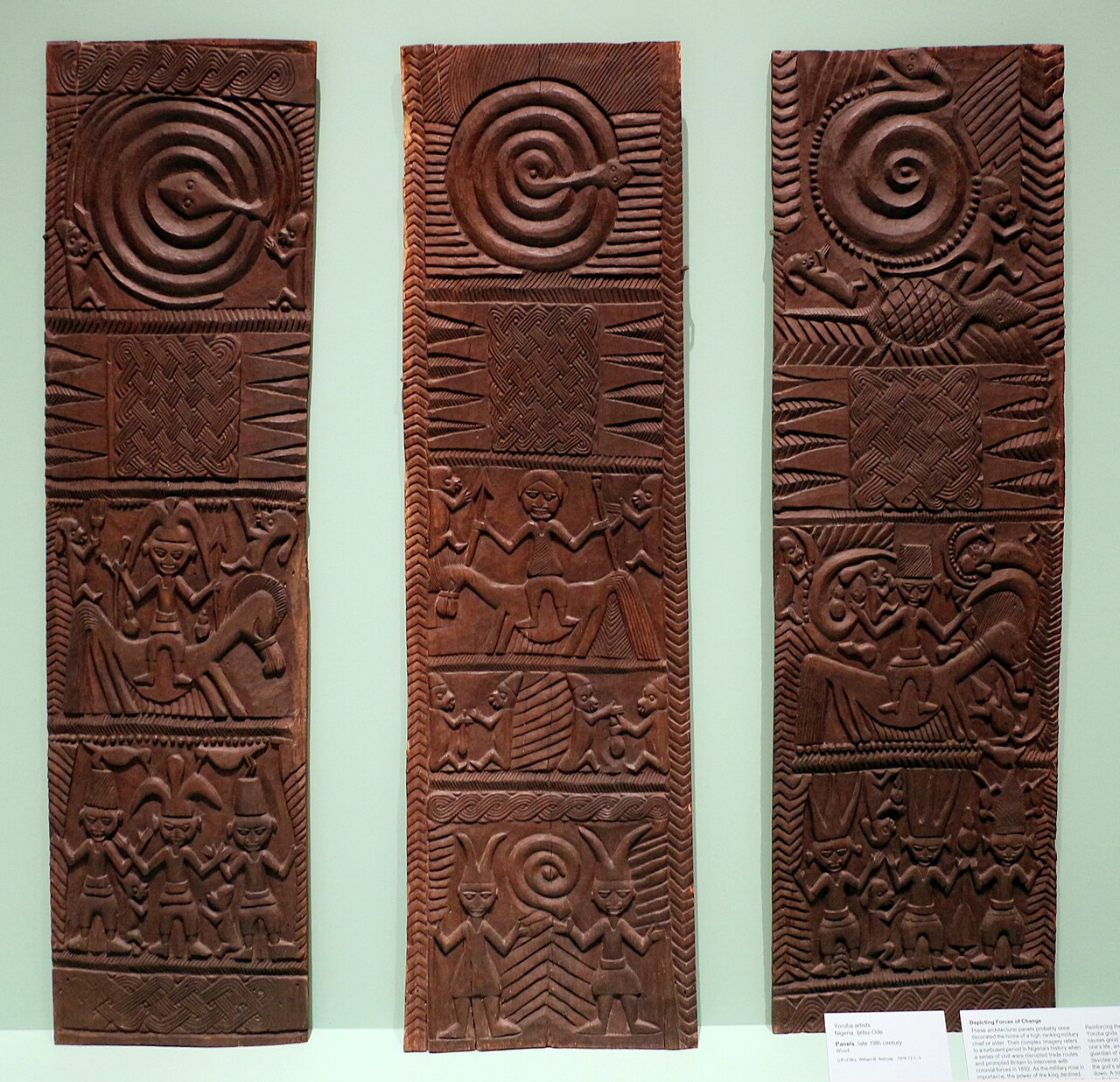
Nigeria, yoruba, pannelli, da ijebu-ode, 1890 caOwn workWikimedia Commons · CC BY 3.0
Aṣọ olónà is a prestige textile woven exclusively by women on vertical upright frame looms in the Ìjẹ̀bú region of southwestern Nigeria . Characterized by complex supplementary-weft float patterning and textured pile bands called ṣàkì, these cloths serve as sacred insignia of office, judicial emblems, and mortuary shrouds for titled elders within the Òṣùgbó society, known elsewhere in Yorùbáland as Ògbóni . The smaller single-panel format, known as ìtàgbé, is draped over the sacred left shoulder or worn as a turban by initiated elders during executive meetings, dispute adjudications, and royal installations . Beyond the Ìjẹ̀bú kingdom, these textiles were traded across coastal waterways for centuries, inspiring regional weaving traditions among the Ndoki and Akwete Igbo and assuming deep ritual value among the Ịjọ of the Niger Delta .
+==============================================================================+
|                       ÌJẸ̀BÚ AṢỌ OLÓNÀ TEXTILE TAXONOMY                      |
+==============================================================================+
|                                                                              |
|  1. ÌBÒRÙN ŃLÁ (Master Wrapper)                                              |
|     - Construction: 3 to 4 vertical panels hand-sewn selvedge-to-selvedge   |
|     - Dimensions: Approx. 160-180 cm wide by 200-250 cm long                 |
|     - Function: Toga-style formal wrapper for Olówo, Àpènà, and royal chiefs |
|     - Iconography: Full mythological narrative cycles, water spirits         |
|                                                                              |
|  2. ÌTÀGBÉ (Title Sash / Shoulder Cloth)                                     |
|     - Construction: Single panel, unwoven warp fringe divided into 7 tassels  |
|     - Dimensions: Approx. 35-45 cm wide by 120-150 cm long                   |
|     - Function: Worn over left shoulder (apá òsì) or folded as turban       |
|     - Texture: Alternating planar floats and plush looped pile (ṣàkì)        |
|                                                                              |
|  3. EXPORT VARIANTS (Coastal Trade & Emulation)                              |
|     - Ikakibite ("Cloth of the Tortoise"): Traded to Eastern Ịjọ lineages   |
|     - Akwete Emulations: Woven by Ndoki/Igbo women on extra-wide loom frames |
|     - Pano da Costa: Brazilian export variety conserved in Candomblé terreiros|
|                                                                              |
+==============================================================================+
Language, Morphology, and Etymology
The terminology surrounding Ìjẹ̀bú title textiles is grounded in indigenous visual taxonomy, structural metaphor, and ritual designation .
Aṣọ Olónà
The compound noun aṣọ olónà is derived from three morphemes:
aṣọ (noun): cloth, fabric, or woven textile .
oní- (prefix): owner, possessor, or entity characterized by the qualifying attribute, undergoing vowel assimilation to become ol- before ó .
Literally translated, aṣọ olónà means "cloth possessing patterns" or "cloth with designed pathways" . In Ìjẹ̀bú cultural semantics, ọ̀nà does not denote mere passive ornamentation. It signifies conscious artistic labor, codified esoteric knowledge, and the deliberate inscription of spiritual pathways across a physical medium .
Ìtàgbé
The noun ìtàgbé (low-mid-high tone) designates the specialized single-panel shoulder sash . Morphologically, it derives from the nominalizing prefix ì-, the verb root tà (to stretch out, extend, or project), and gbé (to carry, lift, or bear) . It conveys the physical action of extending and carrying the cloth upon the upper body . In judicial and ritual parlance within the Òṣùgbó lodge, ìtàgbé is frequently referred to by the metonym ṣàkì, identifying the cloth by its distinctive raised, plush pile texture .
The term ṣàkì (mid-low tone) refers literally to the reticulum or folded, textured inner stomach lining of a cow or other ruminant animal, prized in Yorùbá culinary culture for its honeycombed surface . Textile historians and local master weavers apply ṣàkì to the dense bands of raised, un-cut or cut looped-weft pile that interrupt flat-woven geometric registers on the face of the cloth . To an elder, wearing ṣàkì outward is a visual assertion of mature authority, spiritual endurance, and the capacity to digest complex communal disputes without losing emotional composure .
Loom Technology and Structural Mechanics
Unlike the narrow-strip double-heddle loom (ofi) operated exclusively by men throughout central Yorùbáland, aṣọ olónà and ìtàgbé are constructed on the upright vertical frame loom (ọ̀pá ìwun or ìwun), a tool traditionally owned and operated by women .
The vertical loom consists of four sturdy timber poles lashed together into a rigid rectangular frame propped at a slight angle against a wall or verandah post . The horizontal upper beam (ọ̀pá òkè) and lower beam (ọ̀pá ìsàlẹ̀) carry a continuous circular warp . The weaver sits on a low wooden stool before the loom, maintaining manual tension .
The mechanical components comprise:
Continuous Warp Mechanism: The warp threads wrap continuously around the top and bottom beams, allowing the weaver to shift the finished cloth downward and around the rear of the frame as work progresses .
Shed Stick (Ọ̀pá Ìyà): A flat wooden slat or smooth cane rod inserted between alternate warp threads to maintain the natural shed .
Single Heddle Rod (Ọ̀pá Ìfà or Ọ̀pá Ìwun): A wooden stick suspended horizontally across the warp plane, linked to individual alternate warp threads by string loops (àlọ́) . Pulling the heddle rod manually forward creates the counter-shed .
Sword Beater (Apasa): A heavy, polished hardwood blade used both to open and hold the shed and to beat each newly inserted weft pick firmly into the fell of the cloth .
The defining visual characteristic of aṣọ olónà is its supplementary-weft float patterning . While the structural ground weave is a balanced plain weave executing a stable foundation of hand-spun, unbleached white or indigo-dyed cotton, supplementary pattern yarns are introduced during weaving .
The weaver uses a pointed wooden pick or bone stylus (ẹgún) to manually count and separate specific warp threads . She passes the supplementary weft across the face of the cloth, floating it over predetermined bundles of three, five, or seven warp ends before catching it beneath a single warp thread . When viewed from the reverse side, the design appears in negative or as isolated tie-down points, while the face presents bold, relief-like figurative patterns .
Historically, ground yarns were spun from local white cotton (òwú tútù) and dyed with locally fermented indigo (ẹlu), while supplementary floats utilized rich crimson threads (aláàárì) unraveled from trans-Saharan silk or trade wool, alongside yellow and deep blue vegetal-dyed cottons .
The Structural Formation of Ṣàkì (Pile Tufting)
To create the plush ṣàkì registers, the weaver introduces a supplementary pick of thick, un-spun cotton rovings or bundled yarns into an open shed . As she progresses across the warp plane, she lifts loops of this heavy yarn outward between adjacent warp threads, wrapping each loop around a smooth wooden gauging rod or her fingers to establish an even pile height . Once a row of loops is secured, she weaves several plain-weave ground picks across the width and beats them down forcefully with the apasa to lock the loops in place .
Depending on the specific sub-regional style within Ìjẹ̀bú-Òde or Ìjẹ̀bú-Ife, these loops may be left intact as continuous rounded tufts or sliced with a sharp knife to create a dense, velvety brush of severed fiber ends .
Every authentic ìtàgbé terminates at both ends in a fringe divided into seven distinct tassels . As the weaver approaches the completion of the warp, she leaves six vertical slits open by reversing the plain-weave ground weft across seven separate warp sections rather than running the shuttle across the total width .
When the textile is cut from the loom frame, the exposed warp ends within each of the seven sections are tightly bound, braided, or wrapped with colored supplementary yarns, producing seven pendant tassels (ìpèsè or ìtélẹ̀) .
Iconography and Cosmological Semantics
The visual repertoire of aṣọ olónà is not decorative abstraction. It functions as an ideographic and symbolic script (àrokò) encoding Ìjẹ̀bú cosmology, royal authority, earth veneration, and the spiritual beings inhabiting the coastal forest lagoons . Lisa Aronson documented fourteen distinct primary motifs across Ìjẹ̀bú title textiles, each operating within a shared system of religious referents .
+==============================================================================+
|                     PRIMARY MOTIFS OF ÌJẸ̀BÚ AṢỌ OLÓNÀ                       |
+==============================================================================+
| Motif Name (Yorùbá) | English Gloss         | Cosmological / Ritual Meaning |
+---------------------+----------------------+-------------------------------+
| Ọ̀nì                 | Crocodile             | Mastery of dual realms (water |
|                     |                       | and earth); judicial vigilance|
+---------------------+----------------------+-------------------------------+
| Ọ̀pọ̀lọ́                | Frog / Toad           | Fertility, continuous renewal,|
|                     |                       | secret vitality of the earth  |
+---------------------+----------------------+-------------------------------+
| Ejò                 | Snake / Python        | Primordial continuity, Òṣùmàrè|
|                     |                       | cosmic transition, royal wrath|
+---------------------+----------------------+-------------------------------+
| Ẹja                 | Fish (Mudfish/Catfish)| Olókun/Erinlẹ̀ water spirit,  |
|                     |                       | navigation of unseen depths   |
+---------------------+----------------------+-------------------------------+
| Agẹmọ               | Chameleon             | Ìjẹ̀bú national deity; supreme |
|                     |                       | adaptability and transformation|
+---------------------+----------------------+-------------------------------+
| Ọ̀tẹ̀                 | Figure with Raised    | Òṣùgbó elder displaying the   |
|                     | Arms (Human Form)     | sign of salutation and secret |
+---------------------+----------------------+-------------------------------+
| Wàláà               | Quranic Writing Board | Protection, talismanic power, |
|                     |                       | incorporation of sacred texts |
+==============================================================================+
The prominent presence of amphibious and aquatic creatures reflects the geography and indigenous theology of the Ìjẹ̀bú kingdom, situated across an intricate network of lagoons, mangrove swamps, and coastal rivers .
The Crocodile (Ọ̀nì): Rendered in geometric plan view with a cross-hatched belly and extended limbs, the crocodile represents the supreme amphibious predator capable of navigating both the terrestrial realm of humans (ayé) and the aquatic realm of spirits (odò/omi) . Within Òṣùgbó philosophy, the crocodile exemplifies the judicial elder: patient, silent beneath the surface, but possessing swift and unyielding strength when justice must be enforced .
The Frog (Ọ̀pọ̀lọ́): Associated with the cool, generative properties of wet soil, the frog symbolizes regeneration, secret fertility, and the capacity of the Earth goddess (Ilẹ̀) to bring forth life . The sudden emergence of frogs during rains is equated with the unexpected revelation of truth during judicial trials held within the ilédì (Òṣùgbó lodge) .
The Mudfish (Ẹja Àrọ̀): The mudfish, capable of surviving buried in desiccated river mud through the dry season, signifies endurance, indestructibility, and safe passage between contradictory states of existence . It also directly references the river deity Erìnlẹ̀ and the marine deity Olókun, foundational spiritual forces in southern Yorùbá religious ecology .
The Chameleon (Agẹmọ)
The chameleon is the central emblem of the Ìjẹ̀bú people and the sacred animal of the deity Agẹmọ, whose annual festival unites the decentralized towns of Ìjẹ̀bú under the paramount authority of the Awùjalẹ̀ of Ìjẹ̀bú-Òde . On aṣọ olónà, the chameleon is depicted with curled tail and angled limbs . In Yorùbá thought, the chameleon possesses deliberate movement, total vision through independent eyes, and the unique ability to match any color in the natural world without losing its underlying nature . This animal represents the pinnacle of diplomatic wisdom, self-restraint (ìkóra-ẹni-níjànú), and sacred statecraft required of kings and Òṣùgbó title-holders .
Anthropomorphic Forms and Gesture (Ọ̀tẹ̀)
Certain aṣọ olónà depict stylized human figures with upraised arms, flexed elbows, and spread legs . This posture replicates the classical Ògbóni greeting and ritual gesture (ọwọ́ òsì lórí ọwọ́ ọ̀tún, placing the left fist over the right with thumbs tucked) performed during secret greetings and invocations before the ẹdan brass staves . These human silhouettes represent either the primordial ancestors of the lodge or the initiate standing naked of deceit before the Earth .
               NUMEROLOGICAL ARCHITECTURE OF ÌTÀGBÉ

                           Number Three (3)
                   Sacred to Earth and Òṣùgbó
                   (Mysterious, Female, Inward)
                                +
                           Number Four (4)
                   Sacred to King and Society
                   (Visible, Male, Outward)
                                ||
                           Number Seven (7)
                 Completeness, Covenant, Balance
                 (Manifested in the 7 Warp Tassels)
Talismanic Geometric Patterns and Writing Boards
In addition to zoomorphic imagery, master weavers incorporate dense geometric fields composed of interlocking rhombuses, zig-zags, diagonal meanders, and the rectangular form of the wàláà (Islamic wooden slate used in Quranic education) . The incorporation of the wàláà motif, which entered southern Yorùbá visual culture through trade with northern Islamic centers, was stripped of strictly Islamic doctrinal meaning and adopted as an esoteric talismanic motif (àrokò) representing concentrated wisdom, recorded knowledge, and spiritual protection against malevolent witchcraft (àjẹ́) .
Ritual, Judicial, and Mortuary Contexts in Òṣùgbó
The Òṣùgbó society (the Ìjẹ̀bú counterpart of the central Yorùbá Ògbóni) is the supreme judicial, civic, and earth-venerating council of elders . While kingship (oba) represents temporal executive authority, Òṣùgbó represents the ultimate sovereignty of the Earth (Ilẹ̀) and ancestral consensus . No Ìjẹ̀bú king can be crowned, rule effectively, or be laid to rest without the ritual sanction, mediation, and active participation of the Òṣùgbó lodge . Within this institutional framework, aṣọ olónà and ìtàgbé operate as the material skin of governance .
+==============================================================================+
|                      RITUAL PROFILE: ÒṢÙGBÓ USE OF CLOTH                    |
+==============================================================================+
| Title Holder       | Cloth Combination       | Placement & Ceremonial Role  |
+-------------------+-------------------------+------------------------------+
| Olówo (High Priest)| Ìbòrùn Ńlá Wrapper +   | Wrapper over body; primary   |
|                    | Dual Ìtàgbé Sashes      | ìtàgbé on left shoulder;     |
|                    |                         | secondary ìtàgbé as turban   |
+-------------------+-------------------------+------------------------------+
| Àpènà (Spokesman & | Ìbòrùn Ńlá Wrapper +   | Draped over left shoulder;   |
| Chief Magistrate)  | Ìtàgbé Sash + Ẹdan Staves| carries official voice of    |
|                    |                         | the sacred earth chamber     |
+-------------------+-------------------------+------------------------------+
| Ìwàrẹ̀fà (Inner     | Matching Ìtàgbé Sashes  | Worn on left shoulder during |
| Council of Six)    |                         | closed executive sessions    |
+-------------------+-------------------------+------------------------------+
| Erelú (Senior Female| Ìbòrùn Wrapper worn as | Wraps torso; holds veto and  |
| Initiate)          | chest-cloth + Ìtàgbé    | spiritual balance for women  |
+==============================================================================+
               THE SACRED PLACEMENT OF THE ÌTÀGBÉ

                    (Crown / Head: Orí)
                            |
                     [Turbanned Ìtàgbé]
                     (Worn on head by Olówo)
                            |
                 +----------+----------+
                 |                     |
          LEFT SHOULDER          RIGHT SHOULDER
           (Apá Òsì)               (Apá Ọ̀tún)
         [SACRED REALM]          [PROFANE REALM]
                 |
         [Ìtàgbé Placed Here]
         - Covers the heart
         - Protects the left flank
         - Connects to Earth/Ancestors
         - Accompanies Ẹdan staves
The Sacred Left Side (Apá Òsì)
In standard Yorùbá etiquette, the right hand (ọwọ́ ọ̀tún) is the hand of public interaction, eating, giving, and social greeting, while the left hand (ọwọ́ òsì) is private, reserved for hygiene and occult work . Within Òṣùgbó, however, this valuation is inverted: the left is the sacred, esoteric side . The left hand is used to make secret salutations, to handle the bronze ẹdan staves, and to pour libations directly onto the bare earth .
Correspondingly, an initiated elder must wear the ìtàgbé draped across the left shoulder (apá òsì), letting the patterned body and seven tassels fall across the chest and back . Placing the cloth over the left shoulder establishes a ritual boundary, insulating the elder's heart and left flank from spiritual attack while signaling to all initiates that the wearer is under the inviolable covenant of the Earth .
Judicial Adjudication and Investiture
When the Òṣùgbó inner council of six senior elders (the Ìwàrẹ̀fà) convenes in the ilédì to judge capital offenses, land disputes, or sacrilege against the land, all members must appear in their prescribed cloths . The presence of aṣọ olónà and ìtàgbé is essential to validate the legal process .
During judicial deliberations:
The Àpènà holds the ẹdan staves against his chest, with his ìtàgbé resting beneath the bronze chains .
A witness or accused party testifying before the assembly is made to swear upon the bare earth while touching the fringe of the presiding elder's ìtàgbé .
If an elder is found guilty of betraying lodge secrets (dá ilẹ̀, literally "breaking or betraying the earth"), his ìtàgbé is formally stripped from his shoulder by the Àpènà, stripping him of titled identity, legal protection, and social status .
Mortuary Rites and Ancestral Transition
The most profound spiritual duty of aṣọ olónà occurs at death . When a senior Òṣùgbó elder dies, the physical body must be sanctified and prepared by fellow initiates in secret before public mourning can commence .
The deceased elder is washed with consecrated herbal infusions and dressed in four full-width panels of aṣọ olónà sewn together into an ìbòrùn ńlá wrapper . The elder's personal ìtàgbé is laid across the chest or tied around the head . The corpse is then laid in state on a high ceremonial funeral bed entirely draped with master-woven aṣọ olónà textiles .
In Ìjẹ̀bú belief, the intricate weft-float motifs serve as an ancestral passport: the water spirits, chameleons, and sacred emblems woven into the cloth allow the deceased soul (ẹ̀mí) to navigate the dangerous spiritual waters separating the living community from the ancestral realm (ọ̀run) without being captured by wandering spirits .
Canonical Oral Literatures and Translations
The philosophical principles governing cloth, social identity, and Òṣùgbó authority are preserved in Yorùbá oral literatures, including proverbs (òwe), praise poetry (oríkì), and Ifá divination verses (ẹsẹ̀ Ifá) .
Proverb on Cloth as the Human Matrix
Yorùbá:
Ènìyàn l'aṣọ mi;
Bí mo bá bojú-wẹ̀yìn tí mo r'ẹ́ni mi,
Inú mi a dùn, ara mi a yá gágá;
Nítorí aṣọ kì í dá ààbò bo ènìyàn bí ẹbí tòótọ́.
Literal gloss:
Human-beings | are-cloth | of-me;
If | I | should | look-face-backward | that | I | see-people | of-me,
Belly/inside | of-me | will | sweeten, | body | of-me | will | quicken | firmly;
Because | cloth | not | habitual | cast | protection | cover | person | like | family | true.
Idiomatic English:
People are my true clothing;
When I look behind me and see my kin standing near,
My inner heart rejoices and my whole body surges with life;
For no woven fabric can shelter a human being as completely as true kin.
(Translated by Rowland Abiodun, 2014) [S7]
Analytical Commentary and Notes on Translation
The proverb contrasts physical textiles with the social fabric of family, lineage, and institutional fellowship . While aṣọ is the highest material mark of honor (iyì), the aphorism reminds the listener that clothing is ultimately an outward metaphor for human solidarity . The phrase inú mi a dùn (literally "my interior will sweeten") uses the viscera (inú) as the locus of emotional and moral truth, a standard feature of Yorùbá psychological vocabulary .
Verses on the Ìtàgbé of the Òṣùgbó Elders
Yorùbá:
Àpènà ní ń gbé'tàgbé b'apá òsì,
A kì í f'apá ọ̀tún gbé ṣàkì wọ ilédì.
Ilẹ̀ mọ̀ wá, Ilẹ̀ mọ̀ wọ́n,
Ẹni tó da'lẹ̀ a b'aṣọ rẹ̀ lọ s'ísà òkú.
Literal gloss:
Àpènà | is | he-who | carries-ìtàgbé | cover-arm | left,
We | not | habitual | use-arm | right | carry | ṣàkì | enter | house-of-the-covenant (ilédì).
Earth | knows | us, | Earth | knows | them,
Person | that | betrays-earth | will | with-cloth | of-him | go | to-pit | dead (grave).
Idiomatic English:
It is the Àpènà who drapes the sacred ìtàgbé over his left shoulder,
No initiate enters the council lodge carrying the tufted cloth upon the right.
The Earth knows us, and the Earth knows them,
Whoever betrays the covenant of the Earth shall descend with his stripped cloth into the pit of the dead.
(Field transcription and translation by Lisa Aronson, 1992, adapted with diacritics) [S1]
Analytical Commentary and Notes on Translation
This liturgical formula explicitly enforces the ritual rule governing the left shoulder (apá òsì) . The verb phrase da'lẹ̀ (derived from dá, to break or betray, and ilẹ̀, the earth) constitutes the ultimate moral crime in Yorùbá jurisprudence: breaking a sacred oath sworn before the community and the earth . The pun between aṣọ (cloth), ìsà (grave), and ilẹ̀ (earth) creates a sonic resonance that reinforces the consequence of ostracism: stripped of his title cloth, the traitor enters the earth naked and without honor .
Trade, Dispersal, and Trans-Ethnic Transmutations
Rather than remaining confined to the Ìjẹ̀bú heartland, aṣọ olónà served as one of the most prestigious commercial and diplomatic commodities along the West African coast from the late fifteenth century through the late nineteenth century .
+==============================================================================+
|                 REGIONAL DISPERSAL ROUTES OF ÌJẸ̀BÚ CLOTH                     |
+==============================================================================+
|                                                                              |
|  [ÌJẸ̀BÚ-ÒDE & ÌJẸ̀BÚ-IFE]  (Primary Weaving Centers: Women's Upright Broadloom)
|            |                                                                 |
|            +----> Coastal Lagoon Waterways (Eastward Trade)                  |
|            |         |                                                       |
|            |         v                                                       |
|            |   [NIGER DELTA / EASTERN ỊJỌ]                                   |
|            |   - Known as Ikakibite ("Cloth of the Tortoise")                |
|            |   - Adopted as royal regalia in Kalabari, Nembe, and Bonny      |
|            |   - Displayed in Ebi-Kare funerary chambers                     |
|            |         |                                                       |
|            |         v                                                       |
|            |   [NDOKI & AKWETE IGBO EMULATION]                               |
|            |   - Master weaver Dada Nwakwata copies motifs (c. 1880s)        |
|            |   - Woven on extra-wide continuous warp vertical looms          |
|            |                                                                 |
|            +----> Transatlantic Slave & Merchant Trade (Westward/Atlantic)   |
|            |         |                                                       |
|            |         v                                                       |
|            |   [BAHIA, BRAZIL (AFRO-ATLANTIC DIASPORA)]                      |
|            |   - Known as Pano da Costa ("Cloth from the Coast")             |
|            |   - Conserved in Candomblé terreiros by initiated mães-de-santo |
|            |                                                                 |
|            +----> Kingdom of Benin (Edo)                                     |
|                      |                                                       |
|                      v                                                       |
|                [BENIN CITY]                                                  |
|                - Traded as Ukpọ-Ẹbọ (Ritual / Medicine Cloth)                |
|                - Used in royal palace shrines and Olokun priesthood rituals  |
|                                                                              |
+==============================================================================+
The Eastern Ịjọ and the Concept of Ikakibite
Through trade networks traversing the coastal lagoon system eastward from Lagos, Lekki, and Epe to the Niger Delta, Ìjẹ̀bú textiles were purchased in great quantities by Eastern Ịjọ communities (including the Kalabari, Nembe, and Grand Bonny) .
Among the Ịjọ:
The cloth was renamed ikakibite (literally "cloth of the tortoise", from ikaki, tortoise, and bite, cloth) .
The Ịjọ reinterpreted the Ìjẹ̀bú crocodile (ọ̀nì) and chameleon (agẹmọ) motifs through their own folklore, identifying the central figure as Ikaki, the mythical tortoise trickster hero who embodies cunning, survival, and deep political intellect .
Ikakibite became mandatory royal attire for paramount chiefs (amanyanabo) and a central element in ebi-kare (the elaborate funerary display chambers constructed to honor deceased lineage heads) .
In the late nineteenth century, Ndoki Igbo women in the commercial crossroads town of Akwete (in present-day Abia State) observed the high prices paid by Ịjọ traders for Ìjẹ̀bú aṣọ olónà . A legendary Akwete master weaver named Dada Nwakwata (active c. 1870-1910) analyzed the structural construction of imported Ìjẹ̀bú cloths, deconstructed the supplementary-weft float technique, and began replicating the motifs on an expanded vertical loom frame .
Akwete weavers adapted the Ìjẹ̀bú aesthetic in several specific ways:
They widened the loom to weave single wrappers over one meter in width, eliminating the need to hand-sew multiple panels together .
They incorporated brightly colored imported machine-spun cotton, rayon, and European silk yarns, resulting in high-contrast multicolored versions of the ikaki motif .
They transformed what was originally an initiate-controlled sacred cloth into a thriving, entrepreneurial commercial textile industry that supplied delta royalty and southern Nigerian elite women with prestige fashion .
The Kingdom of Benin (Ukpọ-Ẹbọ)
Documented trade between Ìjẹ̀bú and the Kingdom of Benin dates back to at least the late fifteenth century, when Portuguese chroniclers recorded the sale of fine Ìjẹ̀bú cotton textiles in the port of Ughoton for onward transit to Benin City and the Gold Coast (Elmina) . In the Edo court of Benin, Ìjẹ̀bú aṣọ olónà was classified as ukpọ-ẹbọ (cloth of medicine or sacred spiritual power) . Edo chiefs and Olokun priestesses draped these textiles across shrine altars and wore them during purification ceremonies, honoring the protective amphibious deities woven across the cotton surface .
The Transatlantic Diaspora: Pano da Costa in Bahia
Between the seventeenth and nineteenth centuries, thousands of Ìjẹ̀bú and neighboring Yorùbá captives were transported across the Atlantic to Salvador da Bahia, Brazil . Throughout the transatlantic trade, hand-woven blue-and-white and supplementary-weft textiles from the Nigerian coast were shipped directly to Brazilian ports, where they were known in Portuguese as pano da costa (cloth from the African coast) .
In Bahia, pano da costa became an indispensable emblem of spiritual authority in the Candomblé Ketu and Candomblé Jeje traditions . Initiated priestesses (mães-de-santo and iaôs) wear the cloth wrapped tightly above the breasts (pano de peito) or over the left shoulder during ritual ceremonies, directly preserving the protective function and directional placement of the Ìjẹ̀bú ìtàgbé across centuries of diaspora dislocation .
Scholarly Debates and Historiographical Divergences
Scholarly investigation into aṣọ olónà and ìtàgbé reveals critical disagreements regarding motif origins, institutional ownership, and historical gender divisions of labor .
+==============================================================================+
|                      KEY SCHOLARLY DISAGREEMENTS                             |
+==============================================================================+
| Issue              | Position A                            | Position B      |
+-------------------+---------------------------------------+----------------+
| Iconographic       | Water Spirit Primacy                  | Earth / Òṣùgbó  |
| Primary Referent   | (Lisa Aronson): Motifs originate in   | Primacy (Local  |
|                    | lagoon spirits (*ọ̀rọ̀/owu*); later     | Elders / Lawal):|
|                    | incorporated into Òṣùgbó statecraft   | Motifs derive   |
|                    | as coastal trade expanded [S1].       | from Earth (Ilẹ̀|
|                    |                                       | & Onílẹ̀) roots|
|                    |                                       | of Òṣùgbó [S3]. |
+-------------------+---------------------------------------+----------------+
| Gender of Weavers  | Exclusively Female Tradition          | Former Male Use |
| in Early History   | (John Picton, Colleen Kriger):        | (Aronson, local |
|                    | Vertical broadloom in southern Nigeria| oral memory):   |
|                    | has always been women's exclusive     | Men wove on the |
|                    | domestic technology [S2][S10].        | vertical frame  |
|                    |                                       | before 19th c.  |
|                    |                                       | wars [S1].      |
+-------------------+---------------------------------------+----------------+
| Seven Tassels      | Royal Numerology                      | Sacred Geometry |
| Symbolic Meaning   | (Aronson): Represents the Awùjalẹ̀   | (Initiate Lore):|
|                    | and six subordinate crowned kings of  | Represents 3    |
|                    | the Ìjẹ̀bú realm [S1].                 | (female/earth) +|
|                    |                                       | 4 (male/sky) [S3|
+==============================================================================+
The Water Spirit vs. Earth Deity Debate
Lisa Aronson argued that the primary visual lexicon of aṣọ olónà originated not in the terrestrial Òṣùgbó secret society, but in coastal water-spirit veneration (ọ̀rọ̀ and owu) common across the lagoon systems connecting Ìjẹ̀bú-Òde with the Niger Delta . According to Aronson, the predominance of crocodiles, mudfish, pythons, and frogs demonstrates that the textile was initially designed to propitiate marine spirits for safe waterway commerce, only later being co-opted by the Òṣùgbó political hierarchy as an elite prestige insignia .
Conversely, indigenous Òṣùgbó elders, supported by art historian Babatunde Lawal and anthropological field researchers, maintain that the iconography is indivisible from the primordial veneration of Mother Earth (Ilẹ̀) . In their reading, the amphibious creatures were selected precisely because they rest their bodies directly upon the damp soil, serving as direct intermediaries between the visible terrestrial surface and the hidden depths where ancestral spirits and Onílẹ̀ (the Owner of the Earth) reside . The disagreement remains active, with museum catalogues presenting both views without synthetic resolution .
The Question of Pre-Colonial Loom Gender Divisions
Conventional African textile historiography (established by Venice and Alastair Lamb, John Picton, and John Mack) asserts a strict gender divide in Nigerian weaving: men operate the horizontal narrow-strip double-heddle loom (ofi), while women operate the vertical single-heddle broadloom frame (ọ̀pá ìwun) .
However, Aronson recorded oral testimonies among senior elder lineages in Ìjẹ̀bú-Òde asserting that prior to the nineteenth-century civil wars, young men and titled male initiates also wove on the vertical frame loom to produce their own sacred lodge regalia . Colleen Kriger and Duncan Clarke express caution regarding these claims, noting that no nineteenth-century European merchant journal, missionary record, or archaeological textile deposit corroborates male operation of the upright broadloom in southern Yorùbáland . They suggest instead that oral accounts may reflect male ownership and ritual commissioning of the looms rather than physical manual weaving .
History and Evolution
The chronological trajectory of Ìjẹ̀bú title weaving reflects continuous structural adaptation through imperial rivalries, civil warfare, colonial conquest, Christianization, and modern institutional reorganization .
+==============================================================================+
|                     CHRONOLOGY OF ÌJẸ̀BÚ TITLE CLOTH HISTORY                 |
+==============================================================================+
| Date / Era          | Major Historical Development & Textile Impact         |
+---------------------+-------------------------------------------------------+
| c. 1485-1500s       | Portuguese merchants purchase Ìjẹ̀bú cloth at Ughoton;|
|                     | Pacheco Pereira describes coastal trade networks [S17]|
+---------------------+-------------------------------------------------------+
| 17th, 18th Century   | Ọ̀yọ́ Empire expands inland; Ìjẹ̀bú maintains coastal |
|                     | monopoly; elite *aṣọ olónà* established in Òṣùgbó [S15]|
+---------------------+-------------------------------------------------------+
| c. 1790             | Earliest extant *aṣọ olónà* collected, now conserved  |
|                     | in National Museums of Scotland, Edinburgh [S4][S24]  |
+---------------------+-------------------------------------------------------+
| 1820s-1880s         | Yorùbá Civil Wars; Ìjẹ̀bú controls arms trade; Akwete  |
|                     | Igbo weavers emulate *aṣọ olónà* as *ikakibite* [S2][S5]|
+---------------------+-------------------------------------------------------+
| 1892 (May)          | British launch Magbon War, bombard Ìjẹ̀bú-Òde;         |
|                     | Òṣùgbó political power undermined by colonial rule [S23]|
+---------------------+-------------------------------------------------------+
| 1914                | Rev. T.A.J. Ogunbiyi founds Reformed Ogboni Fraternity|
|                     | (ROF); *ìtàgbé* adopted with woven Latin text [S1][S25]|
+---------------------+-------------------------------------------------------+
| Late 20th, Today     | Hand-spinning replaced by synthetic yarn; preservation|
|                     | by heritage guilds and Candomblé diaspora orders [S20] |
+==============================================================================+
Pre-Colonial Genesis and Early European Records
The earliest written documentation of Ìjẹ̀bú textile production appears in late fifteenth-century Portuguese maritime chronicles . In his navigational guide Esmeraldo de Situ Orbis (written between 1505 and 1508), Duarte Pacheco Pereira recorded that Portuguese caravels trading in the Bight of Benin regularly purchased blue-and-white patterned cotton cloths from the kingdom of "Geebu" (Ìjẹ̀bú) to barter for gold, ivory, and enslaved laborers along the Mina coast in modern Ghana .
During the seventeenth and eighteenth centuries, while the interior Ọ̀yọ́ Empire expanded its cavalry forces and dominated northern trade routes, the Ìjẹ̀bú kingdom maintained a fiercely guarded monopoly over the southern lagoon waterways . Ìjẹ̀bú strictly prohibited interior traders and European merchants from entering their mainland territory, forcing all commercial exchanges to occur at designated coastal border markets like Ejinrin and Lekki . This isolationist commercial policy protected Ìjẹ̀bú weavers from direct foreign competition and cemented aṣọ olónà as an elite, high-value luxury commodity across the entire Lower Niger region .
The earliest securely dated surviving specimen of an Ìjẹ̀bú aṣọ olónà textile was acquired in West Africa prior to 1790 and is preserved in the collections of the National Museums of Scotland in Edinburgh (formerly the Royal Scottish Museum) . This historic piece demonstrates that the supplementary-weft float technique, the ṣàkì looped pile bands, and the zoomorphic crocodile and frog motifs were already fully developed in their classical aesthetic form by the late eighteenth century .
        [ PRE-1800 INDIGENOUS PRODUCTION ]
        - Hand-spun local cotton (òwú tútù)
        - Native indigo vat fermentation (ẹlu)
        - Unraveled trans-Saharan carmine silk (aláàárì)
        - Exclusive sacred lodge and royal patronage
                         |
                         v (19th Century Wars & Trade Boom)
        [ MID-19TH CENTURY ADAPTATION ]
        - Influx of machine-spun European trade yarns
        - Industrial chemical dyed wools introduced
        - Massive export to Niger Delta (Ikakibite)
        - Emulation by Akwete Igbo weavers
                         |
                         v (Colonial Subjugation & Syncretism)
        [ 20TH CENTURY INSTITUTIONAL SHIFT ]
        - 1892 British Conquest of Ìjẹ̀bú-Òde
        - 1914 Foundation of Reformed Ogboni Fraternity (ROF)
        - Introduction of Roman lettering into the weave
        - Adoption of lurex, rayon, and synthetic fibers
The Nineteenth-Century Wars and Regional Reorientation
The collapse of Old Ọ̀yọ́ in the 1830s triggered decades of devastating warfare across Yorùbáland (the Yorùbá Civil Wars), marked by the rise of military city-states like Ìbàdàn and Abẹ́òkúta . Throughout these conflicts, Ìjẹ̀bú leveraged its geographical position to control the supply of European firearms, ammunition, and salt into the interior .
The wealth generated by Ìjẹ̀bú merchants and chiefs during this era fueled a massive domestic demand for title cloths . Concurrently, the palm oil boom in the Niger Delta created an affluent merchant class among the Ịjọ, who imported aṣọ olónà in unprecedented volumes through the coastal river networks . It was during this high-water mark of nineteenth-century commerce that Akwete weavers under Dada Nwakwata successfully established their competing production centers, copying Ìjẹ̀bú designs to meet delta market demand .
Missionary Contact, the 1892 Magbon War, and Colonial Rule
Christian missionaries from the Church Missionary Society (CMS) had established stations in Badagry, Lagos, and Abẹ́òkúta by the 1840s, but Ìjẹ̀bú-Òde remained strictly closed to European evangelists and British colonial administrators until the late nineteenth century . British authorities in the Lagos Colony viewed Ìjẹ̀bú's toll gates and commercial blockades as intolerable impediments to free interior trade .
In May 1892, the British military launched a punitive expedition against the Ìjẹ̀bú kingdom, known locally as the Imagbon War (Ogun Ìmágwọ́n) . Utilizing Maxim machine guns and artillery, British forces routed the Ìjẹ̀bú army at the village of Magbon, entered Ìjẹ̀bú-Òde, and annexed the territory into the British Lagos Protectorate .
The conquest radically altered the political environment:
The judicial power of the Òṣùgbó was formally curtailed by colonial district officers and native court systems .
CMS missionaries flooded the kingdom, demonizing Òṣùgbó as an immoral pagan cult and demanding that Christian converts surrender their ẹdan staves and aṣọ olónà cloths . Many ancient cloths in European museum collections, such as those at the British Museum, were acquired directly through missionary confiscations and sales during this period .
Despite missionary hostility, titled Ìjẹ̀bú families preserved their heirlooms secretly, continuing to commission ìtàgbé from compound weavers for private family rites and installations .
The 1914 Reformed Ogboni Fraternity (ROF) Transformation
In 1914, an Anglican archdeacon of Yorùbá descent, the Reverend Thomas Adesina Jacobson Ogunbiyi, sought to reconcile elite indigenous Yorùbá political tradition with Christian civic membership by founding the Reformed Ogboni Fraternity (ROF) . The ROF removed animal blood sacrifices and overt spirit propitiation from lodge rituals, replacing them with biblical texts while retaining the institutional hierarchy (such as the titles of Olówo, Àpènà, and Ìwàrẹ̀fà), the sacred left-handed handshake, and the wearing of traditional regalia .
This institutional reform initiated a new aesthetic chapter in Ìjẹ̀bú title weaving :
Weavers began incorporating English letters, Roman numerals, member names, dates, and organizational acronyms (such as "R.O.F." or "O.I." for Olótu Ìwàrẹ̀fà) directly into the supplementary-weft registers alongside classical zoomorphic imagery .
As seen in Lisa Aronson's documentation of Chief Adesina Adeyemi (the Oràngún and Àpènà of Òṣùgbó in Ìjẹ̀bú-Ife during the late 1970s), modern fraternity leaders commissioned specialized ìtàgbé containing both corporate institutional lettering and sacred protective motifs, wearing one sash across the left shoulder and a matching sash bound as a turban on the head .
Post-Independence Realities and Modern Heritage
Following Nigerian independence in 1960, industrialization, factory textile production, and urban migration led to a steep decline in traditional broadloom weaving across southern Yorùbáland . The laborious, multi-week process of hand-spinning native cotton, fermenting plant indigo, and counting individual warp threads on an upright frame was largely abandoned by younger generations in favor of faster, mechanized trades or university education .
Today, authentic vertical-loom aṣọ olónà and ìtàgbé are produced by a small number of elderly master weavers in select rural compounds around Ìjẹ̀bú-Òde and Ìjẹ̀bú-Ife . While mass-produced narrow-strip aṣọ-òkè weaves from Ìṣẹ́yìn and synthetic jacquard fabrics are frequently substituted for routine social wear, traditional Òṣùgbó conclaves, royal coronation rites for the Awùjalẹ̀, and high-status chieftaincy funerals in Ìjẹ̀búland still strictly require the deployment of genuine aṣọ olónà and seven-tasseled ìtàgbé .
Concurrently, museum conservators, art historians, and African diaspora practitioners in Brazil and the Caribbean maintain deep reverence for these textiles, recognizing them as one of the most sophisticated, linguistically structured, and intellectually rigorous textile traditions in African history .
Sources
[1]Lisa Aronson, "Ijebu Yoruba Aso Olona: A Contextual and Historical Overview," African Arts, Vol. 25, No. 3, Special Issue: West African Textiles (UCLA James S. Coleman African Studies Center, 1992), pp. 52-63, 101-102. https://www.jstor.org/stable/3337066
[2]John Picton and John Mack, African Textiles: Looms, Weaving and Design (British Museum Publications, 1989), pp. 78-95.
[3]Babatunde Lawal, "The Faces of Justice and Peace: Arts of the Yoruba Ògbóni/Òṣùgbó Society," in Visions of Africa: Yoruba (5 Continents Editions, 2012), pp. 45-68.
[4]Duncan Clarke and Antony Griffiths, Collection Online: Ijebu Ode Title Cloths and Itagbe Specimens (Registration Nos. Af1951,12.1; Af1964,02.52; 2018,2036.106 to 112) (The British Museum Department of Africa, Oceania and the Americas, 2018). https://www.britishmuseum.org/collection/object/E_Af1951-12-1
[5]Lisa Aronson, "Akwete Weaving: Tradition and Change," in Cloth, Dress and Art Patronage in Africa, edited by Judith Perani and Norma Wolff (Berg Publishers, 1999), pp. 105-130.
[6]Abraham Roy Clapham, Dictionary of Modern Yoruba (Hodder and Stoughton, 1958), pp. 67, 312, 489.
[7]Rowland Abiodun, Yoruba Art and Language: Seeking the African in African Art (Cambridge University Press, 2014), pp. 38-54, 143-158.
[8]Ọláyínká Àkànle, Lanre Olutayo, and Olukayode Fadina, "Aso-Oke (Hand Woven Textiles) of Southwestern Nigeria: A Compact Examination of a Resilient Artifact," American Journal of Sociological Research, Vol. 1, No. 1 (2011), pp. 9-17.
[9]Venice Lamb and Alastair Lamb, West African Narrow Strip Weaving (The Palm Institute of Textile Science, 1973), pp. 14-32.
[10]Colleen E. Kriger, Cloth in West African History (Rowman & Littlefield / AltaMira Press, 2006), pp. 53-74.
[11]Henry John Drewal, John Pemberton III, and Rowland Abiodun, Yoruba: Nine Centuries of African Art and Thought (The Center for African Art / Harry N. Abrams, 1989), pp. 115-146.
[12]Denis Williams, Icon and Image: A Study of Sacred Art in Five Continental Cultures (New York University Press, 1974), pp. 180-215.
[13]Peter C. Lloyd, "The Yoruba Town Today," Sociological Review, Vol. 7, No. 1 (1959), pp. 45-63; and "The Itsekiri in the Nineteenth Century," Journal of African History, Vol. 4, No. 2 (1963), pp. 207-231.
[14]Barry Hallen and John Olubi Sodipo, Knowledge, Belief, and Witchcraft: Analytic Experiments in African Philosophy (Stanford University Press, 1997), pp. 65-89.
[15]Robin Law, The Oyo Empire c. 1600-c. 1836: A West African Imperialism in the Era of the Atlantic Slave Trade (Clarendon Press, Oxford, 1977), pp. 120-145.
[16]Wande Abimbola, An Exposition of Ifa Literary Corpus (Oxford University Press Nigeria, 1976), pp. 88-112.
[17]Duarte Pacheco Pereira, Esmeraldo de Situ Orbis (c. 1505-1508), translated and edited by George H. T. Kimble (The Hakluyt Society, London, 1937), pp. 124-130.
[18]Joanne B. Eicher and Tonye V. Erekosima, "Kalabari Cut-Thread and Pulled-Thread Cloth: An Example of Cultural Authentication," African Arts, Vol. 14, No. 2 (1981), pp. 48-51, 87.
[19]Joseph Nevadomsky, "Kemwin-Kemwin: The EDO Art of Benin and Its Neighbors," African Arts, Vol. 30, No. 4 (1997), pp. 54-63.
[20]Pierre Verger, Flux et reflux de la traite des nègres entre le Golfe de Bénin et Bahia de Todos os Santos, du XVIIe au XIXe siècle (Mouton & Co, 1968), pp. 410-435.
[21]Robert Farris Thompson, Flash of the Spirit: African and Afro-American Art and Philosophy (Random House / Vintage Books, 1983), pp. 16-35.
[22]Duncan Clarke, The Art of African Textiles (Thunder Bay Press, 1997), pp. 42-58.
[23]Toyin Falola and G. O. Oguntomisin, The Military in Nineteenth-Century Yoruba Politics (University of Ife Press, 1984), pp. 85-110.
[24]Sarah Worden, "African Collections in the National Museums Scotland: Historical Trajectories," Journal of Museum Ethnography, No. 28 (2015), pp. 72-89.
[25]J. D. Y. Peel, Religious Encounter and the Making of the Yoruba (Indiana University Press, 2000), pp. 278-305.
[26]E. A. Ayandele, The Missionary Impact on Modern Nigeria, 1842-1914: A Political and Social Analysis (Longmans, 1966), pp. 54-78.