Diaspora Ethnonyms and Re-Ethnogenesis · Ìpilẹ̀ṣẹ̀
Diaspora Ethnonyms and Re-Ethnogenesis
An examination of how Atlantic enslavement transformed localized West African identities into diasporic ethnonyms such as Lucumí, Nagô, and Aku, driving mutual processes of re-ethnogenesis across the Black Atlantic.
advancedhighìṣẹ́jú 25 kíkà·orísun 31
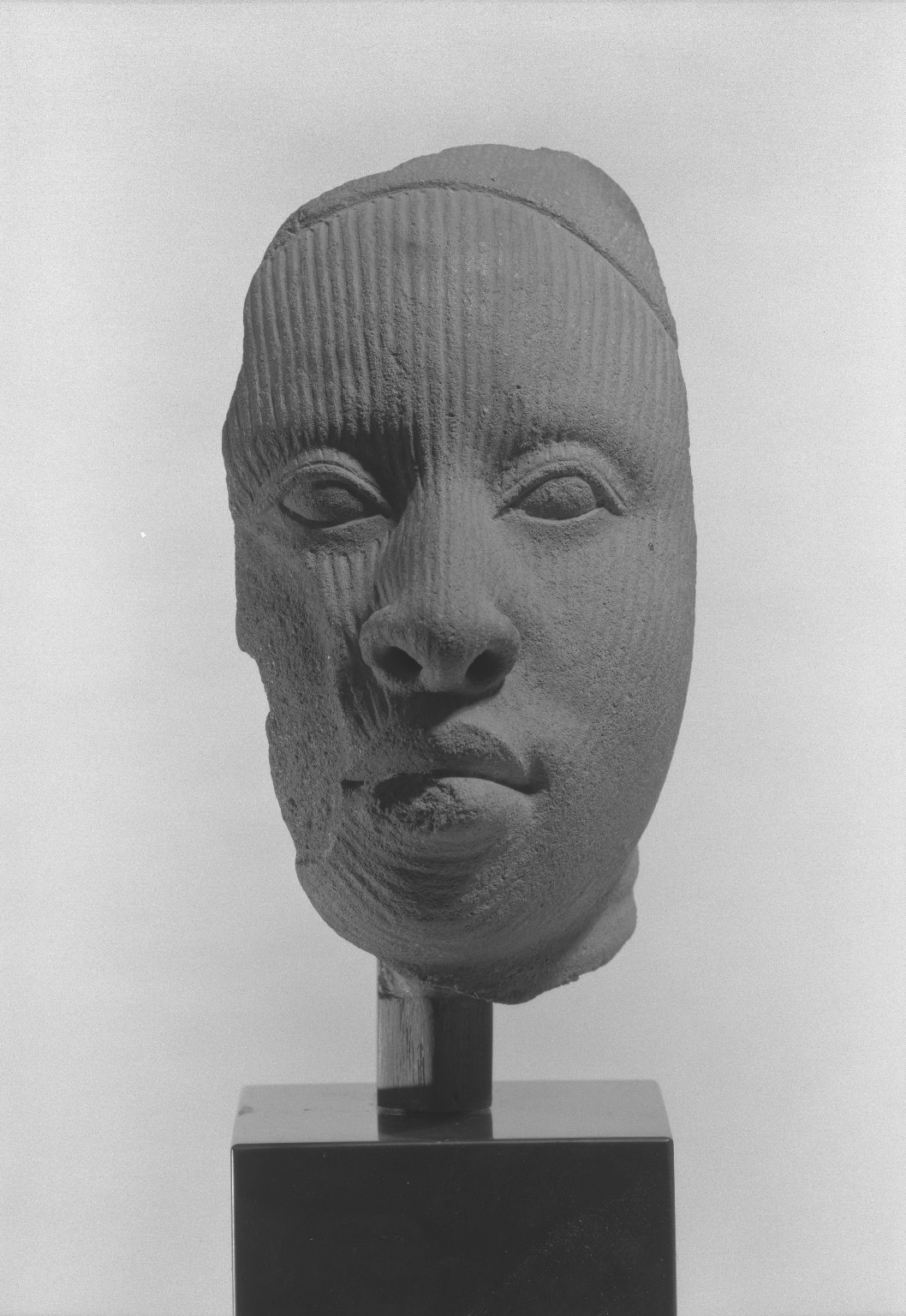
Fragment of a HeadOnline Collection of Brooklyn Museum; Photo: Brooklyn Museum, L54.5_front_acetate_bw.jpgWikimedia Commons · CC BY 3.0
Diaspora ethnonyms are collective designations such as Lucumí, Nagô, and Aku that emerged across the Atlantic world to classify captive populations originating from the Yorùbá-speaking region of West Africa . Before the late nineteenth century, inhabitants of this region did not identify as a single Yorùbá ethnic group, but rather organized their political loyalties around autonomous kingdoms and sub-groups such as Ọ̀yọ́, Ẹ̀gbá, Ìjẹ̀ṣà, Ìjẹ̀bú, Kétu, Èkìtì, and Ọ̀wọ̀ . Through the institutional crucibles of transatlantic enslavement, urban mutual aid societies, religious brotherhoods, and liberated African settlements, these disparate groups consolidated into unified diasporic "nations" . This process of re-ethnogenesis in the Americas and Sierra Leone not only established durable transnational cultural identities, but also fed back into West Africa to shape the emergence of modern Yorùbá national consciousness .
History and evolution
The historical trajectory of Yorùbá diaspora ethnonyms reflects shifting trade routes, political collapses in West Africa, and administrative regimes in the Americas . The earliest European references to Yorùbá-speaking groups appeared in early sixteenth-century Portuguese navigation and trade records along the Bight of Benin . Duarte Pacheco Pereira noted commercial encounters with interior peoples near the Kingdom of Benin around 1506 to 1508 . By 1627, the Jesuit missionary Alonso de Sandoval, writing in Cartagena de Indias, recorded Lucumíes as a distinct African nation arriving in Spanish America, identifying their origins in the West African interior east of the Popo and Allada kingdoms . Olfert Dapper's 1668 compilation described the interior kingdom of Ulkami (or Ulkuma), which contemporary historians associate with early commercial networks linked to the Ọ̀yọ́ Empire or eastern Yorùbá territories .
Under the ascendancy of the Ọ̀yọ́ Empire from the late seventeenth through the eighteenth century, imperial expansion redirected coastal commerce through ports such as Ouidah, Jaquin, and Apa . In French and Portuguese records of this era, the term Nagô (derived from the southwestern frontier group, the Ànàgó) began to supplant Lucumí as the primary coastal designation for Yorùbá speakers . Chevalier des Marchais recorded Nago at Ouidah in the 1720s, and French slaving reports from 1750 explicitly categorized interior captives from Ọ̀yọ́ and surrounding territories as Anago . In northern West Africa, Islamic scholarly treatises by Ahmad Bābā al-Timbuktī in 1615 and later Sultan Muhammad Bello in 1812 utilized the exonym Yariba or Yárùbá to describe the subjects of the Ọ̀yọ́ Empire .
The nineteenth-century Yorùbá civil wars caused a demographic shift across the Atlantic . The Owu War (c. 1821 to 1826), the collapse of Old Ọ̀yọ́ (c. 1835 to 1836), and subsequent intra-regional conflicts generated an unprecedented captive supply . Tens of thousands of Yorùbá speakers were funneled into transatlantic slave ships destined primarily for Bahia in Brazil and western Cuba, as well as being intercepted by the British Royal Navy's West Africa Squadron and relocated to Freetown, Sierra Leone . In Freetown, British colonial authorities and Christian missionaries designated these recaptives as Aku, a name derived from their formulaic greetings .
Missionary contact in Sierra Leone catalyzed the linguistic unification of these dispersed populations . The Church Missionary Society (CMS), particularly through the intellectual work of the repatriated Egbá scholar and bishop Samuel Ajayi Crowther, adopted the term Yoruba (previously limited in northern usage to Ọ̀yọ́) as the standard designation for the entire language family and ethno-linguistic group . Crowther's 1843 grammar and his 1852 dictionary established an Ọ̀yọ́-based written standard that transcended local dialects .
During the nineteenth-century colonial era, transatlantic returnees known as Agudas (from Brazil and Cuba) and Saros (from Sierra Leone) repatriated to coastal cities such as Lagos, Badagry, and Ouidah . These literate, commercial, and religious actors moved between Atlantic port cities, reinforcing a unified Yorùbá identity across the ocean . In colonial Nigeria, cultural nationalist organizations such as the Ẹgbẹ́ Ọmọ Odùduwà (founded in 1945) consolidated this pan-Yorùbá political consciousness .
Following mid-twentieth-century independence movements and post-revolutionary migrations from Cuba, diaspora ethnonyms underwent a global revival . In late twentieth- and twenty-first-century religious movements, designations like Lucumí in the United States and Puerto Rico, Nagô-Ketu in Brazilian Candomblé, and Orisha worship in Trinidad have shifted from colonial administrative labels to prestigious markers of ancestral cultural legitimacy .
Linguistic and Etymological Profiles
================================================================================
                    ATLANTIC YORÙBÁ ETHNONYMIC LABELS
================================================================================

 [ REGIONAL SUB-GROUPS IN WEST AFRICA ]
 (Ọ̀yọ́, Ẹ̀gbá, Ìjẹ̀ṣà, Ìjẹ̀bú, Kétu, Ànàgó, Èkìtì, Ọ̀wọ̀)
       |
       +-------------------+---------------------+-------------------+
       |                    |                     |                    |
 [ CARIBBEAN / SPANISH ]  [ BRAZIL / PORTUGUESE ] [ SIERRA LEONE ]   [ SAHEL / HAUSA ]
   Lucumí / Olukumí         Nagô / Anagonu          Aku                Yariba / Yorùbá
       |                    |                     |                    |
   - Derived from           - Derived from        - Derived from       - Hausa/Songhai
     "olùkù mi" (my          Ànàgó sub-group       greeting "ẹ kú"      exonym for Ọ̀yọ́
     friend) or Bini         via Fon exonym        (salutations)      - Adopted by CMS
     "Olukwumi"             - Consolidated in     - Consolidated in     to unify all
   - Institutionalized       Candomblé nações      Freetown liberated   sub-groups
     in Cuban cabildos                             villages
================================================================================
Lucumí (Olukumí)
The ethnonym Lucumí (rendered historically as Olukumi, Ulkami, Olcami, or Licomin) represents the primary historical designator for Yorùbá captives in the Hispanic Caribbean, Central America, and western South America .
Linguistically, the most widely accepted etymology traces the term to the Yorùbá phrase olùkù mi, meaning "my friend" or "my confidant" . In several eastern and central Yorùbá dialects (including Ọ̀wọ̀, Ìjẹ̀ṣà, and Èkìtì), olùkù survives as a standard noun for companion or associate . European traders and coastal intermediaries frequently heard interior captives addressing one another using this greeting and relational marker, subsequently converting the phrase into an ethnonymic noun .
A competing historiographical thesis, articulated by Ojo and Lovejoy, links the label to the historical Olukumi linguistic enclave in the Delta and Edo borderlands . According to this view, the term was mediated through the Kingdom of Benin, where it designated eastern Yorùbá-speaking frontier populations and palace servitors long before large-scale transatlantic departures commenced from the Bight of Benin .
In colonial Cuba, Lucumí functioned not as an undifferentiated monolith, but as a broad umbrella nation divided into precise sub-ethnonyms mirroring West African polities :
Lucumí Eyó: Captives from the Ọ̀yọ́ kingdom .
Lucumí Iyesá (or Elló): Captives from Ìjẹ̀ṣà territory .
Lucumí Egbá (or Ebá): Captives from the Ẹ̀gbá forests and Abeokuta .
Lucumí Ketu: Captives from the western kingdom of Kétu .
Lucumí Otá: Captives from the southern Awori town of Ọ̀tà .
Lucumí Tacua: Nupe captives who were linguistically distinct but culturally integrated into Ọ̀yọ́ networks .
Nagô (Ànàgó)
The ethnonym Nagô (also recorded as Nago, Nagot, or Anagonu) became the dominant term across the Portuguese, French, and Dutch Atlantic, particularly in Bahia, Pernambuco, Saint-Domingue (Haiti), and Suriname .
Morphologically, Nagô represents the Fon and Ewe truncation of Ànàgó, an indigenous sub-ethnic Yorùbá population situated along the southwestern borderlands of modern Nigeria and the Republic of Benin (including the kingdoms of Ipokia, Ifonyin, and coastal settlements near Porto-Novo) . In Fon, the suffix -nu designates people or citizenship, yielding Anagonu ("people of Anago") . Because the Kingdom of Dahomey frequently waged war against and enslaved these adjacent Ànàgó communities during the eighteenth century, Dahomean slave merchants at Ouidah applied Anagonu or Nagô indiscriminately to all Yorùbá speakers delivered to European ships .
In Brazilian Portuguese, Nagô expanded from a slave trade label into an ethno-religious descriptor . Over the course of the nineteenth century, urban Africans in Salvador da Bahia embraced Nagô as an overarching identity opposed to Central African (Angola, Congo) and Gold Coast/Gbe (Mina, Jeje) groups . Sub-classifications persisted within ritual networks:
Nagô-Ketu: The ritual lineage adhering to Kétu liturgy and deities, which attained cultural dominance in Bahia .
Nagô-Ijexá: Communities maintaining Ìjẹ̀ṣà musical phrasing and devotion to Ọ̀ṣun .
Nagô-Egbá: Ritual clusters reflecting Ẹ̀gbá religious lineages .
Nagô-Vodun: Hybridized lineages sharing liturgical structures with Fon and Ewe Jeje houses .
Aku
The ethnonym Aku (or Aku Mohammedans) arose in nineteenth-century Sierra Leone and spread across British colonial administrative contexts in West Africa and the Caribbean .
The etymology is purely locutionary, derived from the ubiquitous Yorùbá honorific prefix used in daily greetings: ẹ kú . The morpheme ẹ functions as the second-person plural or honorific singular pronoun, while kú conveys a blessing of endurance, greetings, or appreciation . Standard Yorùbá greetings include:
Ẹ kú àárọ̀: "Good morning" (greetings for the morning) .
Ẹ kú ilé: "Greetings to those at home" (spoken upon returning) .
Ẹ kú àbọ̀: "Welcome" (spoken to one arriving) .
Ẹ kú iṣẹ́: "Greetings on your work" (acknowledgment of labor) .
Non-Yorùbá populations in the colony of Freetown, noticing the constant repetition of this greeting formula among recaptives landed from intercepted slave ships, labeled the entire group Aku . In his 1854 comparative linguistic work Polyglotta Africana, the missionary Sigismund Wilhelm Koelle recorded twelve distinct dialects of the "Aku" language, demonstrating that while the population recognized their shared speech, they maintained sharp awareness of their original sub-national origins .
Yariba / Yorùbá
The term Yorùbá (originally Yariba or Yárùbá) originated as a northern exonym . While internal oral traditions often favored regional designations or mythical parentage as Ọmọ Odùduwà ("Children of Odùduwà"), the Songhai and Hausa scholars used Yariba strictly to describe the people of the Ọ̀yọ́ Empire . The earliest extant written record appears in Ahmad Bābā’s 1615 legal treatise Mi‘rāj al-Ṣu‘ūd, which evaluated whether non-Muslim populations of Yariba were licit for enslavement .
+-------------------------------------------------------------------------+
|                  THE STANDARDIZATION OF "YORÙBÁ"                         |
+-------------------------------------------------------------------------+
| 1615: Ahmad Bābā al-Timbuktī uses "Yariba" for Ọ̀yọ́ in Arabic text       |
| 1812: Sultan Muhammad Bello uses "Yarba" in Infaq al-Maysūr             |
| 1826: Hugh Clapperton records "Yarriba" during northern explorations    |
| 1843: Samuel Ajayi Crowther publishes *Grammar of the Yoruba Language*  |
| 1852: Crowther publishes *Vocabulary of the Yoruba Language*            |
| 1897: Samuel Johnson finishes *The History of the Yorubas*             |
+-------------------------------------------------------------------------+
The adoption of Yoruba as an umbrella ethnonym for all related dialects was spearheaded by Samuel Ajayi Crowther and the Church Missionary Society from the 1840s onward . Crowther recognized that the dialect of Ọ̀yọ́ possessed the demographic and political prominence necessary to serve as a written standard for evangelization, education, and printing .
Institutional Crucibles of Diasporic Ethnogenesis
The consolidation of disparate West African sub-groups into cohesive Atlantic "nations" was facilitated by specific civic, religious, and legal institutions .
+----------------------------------------------------------------------------+
|                INSTITUTIONAL CRUCIBLES OF RE-ETHNOGENESIS                   |
+----------------------------------------------------------------------------+
| CUBA: Cabildos de Nación                                                    |
| - Ethnic mutual aid associations organized under patron saints              |
| - Functioned as legal entities, burial societies, and dance clubs           |
| - Preserved royal lineages, sacred drumming, and Lucumí liturgical corpora |
+----------------------------------------------------------------------------+
| BRAZIL: Irmandades & Candomblé Terreiros                                    |
| - Lay Catholic brotherhoods (e.g., Irmandade de Nossa Senhora da Boa Morte) |
| - Autonomic Candomblé houses (Ilê Axé Iyá Nassô Oká / Casa Branca)          |
| - Reconstructed Nagô cosmology as civic counter-hegemony in Bahia           |
+----------------------------------------------------------------------------+
| SIERRA LEONE: Liberated African Settlements & Aku Communities               |
| - Freetown communal organization and mutual benefit societies               |
| - Formation of Christian Saro elite and Muslim Aku identity                 |
| - Systematic documentation and grammatical standard-setting (CMS / Koelle)  |
+----------------------------------------------------------------------------+
| TRINIDAD & CARIBBEAN: Rada/Orisha Compounds                                 |
| - Post-emancipation indentured African settlements                          |
| - Inter-island networking of Shango shrines and ancestral songs             |
+----------------------------------------------------------------------------+
Cabildos de Nación in Cuba
In Spanish colonial Cuba, the state and Catholic Church permitted and regulated mutual aid societies known as cabildos de nación . Structured nominally under the patronage of a Catholic saint, these associations allowed enslaved and free Africans of the same "nation" to gather on Sundays and feast days .
Within the cabildos, members elected kings (reyes) and queens (reinas), pooled financial resources to purchase the freedom of enslaved brethren (coartación), organized elaborate funeral rites, and celebrated public festivals with traditional sacred drums . The Cabildo Lucumí served as an arena where captives from Ọ̀yọ́, Ìjẹ̀ṣà, Ẹ̀gbá, and Kétu negotiated linguistic differences, unified their distinct local oríṣà lineages into a single liturgical system (Regla de Ocha), and presented a united political front to Spanish colonial authorities .
Irmandades and Candomblé Terreiros in Brazil
In Portuguese Brazil, particularly in Salvador da Bahia, lay Catholic brotherhoods (irmandades) and underground religious compounds (terreiros) fulfilled analogous roles . While brotherhoods such as the Irmandade de Nossa Senhora da Boa Morte in Cachoeira organized Nagô women around Catholic devotions and collective mutual aid, the domestic sanctuaries of Candomblé served as sovereign spaces of re-ethnogenesis .
The establishment of early nineteenth-century Bahian terreiros, such as Ilê Axé Iyá Nassô Oká (Casa Branca do Engenho Velho), institutionalized the dominance of the Nagô-Ketu liturgical nation . Priests and priestesses synthesized the divergent local pantheons of Yorùbáland into a unified hierarchy governed by sixteen central orixás, embedding Yorùbá cosmology within Brazilian urban geography .
Liberated African Settlements in Freetown
Following the 1807 British Abolition Act, the colony of Sierra Leone became an involuntary destination for over 90,000 liberated Africans . In Freetown and surrounding villages such as Regent, Hastings, and Waterloo, Yorùbá recaptives constituted the single largest demographic contingent, comprising roughly one-third of the total population .
Faced with colonial administration and multi-ethnic competition, the Aku established extensive mutual aid networks, credit societies (esusu), and municipal self-governance structures under elected headmen . The Aku community split into two interconnected wings: a Christianized, English-educated bourgeois class (Saros) that staffed missionary and administrative posts across West Africa, and a distinct Muslim community (Aku Mohammedans or Aku Marabouts) in the Fourah Bay and Aberdeen districts that maintained strict Islamic dress, jurisprudence, and Yorùbá linguistic vitality .
Indentureship in Trinidad and the British Caribbean
Following the abolition of slavery in the British Empire in 1834, colonial planters imported over 8,000 liberated Africans as indentured laborers to Trinidad, Jamaica, and Guyana between 1841 and 1867 . A high proportion were Yorùbá speakers landed directly from intercepted vessels .
In rural settlements such as Belmont and Diego Martin in Trinidad, these workers established autonomous communal hamlets known as "Yarraba" settlements . As documented by linguist Maureen Warner-Lewis, these communities retained fluent conversational Yorùbá into the mid-twentieth century, preserving oral literature, oríkì poetry, and the liturgical framework of the Trinidad Orisha religion .
Primary Text and Linguistic Analysis
Diasporic oral performance preserves foundational texts that document this historical dispersion, the trauma of Atlantic dislocation, and the enduring memory of ancestral identity . The following oral poem was recorded among elder Yorùbá descendants in the Caribbean by Maureen Warner-Lewis, capturing the collective memory of maritime transport and resettlement .
The Oral Text
Layer 1: Original Yoruba Transcription
Ayé ń lọ, ayé ń bọ̀,
Àwọn ọmọ Yorùbá wà lórí erékùṣù.
A dé orí àpáta,
A ò gbàgbé ilé Baba wa.
Àwọn Òrìṣà ń gbè wá lókè òkun,
Ẹ kú àbọ̀, ẹ kú àtìpó.
Layer 2: Word-by-Word Gloss
Ayé (world/life) ń lọ (is going), ayé (world/life) ń bọ̀ (is coming),
Àwọn ọmọ (the children of) Yorùbá (Yoruba) wà (exist/are) lórí (on top of) erékùṣù (island).
A (we) dé (arrive/reach) orí (head/top of) àpáta (rock),
A (we) ò (not) gbàgbé (forget) ilé (house/home of) Baba (father) wa (our).
Àwọn Òrìṣà (the deities) ń gbè (are supporting/delivering) wá (us) lókè (across/over) òkun (ocean),
Ẹ kú (honorific greeting for) àbọ̀ (arrival), ẹ kú (honorific greeting for) àtìpó (sojourning/exile).
Layer 3: Idiomatic English Translation
The world turns and cycles continue,
The children of Yorùbá now dwell upon an island.
We have landed upon a barren rock,
Yet we do not forget our ancestral homeland.
The Òrìṣà sustain us across the great ocean,
We greet each other in arrival, we honor each other in exile.
(Translation: corpus standard based on Maureen Warner-Lewis, Trinidad Yoruba, 1996 [S20])
Analytical Commentary on the Text
What it means: The chant articulates the reality of physical exile while asserting that spiritual, genealogical, and linguistic bonds remain unbroken despite the middle passage .
Social function: Historically chanted during ancestral invocations (ẹbọ and oríkì recitations) in Caribbean Orisha compounds, the verse served to validate the legitimacy of diaspora ritual spaces against elite colonial stigmatization .
Illustrative scenario: Performed during an annual feast (ẹbọ) in Belmont, Trinidad, an elder singer chants these lines to initiate the possession cycle for Ṣàngó, reminding participants that their presence on an island is a continuation of continental history rather than an absolute rupture .
Cultural value: In Yorùbá philosophical thought, the concept of àtìpó (residence in a foreign land as a stranger) carries deep ethical obligations to remember lineage origins (orísun) . Forgetting the house of the father (ilé baba) is regarded as a severe spiritual failure that severs an individual from ancestral protection .
Tonality and wordplay: The tonal juxtaposition between ń lọ (mid tone, high tone: going) and ń bọ̀ (mid tone, low tone: returning) establishes a rhythmic cadence expressing the historical ebb and flow of human fortunes . The phrase ẹ kú àtìpó applies the sacred ẹ kú greeting formula specifically to the condition of diaspora displacement .
Notes on translation: The term àpáta translates literally as "rock," but in Caribbean Yorùbá oral registers, it is an affectionate metaphor for the isolated island landmass itself . English translations often lose the communal force of the honorific particle ẹ kú, which acknowledges the shared labor and suffering inherent in surviving exile .
Theoretical and Historiographical Debates
The mechanisms governing diaspora ethnogenesis and the survival of Yorùbá identity have generated intense debate within Atlantic historiography and anthropology .
+----------------------------------------------------------------------------+
|               MAJOR HISTORIOGRAPHICAL INTERPRETATIONS                       |
+----------------------------------------------------------------------------+
| CREOLIZATION MODEL (Mintz & Price)                                          |
| - Radical rupture of Middle Passage destroyed institutional social structures|
| - New World cultures built through rapid syncretic improvisation            |
| - African ethnicities viewed as loose aggregate categories                  |
+----------------------------------------------------------------------------+
| AFRICAN CONTINUITY & ETHNOGENESIS (Thornton, Lovejoy, Sweet)                |
| - Specific, clustered provenance patterns preserved intact ethnic memory    |
| - Late surge of 19th-century Yorùbá captives created demographic dominance  |
| - Ethnonyms represent conscious reconstruction of African institutions      |
+----------------------------------------------------------------------------+
| TRANSNATIONAL DIALOGUE MODEL (Matory, Yai)                                  |
| - Yorùbá identity co-produced simultaneously in West Africa and Americas     |
| - Bilateral travel of merchants, priests, and returnees (Saros and Agudas)  |
| - Diaspora institutions directly influenced homeland nationalist movements  |
+----------------------------------------------------------------------------+
| DISCURSIVE CRITIQUE (Palmié)                                                |
| - Cautions against projecting modern ethnic categories retroactively         |
| - Emphasizes that "nations" were colonial legal administrative devices       |
| - Identity formed through dialectical tension with state surveillance       |
+----------------------------------------------------------------------------+
The Creolization Model vs. African Continuity
The foundational debate in African diaspora studies centers on the degree of cultural continuity versus rapid New World innovation .
Sidney Mintz and Richard Price formulated the "rapid creolization" model, arguing that the middle passage stripped enslaved Africans of institutionalized social structures . Under this framework, captives arrived as an atomized aggregate who could share only deep-level cognitive orientations rather than specific ethnic institutions . Mintz and Price argued that diaspora "nations" like the Lucumí or Nagô were novel Caribbean and South American creations built out of necessity under colonial domination, with little direct continuity from pre-existing African political structures .
Conversely, historians John Thornton and Paul Lovejoy demonstrate that demographic clustering, trade patterns, and political crises in specific African regions created concentrated cohorts of captives who shared mutually intelligible dialects, religious liturgies, and military skills . Lovejoy emphasizes that the collapse of the Ọ̀yọ́ Empire during the early nineteenth century flooded the Atlantic trade with hundreds of thousands of Yorùbá speakers over a concentrated forty-year span . This demographic influx allowed direct institutional transfers to take place, enabling the reconstitution of sophisticated religious networks and mutual aid cabildos that preserved continental identities .
Transnational Co-Production
Anthropologist J. Lorand Matory challenges unidirectional models of cultural transmission by proposing a transnational dialogic framework . Matory argues that modern Yorùbá identity was not simply generated in West Africa and transported to the Americas, nor was it invented independently in the diaspora . Instead, it was co-produced through a sustained nineteenth-century Atlantic dialogue involving:
Literate Saro repatriates in Lagos and Freetown .
Afro-Brazilian Aguda merchants operating shipping lines between Salvador da Bahia and the Bight of Benin .
Priests and priestesses of Candomblé and Santería who traveled across the ocean for ritual initiations and political alliances .
In Matory's analysis, the prestigious status of Nagô culture in Bahia directly influenced the cultural nationalist pride of elite returnees in Lagos, which in turn accelerated the adoption of pan-Yorùbá identity in Nigeria . Olabiyi Yai reinforces this paradigm, urging scholars to view the Black Atlantic as a continuous communicative circuit rather than a binary divide between homeland and diaspora .
The Discursive and Administrative Critique
Stephan Palmié offers a critical intervention against essentialist readings of African diaspora identities . Palmié demonstrates that ethnonymic labels such as Lucumí were primarily colonial technologies of categorization deployed by Spanish authorities to manage, segregate, and surveil captive urban populations .
According to Palmié, scholars must avoid confusing colonial administrative classifications with innate African ethnic consciousness . The cabildos de nación were spaces where Africans actively negotiated Spanish legal mandates, internal status hierarchies, and creole generational tensions, producing a synthetic "Lucumí" identity that cannot be treated as an unmodified relic of pre-colonial West Africa .
Contemporary Manifestations
In the twenty-first century, historical diaspora ethnonyms maintain vibrant civic, liturgical, and academic significance across the globe .
================================================================================
           CONTEMPORARY SURVIVALS OF DIASPORA YORÙBÁ DESIGNATIONS
================================================================================

 [ CUBA & GLOBAL SANTERÍA ]
 - Liturgical language designated as "Habla Lucumí"
 - Initiates identify religiously as "Lucumí" or "Olorisha"
 - Global spread via Cuban diaspora to Miami, New York, Madrid, San Juan

 [ BRAZILIAN CANDOMBLÉ ]
 - Dominant ritual federation known as "Candomblé Nagô-Ketu"
 - Sacred vocabulary termed "Língua Nagô" or "Iorubá Litúrgico"
 - Bahia recognized as a global center of Afro-Atlantic religious prestige

 [ SIERRA LEONE & THE SARO DIASPORA ]
 - "Aku" identity preserved as a distinct Muslim community in Freetown
 - "Krio" ethnic identity incorporates deep Yorùbá linguistic substrata
 - Saro cultural traditions maintained across West African coastal cities

 [ TRINIDAD & EASTERN CARIBBEAN ]
 - "Orisha Shango" tradition preserves Yorùbá songbooks and drum liturgies
 - Cultural revival movements asserting links to continental Yorùbá heritage
================================================================================
In Cuba and its worldwide diaspora (concentrated in Miami, New York, Madrid, and San Juan), Lucumí designates both the liturgical language of Regla de Ocha and the collective community of initiated priests (santeros or olorichas) . Dictionaries of liturgical Lucumí continue to be compiled, maintaining thousands of Yorùbá nouns, verb phrases, and praise verses used in divination and ritual sacrifice .
In Brazil, the prestige of the Nagô-Ketu tradition remains central to Afro-Brazilian identity politics and cultural tourism in Bahia . Major historical terreiros such as Casa Branca, Ilê Axé Opô Afonjá, and Gantois are designated as National Historic and Artistic Heritage sites, celebrated as epicenters of Nagô civilizational memory .
In Sierra Leone, the Aku remain an officially recognized ethnoreligious minority with historic leadership in commerce, Islamic scholarship, and civic administration . Meanwhile, the wider Krio language of Sierra Leone retains extensive Yorùbá loanwords, idiomatic calques, and proverbs originating from nineteenth-century recaptive settlement .
Through this continuous historical circulation, diaspora ethnonyms that began as external slave-trade markers have transformed into global badges of cultural resilience and ancestral connection .
Àwọn orísun
[1]Matt D. Childs, The 1812 Aponte Rebellion in Cuba and the Struggle against Atlantic Slavery (University of North Carolina Press, 2006), pp. 45-78.
[2]Toyin Falola and Matt D. Childs, eds., The Yoruba Diaspora in the Atlantic World (Indiana University Press, 2004), pp. 1-32.
[3]J. D. Y. Peel, Religious Encounter and the Making of the Yoruba (Indiana University Press, 2000), pp. 24-47.
[4]J. Lorand Matory, Black Atlantic Religion: Tradition, Transnationalism, and Matriarchy in the Afro-Brazilian Candomblé (Princeton University Press, 2005), pp. 38-82.
[5]Kristin Mann, Slavery and the Birth of an African City: Lagos, 1760-1900 (Indiana University Press, 2007), pp. 145-188.
[6]Robin Law, "Ethnicity and the Slave Trade: 'Lucumi' and 'Nago' as Ethnonyms in West Africa," History in Africa 24 (1997), pp. 205-219.
[7]Duarte Pacheco Pereira, Esmeraldo de Situ Orbis, translated and edited by George H. T. Kimble (Hakluyt Society, 1937), pp. 120-135.
[8]Alonso de Sandoval, De instauranda Aethiopum salute: El mundo de la esclavitud negra en América, edited by Ángel Valtierra (Empresa Nacional de Publicaciones, 1956 [1627]), pp. 65-92.
[9]Robin Law, The Slave Coast of West Africa, 1550-1750: The Impact of the Atlantic Slave Trade on an African Society (Oxford University Press, 1991), pp. 154-190.
[10]Pierre Verger, Flux et reflux de la traite des nègres entre le Golfe de Bénin et Bahia de Todos os Santos, du XVIIe au XIXe siècle (Mouton, 1968), pp. 230-275.
[11]Ahmad Bābā al-Timbuktī, Mi‘rāj al-Ṣu‘ūd: Ahmad Baba’s Replies on Slavery, edited and translated by John O. Hunwick and Fatima Harrak (Institut des Études Africaines, 2000 [1615]), pp. 21-39.
[12]Muhammad Bello, Infaq al-Maysur fi Tarikh Bilad al-Takrur, edited by C. E. J. Whitting (Luzac, 1951 [1812]), pp. 12-18.
[13]Paul E. Lovejoy, Transformations in Slavery: A History of Slavery in Africa, 3rd edition (Cambridge University Press, 2012), pp. 160-194.
[14]Robin Law, The Ọyọ Empire, c. 1600-c. 1836: A West African Imperialism in the Era of the Atlantic Slave Trade (Clarendon Press, 1977), pp. 280-312.
[15]Richard Peter Anderson, Abolition in Sierra Leone: Re-Building Lives and Identities in Nineteenth-Century West Africa (Cambridge University Press, 2020), pp. 112-158.
[16]John Peterson, Province of Freedom: A History of Sierra Leone, 1787-1870 (Faber & Faber, 1969), pp. 158-195.
[17]Samuel Ajayi Crowther, A Vocabulary of the Yoruba Language (Church Missionary Society, 1852), pp. 1-45.
[18]Toyin Falola, Yoruba Gurus: Indigenous Production of Knowledge in Africa (Africa World Press, 1999), pp. 67-98.
[19]George Brandon, Santeria from Africa to the New World: The Dead Sell Memories (Indiana University Press, 1993), pp. 54-89.
[20]Maureen Warner-Lewis, Trinidad Yoruba: From Mother Tongue to Memory (University of Alabama Press, 1996), pp. 18-65.
[21]Olatunji Ojo and Paul E. Lovejoy, "The 'Olukumi' Nation and the Atlantic Slave Trade," Slavery & Abolition 36, no. 4 (2015), pp. 638-662.
[22]David H. Brown, Santería Enthroned: Art, Ritual, and Innovation in an Afro-Cuban Religion (University of Chicago Press, 2003), pp. 22-68.
[23]João José Reis, Slave Rebellion in Brazil: The Muslim Uprising of 1835 in Bahia (Johns Hopkins University Press, 1993), pp. 93-128.
[24]Beatrix Heintze and Achim von Oppen, eds., Angola on the Move: Transport Routes, Communications and History (Frankfurt am Main, 2008), cited for Afro-Bahian ethnonymic distribution in Luis Nicolau Parés, The Formation of Candomblé: Vodun History and Ritual in Brazil (University of North Carolina Press, 2013), pp. 85-124.
[25]Christopher Fyfe, A History of Sierra Leone (Oxford University Press, 1962), pp. 210-245.
[26]Stephan Palmié, Wizards and Scientists: Explorations in Afro-Cuban Modernity and Tradition (Duke University Press, 2002), pp. 79-158.
[27]Sheila S. Walker, "Everyday and Esoteric Reality in the Afro-Brazilian Candomblé," Africa: Journal of the International African Institute 60, no. 1 (1990), pp. 103-128.
[28]Maureen Warner-Lewis, Guinea's Other Suns: The African Dynamic in Trinidad Culture (The Majority Press, 1991), pp. 45-82.
[29]Sidney W. Mintz and Richard Price, The Birth of African-American Culture: An Anthropological Approach (Beacon Press, 1992 [1976]), pp. 1-42.
[30]John Thornton, Africa and Africans in the Making of the Atlantic World, 1400-1800, 2nd edition (Cambridge University Press, 1998), pp. 183-205.
[31]Olabiyi Babalola Yai, "Texts of Enslavement: Fon and Yoruba Vocabularies from Eighteenth- and Nineteenth-Century Brazil," in Identity in the Shadow of Slavery, edited by Paul E. Lovejoy (Continuum, 2000), pp. 102-112.