Transatlantic Transculturation and Lucumí Jurisdiction
How West African Òrìṣà and Ifá traditions were reconstituted in Cuba through institutional compromises between babalawos and cowrie shell diviners.
intermediatehigh·
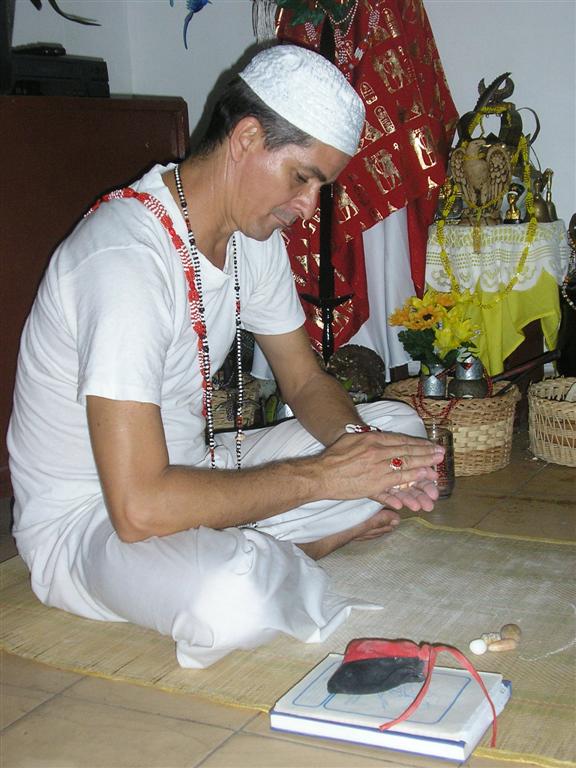
How West African Òrìṣà and Ifá traditions were reconstituted in Cuba through institutional compromises between babalawos and cowrie shell diviners.
Lucumí (Lukumi, from the Yorùbá greeting olùkù mi, meaning my dear friend or my confidant) is the transatlantic Cuban branch of the West African Òrìṣà (orisha, deity) and Ifá religious traditions [S1, S2]. Reconstituted during the nineteenth century under the conditions of plantation slavery and urban mutual aid societies, the Lucumí system reorganized regional West African cults into an integrated hierarchical framework [S2, S3]. In this system, ritual authority is divided between the babaláwo (bàbáláwo, father of secrets, the priest of Ifá) and the olorisha (olórìṣà, owner or priest of an òrìṣà), whose public rites are directed by the obá oriaté (master of ceremonies and divination) [S2, S4].
The reconstitution of Yorùbá ritual in the Americas follows a clear historical trajectory shaped by political collapse in West Africa and legal adaptations in the Caribbean.
Earliest records and the Ọ̀yọ́ collapse (1800-1850s). While African captives arrived in Cuba from the sixteenth century onward, the massive demographic influx of Yorùbá-speaking captives occurred between 1817 and the late 1850s, driven by the collapse of the Ọ̀yọ́ Empire, the Fulani jihads, and the resulting civil wars [S2, S5]. Spanish authorities and slavers categorized these captives as Lucumí, an ethnolinguistic umbrella term that encompassed Ọ̀yọ́, Ègbá, Ègbádò, Ìjẹ̀ṣà, Ìjẹ̀bú, and neighboring populations [S1, S2].
The colonial cabildos de nación (1850s, 1880s). In urban Havana and Matanzas, enslaved and free Africans organized under Spanish municipal law into cabildos de nación (ethnic mutual aid societies chartered under Catholic patron saints) [S2, S3]. Within cabildos such as the Cabildo Africano Lucumí Santa Bárbara in Matanzas and Cabildo Changó Tedún in Havana, initiates gathered sacred paraphernalia, consecrated the first transatlantic consecrated batá drums (àyàn) around the 1870s, and preserved lineages of Ifá and Òrìṣà practice [S2, S6].
Abolition, state repression, and the house-temple (1886-1902). Following the abolition of slavery in Cuba in 1886 and Spanish decrees restricting ethnic cabildos in 1888, practitioners shifted their institutional base to the ilé-òrìṣà or casa-templo (private home temple) [S2, S3]. During the late colonial period and the early Cuban Republic, police and civic authorities criminalized Afro-Cuban practices under the pejorative banner of brujería (witchcraft), driving initiations and sacred gatherings into domestic spaces [S7, S8].
The consolidation of the Regla de Ocha-Ifá (1900-1940s). Between 1890 and 1920, elder priestesses and priests in Havana and Matanzas standardized the complex multiple-òrìṣà initiation structure known as the asiento (seating or coronation) or kariosha (kó-orí-òrìṣà, placing the òrìṣà on the head) [S2, S6]. During this era, female elders such as ña Rosalía Abreu (Efunshé) and Timotea Albear (Latuán) formalized the ritual division of labor with pioneer babalawos including Ño Remigio Herrera (Àdéṣìná) and Ño Carlos Adé Bí [S2, S6].
The 1959 Revolution, the Mariel boatlift, and global diaspora (1959-1990s). Following the Cuban Revolution of 1959, waves of Cuban emigrants carried the Lucumí system to Miami, New York, San Juan, Caracas, and Madrid [S3, S9]. In the United States, practitioners faced civic repression regarding animal sacrifice, culminating in the landmark 1993 US Supreme Court victory in Church of the Lukumi Babalu Aye v. City of Hialeah, which recognized animal sacrifice as constitutionally protected religious exercise [S7, S10].
Transnational re-encounters and contemporary re-Yorùbization (1970s, present). From the 1970s onward, interaction between Cuban Lucumí houses, African American cultural nationalists, and West African practitioners created debates regarding ritual purity, textual authority, and jurisdictional boundaries [S2, S11]. In Cuba, the formation of the Asociación Cultural Yoruba de Cuba in 1991 provided state-recognized institutional representation for babalawos, while independent houses continued to assert ritual autonomy [S9, S12].
Scholars studying Afro-Cuban religion have long debated how West African traditions survived and evolved in the Americas. In 1940, the Cuban ethnographer Fernando Ortiz coined the term transculturación (transculturation) to replace the Anglo-American concept of acculturation [S8, S13]. Ortiz argued that Cuban culture did not develop through one-way assimilation into European norms, but rather through a three-part process:
Stephan Palmié builds on Ortiz by arguing that Afro-Cuban religion is not an archaic survival of precolonial West Africa preserved in static isolation, but a modern historical formation produced within Atlantic commercial capitalism . Palmié demonstrates that Lucumí ritual reasoning operates with intellectual rigor, serving as an analytical tool through which initiates interpret power, history, and social relations .
J. Lorand Matory challenges the assumption that transatlantic transmission was a one-way transfer, documenting a continuous, two-way circulation of people, commodities, letters, and ritual ideas across the Atlantic throughout the nineteenth and twentieth centuries . David H. Brown shows that Lucumí practitioners selectively appropriated European prestige symbols, including Victorian porcelain, royal canopies, Spanish military insignia, and Catholic iconography, to construct ritual thrones that visually asserted the sovereign dignity of the Òrìṣà within a hostile colonial society .
                 TRANSATLANTIC TRANSCULTURATION
                               │
       ┌───────────────────────┴───────────────────────┐
       ▼                                               ▼
West African Lineages                         Spanish Colonial Matrix
- Regional Òrìṣà cults                       - Cabildos de nación
- Royal Ifá courts (Ọ̀yọ́/Kétu)               - Catholic saint syncretism
- Lineage-based shrines                       - Domestic confinement (Ilé)
       │                                               │
       └───────────────────────┬───────────────────────┘
                               │
                               ▼
                    Lucumí Synthesis in Cuba
      - Integrated Pantheonic Initiation (Asiento)
      - Dual Jurisdictional Structure: Babaláwo & Oriaté
      - Standardization of 16-Cowrie Divination (Érìndínlógún)
      - Lineage Networks (Ramas de Ocha e Ifá)
In West Africa, Òrìṣà devotion was largely decentralized and organized around localized lineage shrines, city-state tutelary deities, and specialized priestly guilds [S2, S5]. A worshiper in Ọ̀yọ́ might be initiated solely into the priesthood of Ṣàngó (the òrìṣà of thunder and kingship), while an initiate in Ẹ̀gbádò was dedicated exclusively to Yemọja (the river and ocean deity) or Olókun [S2, S6].
Enslavement shattered the territorial and lineage infrastructure that sustained single-òrìṣà shrines [S2, S3]. In Cuba, captives from different regions were forced into close quarters. To ensure survival, practitioners gathered across ethnic sub-groups within the cabildos de nación [S2, S3].
When the colonial government suppressed the cabildos in the late nineteenth century, initiates reconstituted the tradition within the ilé-òrìṣà (also known in Spanish as the casa de santo or casa-templo) [S2, S3]. Within these domestic compounds, elder priestesses instituted the collective initiation (asiento), in which a novice receives not just their tutelary deity, but an entire core pantheon:
Through this collective reception, the ilé-òrìṣà became a self-contained ecclesiastical unit capable of initiating novices and perpetuating lineages (ramas) without relying on regional geographic shrines [S2, S6].
The consolidation of the Lucumí system required resolving the division of ritual authority between the babaláwo (priest of Ifá) and the olorisha (priest of the Òrìṣà) [S2, S4].
In nineteenth-century Cuba, tensions arose over who possessed the right to direct public initiations, perform life-cycle readings, and sacrifice four-legged animals [S2, S6]. This led to a negotiated institutional compromise that remains central to Lucumí orthodoxy [S2, S4].
                 LUCUMÍ RITUAL JURISDICTION
                               │
       ┌───────────────────────┴───────────────────────┐
       ▼                                               ▼
IFÁ JURISDICTION (Babaláwo)                 OCHA JURISDICTION (Olorisha / Oriaté)
- Instrument: Ọ̀pẹ̀lẹ̀ & Ikin                    - Instrument: Érìndínlógún (Diloggún)
- Corpus: 256 Odù Ifá                          - Corpus: 16 Odù (reads 1 to 12)
- Exclusive rites:                             - Public rites:
  * Determining Orí / Tutelary Òrìṣà              * Directing Kariosha / Asiento
  * Consecrating Guerreros (Èṣù/Ògún)            * Performing Itá Imọlẹ̀ of initiation
  * Kuakuanaldo (Knife Confirmation)             * Pinaldo (Knife ceremony in Ocha)
- Referral rule: Divines Odù 13-16             - Referral rule: Must stop at 13 (Mẹ́tàlá)
In early nineteenth-century Cuba, senior priestesses (ìyálórìṣà) directed initiations directly [S2, S6]. As ritual protocols became standardized, the specialized office of the Obá Oriaté (from ọba, king or leader, and orí-àtẹ, the head of the divination mat) emerged to preside over the complex week-long initiation ceremonies [S2, S4].
The Oriaté is an olorisha with advanced mastery of the cowrie shell oracle (érìndínlógún, rendered in Spanish as el diloggún), sacrificial protocols, sacred herbalism (ewé), and the oral liturgies (orin) [S2, S4]. The Oriaté directs:
The boundary between Ocha (the domain of the olorisha) and Ifá (the domain of the babaláwo) is mediated by the mathematical structure of the divination systems [S2, S4, S14].
The cowrie oracle (érìndínlógún) uses sixteen consecrated cowrie shells cast upon a woven mat (atẹ) [S4, S14]. In West African practice, cowrie diviners interpret verses across all sixteen basic casting figures, from Òkànràn (1 open mouth) to Èjìogbè (8 open mouths) and up to Ìrètẹ̀ (16 open mouths) .
In Cuban Lucumí practice, an institutional boundary was codified:
This division preserves the institutional balance: it recognizes the autonomy of the olorisha within the realm of the Òrìṣà, while safeguarding the primacy of Ifá as the highest appellate oracle in metaphysical affairs [S2, S4].
A second boundary dispute involved the authority to perform animal sacrifices, particularly the sacrifice of four-legged animals (agbò, òbúkọ, ewúrẹ́) [S2, S6].
Babalawos asserted that through the reception of Kuanaldo (or Kuakuanaldo, the Ifá knife ceremony), they held exclusive authority over the sacrificial blade of Ògún .
In response, nineteenth-century olorishas, led by elder priestesses and master Oriatés, established the Pinaldo ceremony (the confirmation of the knife within Ocha) [S2, S6]. Through Pinaldo, an initiated santero or santera receives their own consecrated knife, reinforcing their lineage authority and permitting them to slaughter sacrificial animals independently of the babaláwo when necessary [S2, S6].
Lucumí ritual practice was consolidated through specific geographic lineages (ramas) centered in Havana and Matanzas [S2, S6].
Oral historical documentation compiled by Brown and Ramos identifies four foundational African-born and early Creole priestesses who established the primary branches of Regla de Ocha [S2, S6]:
Ña Rosalía Abreu (Efunshé Ikúndeí). An Ègbádò priestess initiated in Africa, Efunshé arrived in Havana in the mid-nineteenth century. She is credited with introducing the systematic asiento protocol, where the initiate receives multiple òrìṣà simultaneously [S2, S6]. Her lineage is known as La Rama de los Trapitos or La Rama de Efunshé [S2, S6].
Timotea Albear (Ajayí Lewú, popularly called Latuán). An Ọ̀yọ́ priestess consecrated to Ṣàngó, Latuán presided as the head priestess of the Cabildo Changó Tedún in Havana [S2, S6]. Revered for her encyclopedic knowledge of diloggún verses, she served as a key instructor to the first generation of Cuban-born male Oriatés [S2, S6].
Ma Monserrate González (Ọbá Tero). An Ègbádò priestess consecrated to Ṣàngó, Ọbá Tero maintained deep knowledge of rare deities including Olókun, Yewà, and Odùduwà [S2, S6]. Following ritual disagreements in Havana with Latuán and Efunshé (an event remembered in oral tradition as La División de La Habana), Ọbá Tero relocated to the neighborhood of Simpson in Matanzas, where she established the primary Matanzas branch of Ocha [S2, S6].
Fermina Gómez (Òṣàbí). A spiritual goddaughter of Ọbá Tero in Matanzas, Fermina Gómez became the primary custodian and distributor of the transatlantic mysteries of Olókun, Babalú-Ayé, and the ancestral Oro Iña rites, influencing both Havana and Matanzas practice throughout the early twentieth century [S2, S6].
During the early 1900s, Latuán and Efunshé appointed and trained the first widely recognized male Oriatés [S2, S6]:
Octavio Samar Rodríguez (Obadimeji). A pivotal figure in Lucumí history, Obadimeji was an olorisha from Matanzas whose original initiation was called into question in Havana [S2, S6]. After undergoing a second kariosha under Latuán and Efunshé around 1902, he was given the name Obadimeji (meaning "the king becomes two" or "crowned twice") [S2, S6]. He became the foremost Oriaté in Cuba, standardizing the rituals of the divination mat across Havana and Matanzas until his death in 1944 [S2, S6].
José Roche (Oṣùn Bíkí) and Calixto Morales (Odùbí). Contemporaries of Obadimeji who spread standardized itá interpretations and liturgical singing formats across western Cuba [S2, S6].
Parallel to the Ocha branches, Cuban Ifá organized into distinct lineages tracing back to African-born babalawos who established cabildos and private temples [S2, S15]:
Ño Remigio Herrera (Àdéṣìná, Odù Ọ̀bàrà Sá / Ọ̀bàrà Méjì). Born in West Africa (frequently cited as Ìjẹ̀ṣà or Ọ̀yọ́), Àdéṣìná was enslaved in Matanzas before purchasing his freedom around 1850 with the assistance of fellow diviners [S2, S15]. He moved to Regla, Havana, where he helped establish the Cabildo Yemayá and served as the preeminent Ifá elder on the island until his death in 1906 [S2, S15].
Ño Carlos Adé Bí (Ojúàní Bóká). An African-born babalawo who gained manumission through his divination skills, Adé Bí collaborated with Àdéṣìná to consecrate sacred Olofi (Ọlọ́fin) shrines and train the first generation of Cuban-born babalawos .
Bernardo Rojas Torres (Ìrètè-Ndí). The primary Cuban-born godson and ritual heir of Àdéṣìná, Rojas codified Ifá notebooks (libretas de Ifá), systematized initiation records, and established the lineage known as the Rama del Vaticano [S2, S15].
Cornelio Vidal (Tata Gaitán, Odù Ògúndá-Fún / Ògúndá-Kẹtẹ). A renowned babalawo who received Odùduwà from African elders and served as an institutional leader in Guanabacoa, bridging nineteenth-century African practice with twentieth-century urban Cuban religious associations .
The sacred liturgical language of Lucumí is an archaic diaspora register derived primarily from nineteenth-century Ọ̀yọ́, Ègbá, and Ìjẹ̀ṣà dialects of Yorùbá, with minor lexical borrowings from Fon (Arará) and Kikongo [S1, S16].
Linguistic studies by Lydia Cabrera, Kristina Wirtz, and Amanda Villepastour document several systematic shifts that occurred as spoken Yorùbá shifted into a specialized ritual language embedded in a Spanish-speaking environment [S1, S8, S16]:
The Moyugba (from the Yorùbá Mo júbà, meaning "I pay homage" or "I submit my respect") is the essential opening invocation recited before any divination, offering, or ceremony in both Ocha and Ifá [S2, S4]. It establishes cosmic order by paying homage first to the divine source, then to the natural elements, the deceased ancestors (egúngún / egun), and finally the living priestly lineage [S2, S4].
Moyugba Ọlọ́run, moyugba Ọlọ́dùmarè, moyugba Ọlọ́fin.
Moyugba ayé, moyugba ilẹ̀, moyugba ọjọ́ òní.
Moyugba gbogbo ará ọ̀run, timbélèṣe Ọlọ́dùmarè.
Iba'ẹ́ layé t'ọ̀run gbogbo egún ilé,
k'e ké o, k'e tọ́ o, k'e gbè wá.
Kí àṣẹ tó, kí àṣẹ tọ́, kí àṣẹ gbogbo oríṣà wà pẹ́lú wa.
Mo-júbà (I pay homage) Ọlọ́run (Owner of Heaven), mo-júbà (I pay homage) Ọlọ́dùmarè (Almighty Source), mo-júbà (I pay homage) Ọlọ́fin (Supreme Ruler / Palace Lord).
Mo-júbà (I pay homage) ayé (the living world/earth), mo-júbà (I pay homage) ilẹ̀ (the ground/soil), mo-júbà (I pay homage) ọjọ́ (day) òní (this present).
Mo-júbà (I pay homage) gbogbo (all) ará (citizens/dwellers) ọ̀run (heaven), tí-ń-bẹ-ní-ẹlẹ́sẹ̀ (who exist at the feet of) Ọlọ́dùmarè (God).
Ìbà (Homage) wọn (their) ní-ayé (in the world) tí (which is) ọ̀run (heaven) gbogbo (all) egún (ancestral spirits) ilé (lineage house),
kí (may) ẹ (you all) kó (gather/nurture) o (emphasis), kí (may) ẹ (you all) tọ́ (guide/correct) o (emphasis), kí (may) ẹ (you all) gbè (support/deliver) wá (us).
Kí (May) àṣẹ (spiritual authority/power) tó (be sufficient), kí (may) àṣẹ (authority) tọ́ (be straight/proper), kí (may) àṣẹ (authority) gbogbo (all) òrìṣà (deities) wà (exist) pẹ̀lú (with) wa (us).
I pay homage to the Owner of Heaven; I pay homage to the Almighty Creator; I pay homage to the Lord of the Sacred Law.
I pay homage to the world; I pay homage to the earth; I pay homage to this present day.
I pay homage to all the dwellers of the invisible realm who sit at the feet of the Almighty.
Homage to all the ancestral spirits of this house who have transitioned from this world to the realm beyond;
may you gather us, may you guide us, and may you lift us up.
May spiritual authority be sufficient, may authority be guided on the true path, and may the divine force of all the Òrìṣà be present with us.
(Translation: corpus editor from field transcriptions collated with Brown and Cabrera ).
In transatlantic performance, the Yorùbá phrase Mo júbà is pronounced as a single fused verb, Moyugba or Mojuba [S1, S2]. The title Ọlọ́fin (historically the royal ruler of Ilé-Ifẹ̀) is understood in Lucumí cosmology as the direct earthly and ritual manifestation of the Supreme Being, represented physically by an exclusive, initiate-held consecration vessel held only by babalawos [S2, S15].
The line timbélèṣe Ọlọ́dùmarè represents a condensation of the Yorùbá phrase tí ń bẹ lẹ́sẹ̀ Ọlọ́dùmarè (those who reside at the feet of God), demonstrating how oral recitation preserved archaic grammatical structures even after active grammatical knowledge of spoken Yorùbá had diminished [S1, S2].
The Moyugba is a required liturgical preface [S2, S4]. It establishes the speaker's genealogy by naming deceased lineage elders (ibá'ẹ́n t'ọ̀run), demonstrating that the officiating priest does not act on individual authority, but as the living end of an ancestral chain [S2, S4, S8].
In situations of lineage dispute, omitting an elder's name is a deliberate social rebuke and denial of lineage legitimacy; conversely, invoking an elder publicly affirms the speaker's descent from that lineage founder [S2, S8].
The expansion of the Lucumí tradition into the United States and its contact with Nigerian practitioners created debates concerning ritual jurisdiction, gender roles, and historical authenticity [S2, S11].
                     CONTEMPORARY ATLANTIC TENSIONS
                                   │
      ┌────────────────────────────┴────────────────────────────┐
      ▼                                                         ▼
AFRO-CUBAN LUCUMÍ ORTHODOXY                                TRADITIONAL NIGERIAN (ÌṢẸ̀ṢE) /
(Casa de Santo / Asociación Yoruba)                         RE-YORÙBÍZED MOVEMENTS
- Synthesis of Òrìṣà and Catholic memory                   - Purging of Catholic & Creole elements
- Rigid Ifá-Ocha jurisdictional separation                 - Lineage-based single-Òrìṣà initiations
- Strict male-only Ifá priesthood (Ikofá only for women)   - Recognition of female Ìyánífá priests
- Authority based on unbroken Cuban ramas                  - Authority based on ancestral West African soil
In the late 1950s, African American initiates in New York City, led by Walter King (later crowned King Ofuntola Oseijeman Adelabu Adefunmi I), were initiated into the Lucumí priesthood by Cuban elders [S2, S11].
In 1970, Adefunmi founded Oyotunji African Village in Beaufort County, South Carolina, establishing an intentional community dedicated to purging Lucumí practice of its European and Catholic associations, which they viewed as masks forced by colonial oppression [S2, S11].
The Oyotunji movement sought to reconstruct an idealized precolonial Ọ̀yọ́ monarchy, establishing single-òrìṣà initiations and adopting standard modern Yorùbá orthography, clothing, and governance [S2, S11].
This caused jurisdictional conflict with Cuban Lucumí elders, who defended the Cuban synthesis:
The most intense jurisdictional debate of the late twentieth and early twenty-first centuries concerns the initiation of women into the Ifá priesthood as ìyánífá [S9, S12, S18].
In traditional West African Yorùbá practice, women can undergo full Ifá initiation and serve as ìyánífá (mother in Ifá), though certain restrictions govern their interactions with the sacred forest vessel of Odù .
In the Cuban Lucumí lineage, babalawos maintained a strict prohibition against female initiation into Ifá [S9, S12]. In Cuba, women receive Ikofáfun (or Ikofá, receiving one hand of consecrated palm nuts), which confers spiritual protection and status as an apẹ̀tẹ̀bí (an official female assistant to Ifá rites), but excludes them from manipulating the divination chain or presiding over the opón Ifá [S9, S12].
In the 1990s and early 2000s, several Nigerian babalawos visiting the Americas, alongside a small number of reformist Cuban babalawos (notably Frank Cabrera, Odù Ogbe Ṣe), began initiating women as ìyánífás in the United States, Venezuela, and Cuba [S9, S12].
This sparked an institutional response in Havana:
Conversely, practitioners affiliated with Nigerian traditional lineages (Ìṣẹ̀ṣe) and feminist diaspora houses argue that the Cuban exclusion of women was an artifact of nineteenth-century colonial patriarchy, rather than an original West African ontological principle [S9, S18].
Scholars including J. Lorand Matory, Aisha Beliso-De Jesús, and Stephan Palmié note that this dispute is not simply about theological doctrine; it is a jurisdictional struggle over who holds the legitimate power to define tradition across the Black Atlantic [S7, S9, S11].
The verses filed under each Odù are case reports in verse, built to a described eight-part structure, held collectively across practitioners rather than by any one person.
What the instruments are, how a consultation runs from the client's whispered question to the prescribed offering, and which decisions belong to the diviner and which do not.
The 2005 proclamation and 2008 inscription, the state of practice in Nigeria and the diaspora, commercialisation and the online problem, and what a curious outsider should and should not do.
The history and structure of Yoruba-derived religion in Cuba, from the cabildos de nación to the modern casa-templo, including initiation, Ifá, diloggún, the saint correspondences and the traditions it is wrongly conflated with.
How the collapse of Ọ̀yọ́ and the wars that followed fed the last decades of the Atlantic trade, why so many Yoruba ended up in Cuba and Brazil, and what returned.
Ifá is a Yorùbá system for reaching a decision by casting a signature, retrieving the memorised verses filed under it, and reasoning from the precedents they contain.